Where Is Bwindi Forest Located?
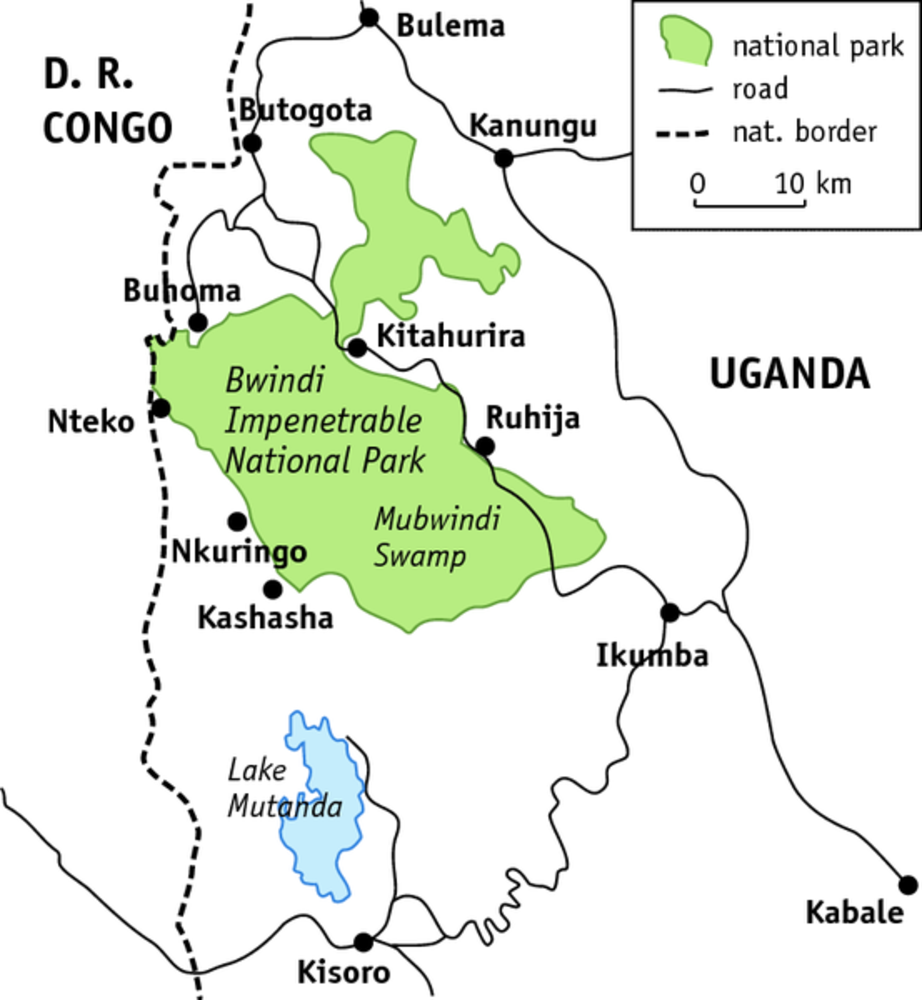
Bwindi Impenetrable National Park is located in southwestern Uganda, in East Africa. The forest lies along the edge of the Albertine Rift Valley, close to Uganda’s borders with Rwanda and the Democratic Republic of Congo. Its position places it within one of Africa’s most biologically rich regions, known for high levels of endemism and ecological diversity.
Bwindi sits in a remote, mountainous part of Uganda, far from major cities. This isolation has helped preserve the forest for thousands of years, allowing it to remain one of the most intact ancient rainforests on the continent.
Regional Setting in Uganda
Bwindi is found in the districts of Kanungu, Kisoro, and Rubanda, areas characterized by steep hills, deep valleys, and terraced farmland. The park lies approximately 460 kilometers by road from Kampala, Uganda’s capital, with travel routes passing through scenic countryside and highland regions.
The forest forms part of a larger conservation landscape that includes other protected areas in the Albertine Rift. Its location contributes to its role as a refuge for endangered species, especially mountain gorillas, which depend on the forest’s altitude and vegetation.
Proximity to Other Major Destinations
Bwindi is located close to several important tourism and conservation areas. It lies near Mgahinga Gorilla National Park, another key mountain gorilla habitat in southwestern Uganda. Across the border in Rwanda is Volcanoes National Park, while Virunga National Park across the border in the Democratic Republic of Congo.
Landscape and Altitude Context
Bwindi Forest lies at elevations ranging from roughly 1,160 meters to over 2,600 meters above sea level. Its high-altitude location contributes to cool temperatures, frequent mist, and dense montane rainforest vegetation. The rugged terrain is a defining feature, with narrow ridges and steep slopes shaping both wildlife habitats and visitor experiences.
The forest’s location within the Albertine Rift also explains its exceptional biodiversity. Geological uplift and long-term climatic stability allowed plant and animal species to evolve and survive here while disappearing elsewhere.
Accessibility and Entry Areas
Bwindi is accessed through Buhoma in the north, Ruhija in the east, and Rushaga and Nkuringo in the south. These entry points are spread across the forest, reflecting its large size and irregular shape. Serving surrounding communities and providing access to different parts of the forest.
Bwindi is well integrated through road transfers and domestic flights to nearby airstrips, accessible while retaining its wild character.
Why Bwindi’s Location Matters
Bwindi’s location is central to its conservation value. Its remoteness, altitude, and position within the Albertine Rift have protected it from large-scale deforestation and allowed endangered species to survive. The forest’s placement at the crossroads of multiple ecosystems makes it one of the most important biodiversity hotspots in Africa.
Plan Your Safari
Understanding where Bwindi Forest is located helps travelers plan realistic travel times and itineraries. Its southwestern Uganda location makes it ideal for combining gorilla trekking with other regional highlights. When approached with good planning, Bwindi’s remote setting becomes part of its magic rather than a challenge.