Tsavo East vs Tsavo West Kenya: Choosing Between Two Vastly Different Parks
Tsavo East vs Tsavo West Kenya presents travelers with a choice between two of Africa’s largest national parks that occupy adjacent territories separated by the Nairobi-Mombasa highway yet differ so fundamentally in landscape, vegetation, and wildlife character that they function as genuinely distinct safari experiences rather than variations on the same theme. Together they form the Tsavo Conservation Area covering over 20,000 square kilometers — larger than the entire country of Israel — but the eastern and western halves of this enormous ecosystem divide into open lava plains and dense scrub respectively, creating different game drive experiences, different species visibility conditions, and different atmospheres that suit different traveler priorities. African Wild Trekkers advises clients on which Tsavo park best fits their specific wildlife interests and travel style, and designs itineraries that sometimes combine both parks for travelers whose time allows a complete Tsavo experience rather than a single-sided visit.
Tsavo East National Park
Open Plains and Red Elephants
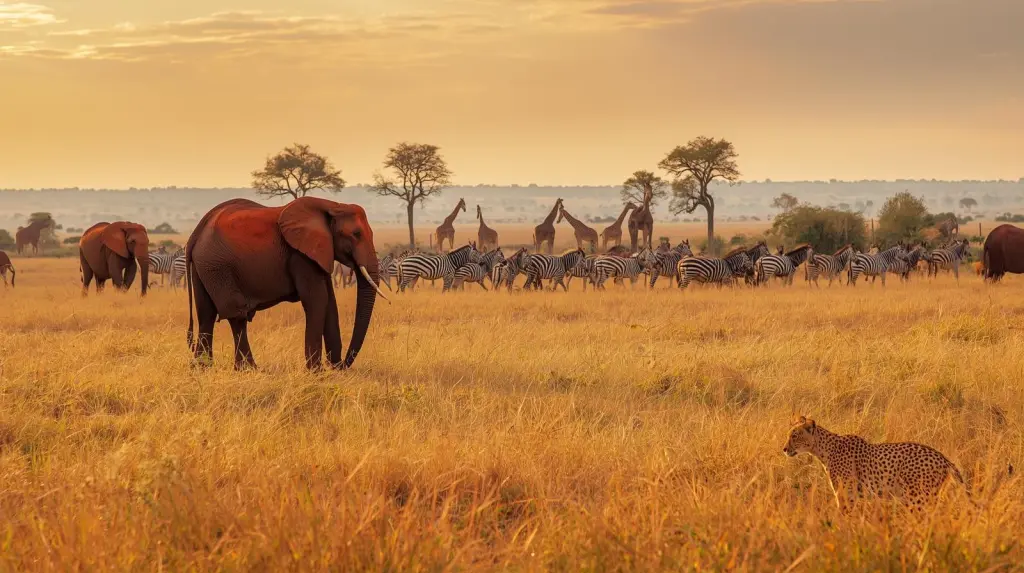
Tsavo East covers approximately 13,747 square kilometers of open red lava plains, semi-arid savanna, and the Galana River corridor — a vast, flat landscape where game drives operate across long-range visibility conditions that produce very different wildlife searching dynamics than the dense bush common in other Kenyan parks. The park’s elephants are famous for their red-dust coloration, which comes from the iron-rich volcanic soil in which they constantly dust-bathe as a skin protection and cooling mechanism — a behavioral quirk that creates a distinctive visual signature visible at considerable distance across the open plains. Tsavo East holds one of Kenya’s largest elephant populations, and drives along the Galana River produce sightings of large herds that concentrate at the permanent water in dry season conditions when the surrounding lava plains lose their surface water sources. The landscape scale of Tsavo East creates a sense of genuine wilderness isolation unavailable in smaller, more intensively visited parks, and travelers who find the Mara’s vehicle density disruptive describe Tsavo East as the most authentically wild-feeling Kenya park experience they have had.
The Lugard Falls on the Galana River provide a dramatic geological feature unique to Tsavo East — a series of waterfalls and rapids where the Galana forces its way through a narrow volcanic rock channel carved into swirling sculptural forms by millennia of water erosion. Crocodiles in extraordinary numbers line the banks below the falls, using the natural fish trap the rapids create to intercept prey, and the concentration of large Nile crocodiles visible at a single location rivals anything available at the Mara River during migration season. The open landscape of Tsavo East also makes it one of Kenya’s better parks for cheetah viewing because the flat terrain allows vehicle paralleling of hunting cheetahs across distances where the cat’s behavior is fully visible, and the park’s less-visited interior sections hold cheetah territories that receive fraction of the vehicle attention that Mara cheetah sightings attract. Game drives on the Aruba Dam circuit in the dry season produce elephant, buffalo, lion, and waterbird concentrations around the only standing water in a large area, creating multi-species viewing in conditions of exceptional intimacy for a park of this enormous scale.
Tsavo East’s Mzima Springs
Mzima Springs, located in Tsavo West but accessible on combined Tsavo itineraries, produces 50 million gallons of crystal-clear spring water daily filtered through the volcanic lava of the Chyulu Hills, creating an underground viewing chamber where hippos and Nile crocodiles are visible from below the water surface through thick safety glass — an experience without parallel anywhere in Africa. The springs themselves emerge from the base of a lava flow in a scene of extraordinary geological beauty, and the palm forest that grows along the spring-fed stream between the sources and the main pool provides habitat for vervet monkeys, hornbills, and kingfisher species visible on the short walking trail that connects the spring sources to the hippo pool. The underwater observation chamber’s view of hippos standing on the spring bottom with the water’s light-filtered clarity above them creates a photograph that experienced Tsavo visitors describe as one of Kenya’s most technically challenging and most rewarding wildlife photography targets. This attraction alone justifies a Tsavo West visit for travelers who have already covered Tsavo East’s plains wildlife and are looking for a genuinely novel experience to complete a comprehensive Tsavo understanding.
Tsavo West National Park
Dense Vegetation and Volcanic Landscape
Tsavo West covers approximately 9,065 square kilometers of volcanic landscape dominated by the Chyulu Hills, ancient lava flows, dense Commiphora-Combretum bush, and the Mzima Springs ecosystem that provides a counterpoint to the surrounding aridity. The dense vegetation of Tsavo West creates a more challenging game drive environment than Tsavo East’s open plains — animals are harder to spot through the thick scrub and require more time per sighting to assess fully — but this same density provides leopards, lions, and elephants with the habitat complexity they use for stalking, denning, and hiding from the vehicle pressure that more open parks generate. Tsavo West’s volcanic features create a landscape of dramatic geological interest beyond wildlife — the Shetani Lava Flow is a massive black basalt field deposited approximately 500 years ago that still looks freshly solidified, and walking the edge of this geological event with its contorted cooling patterns and cave formations provides a safari day with geological depth unusual in East Africa’s predominantly biological wildlife focus.
Tsavo West’s position near the coast-bound Mombasa highway and the border with Tanzania makes it a natural component of safari circuits combining Kenya’s interior parks with beach stays on the south Kenya coast. Travelers who fly into Mombasa and drive inland to Tsavo West before connecting to the Mara circuit experience the Kenya safari landscape from its coastal margins inward, and this direction of travel provides a different perspective on the country’s ecological gradient from coastal vegetation through semi-arid Tsavo interior to highland Rift Valley grassland. Kilaguni Serena Safari Lodge within Tsavo West operates a waterhole-fed viewing area directly in front of the lodge terrace that produces all-day wildlife encounters — including lion, elephant, and buffalo — from a stationary position that suits travelers who prefer a more passive wildlife observation style to active game drive pursuit across the park’s challenging road network.
Which Park Should You Choose?
Choose Tsavo East if your priority is a large-scale open wilderness feel with excellent elephant viewing, few vehicles, red dust landscape aesthetics, and the sense of genuine remoteness that Kenya’s smaller, more visited parks cannot provide. Tsavo East suits travelers who have already visited the Maasai Mara and want the contrast of a less managed, less crowded, more rugged Kenya safari experience on a subsequent visit. Choose Tsavo West if your priority is geological landscape diversity, Mzima Springs, the Chyulu Hills green backdrop, and a stop-over position between Nairobi or the Mara and the Kenya coast that adds wildlife value to what would otherwise be a pure transit day. The combination of both parks across a three-to-four-day Tsavo circuit provides the most complete understanding of this massive ecosystem and creates a Kenya safari add-on that complements any amount of time already spent in the country’s more famous destinations.
Cost differences between the two parks are minimal at the permit level — both charge standard Kenya national park non-resident fees — and the primary cost driver in a Tsavo safari is accommodation choice rather than park selection. Mid-range lodges in both parks deliver acceptable quality for travelers who treat Tsavo as a budget complement to a premium Mara and Amboseli circuit, while premium properties in Tsavo West including Finch Hattons and Sarova Salt Lick in the adjacent Taita Hills offer luxury experiences that stand independently as destinations rather than budget fillers within a wider Kenya itinerary.
Plan Your Safari
Tsavo safari planning benefits from combining both parks across a minimum of three nights to do justice to the combined ecosystem, or using one park as a dedicated one-to-two-night focus within a circuit that includes Amboseli and the Mara. African Wild Trekkers advises on which Tsavo park best fits your existing Kenya itinerary and books lodges that position you for the most productive game drive access within each park’s road network.
Your Tsavo package includes park entry fees, accommodation, all game drives with a specialist Tsavo guide, and road transfers connecting Tsavo to your other Kenya destinations. We design Tsavo visits as genuine safari experiences rather than transit stops, allocating enough game drive time to do justice to parks this large.
Contact African Wild Trekkers at africanwildtrekkers.com/contact with your Kenya travel dates and we will design a complete Tsavo itinerary within 24 hours.