Kenya Safari Packing List: Everything You Need for the Bush
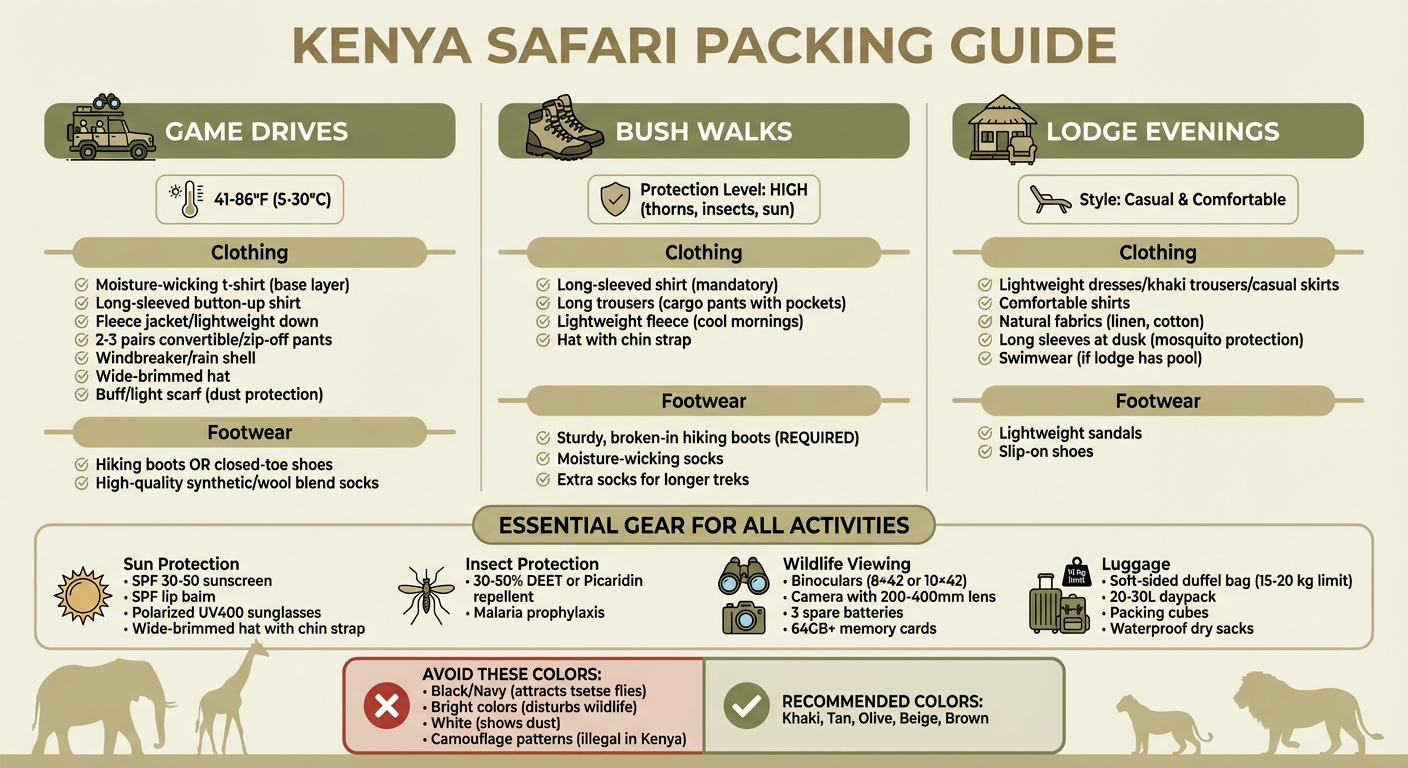
The Kenya safari packing list for 2026 covers every category a traveler needs for the Maasai Mara, Amboseli, Samburu, Tsavo, and Kenya’s other national parks. Dawn temperatures in the Mara can drop to 10°C while midday heat climbs to 30°C on the same day—a layering system works better than a fixed-weight approach. Light aircraft luggage restrictions of 15 kilograms total in a soft bag apply to all scheduled and charter flights to Kenya’s bush airstrips. Travelers who ignore this limit find their extra bag stored in Nairobi rather than waiting at the lodge.
Safari Clothing for Kenya
Colors, Layers, and Game Drive Clothing
Neutral colors—khaki, tan, olive green, grey, and brown—form the foundation of a Kenya safari wardrobe. They blend with the bush environment and avoid alerting wildlife or attracting insect attention that bright colors can generate. White and bright colors show dust visibly within the first hour of a game drive and are impractical rather than forbidden. Pack four to five neutral-colored shirts—a mix of long-sleeve for morning game drives and short-sleeve for the warm afternoon hours.
Layering is the critical principle for Kenyan safari dressing. Open-sided game drive vehicles expose you to pre-dawn cold during the 6 AM departure that disappears completely by 9 AM once the sun climbs. A fleece jacket or light down vest over your long-sleeve shirt handles the coldest Maasai Mara mornings in July and August, which regularly drop to 8–12°C before sunrise. Add a lightweight waterproof shell jacket that packs to fist size for the wet season months—brief, intense rain showers can soak an open vehicle within minutes.
Footwear for Safari in Kenya
Closed-toe shoes or hiking boots are essential for any activity involving walking—guided bush walks, cultural village visits, airport transfers through unpaved airstrip areas, and evening lodge walks all need footwear that protects against thorns and grass seeds. Light hiking boots with ankle support are the most versatile choice—they handle dusty laterite roads, grassy airstrips, wooden lodge walkways, and occasional rocky scrambles without the weight of heavy hiking boots. A second pair of lightweight camp shoes fills the evening footwear role at the lodge. Avoid white or pale-colored shoes that pick up Kenyan red laterite dust after a single game drive.
Merino wool socks regulate temperature in both cold mornings and warm afternoons. They resist odor that synthetic socks generate over multiple days and dry overnight when hand-washed at the lodge. Pack four to five pairs of lightweight Merino hiking socks and two pairs of thicker Merino socks for the coldest Maasai Mara mornings. Gaiters are worth packing for the wet season when walking through long wet grass between the vehicle and lodge entrance.
Camera Equipment for Kenya Safari
Choosing the Right Camera Setup
The essential camera requirement for a Kenyan safari is a telephoto lens reaching at least a 400mm equivalent focal length. This focal length fills the frame with lions, cheetahs, and leopards at standard viewing distances from a game drive vehicle. A mirrorless camera body with a 100–500 mm zoom lens represents the current standard for safari wildlife photography at a manageable weight and size. Carry cameras in a padded bag between shots—the corrugated dirt roads of the Maasai Mara generate vibrations that damage unprotected equipment within a single game drive.
Set aperture priority at f/5.6 to f/8 for the sharpest results across a moving subject during midday hours. Open to f/4 or f/2.8 during the golden hour when light is low and speed matters more than depth of field. Use ISO auto with a maximum ceiling of 6400 to prevent underexposed images in low light without manual adjustment during an active predator sighting. Continuous burst mode covers a full cheetah chase or wildebeest river crossing without gaps in the sequence.
Memory Cards, Batteries, and Power
A full day in the Maasai Mara during a river crossing or lion kill generates 2,000–5,000 images on a mirrorless camera. Bring a minimum of three fully charged batteries per camera body and purchase batteries from the camera manufacturer or a reputable authorized brand—counterfeit batteries fail at cold temperatures or during burst sequences. Six 128GB or 256GB SD cards in waterproof cases provide storage for the entire safari. Bring a multi-port USB charging hub that works on 220V — Kenya uses the British three-pin plug standard.
Dust is the primary enemy of camera equipment on Kenya’s dry season game drives. Keep a dust blower rather than a cloth for sensor cleaning. A lightweight rain cover for each camera body handles both dust in dry conditions and water in wet ones—the same cover works as a dust shield when draped loosely during dusty road sections.
Health and Comfort Essentials
Sun and Insect Protection
The UV index at the Maasai Mara and Amboseli reaches 11–12 during dry season midday hours—the highest category on the UV scale. Apply SPF 50+ sunscreen every 90 minutes on all exposed skin, including lips, ears, and the back of your neck where open vehicle canopies provide no shade. Apply 40 percent DEET insect repellent to all exposed skin during dawn and dusk—the two highest malaria mosquito activity periods that also happen to coincide with the best wildlife viewing hours. Reapply every three to four hours because sweating in savanna heat degrades repellent effectiveness faster than the stated product duration.
A wide-brimmed hat with neck coverage outperforms a baseball cap for open-vehicle game drives—the exposed neck of a baseball cap wearer burns painfully after three hours at equatorial midday intensity. Pack polarized sunglasses for the Maasai Mara and Amboseli, where flat open plains reflect intense glare that standard tinted lenses cannot cut. A buff or lightweight neck gaiter doubles as sun protection and a dust shield when the wind direction pushes your vehicle’s own dust forward during road sections.
Medications and Travel Health Kit
Carry your malaria prophylaxis in hand luggage rather than checked bags—a delayed or lost bag at the wrong moment in the medication schedule creates a serious health risk. A basic safari first aid kit includes ibuprofen, paracetamol, an antihistamine, loperamide for diarrhea, oral rehydration salts, blister plasters, antiseptic wipes, and antibiotic ointment for insect bite scratches that break the skin in a humid environment. Ask your travel medicine clinic to prescribe a course of ciprofloxacin for treating traveler’s diarrhea that does not resolve within 48 hours. Pack all medications in original, labeled containers to prevent complications at airport security.
Kenya’s main safari parks sit between 900 and 1,500 meters: the Maasai Mara at 1,500 m, Samburu at 900 m, and Amboseli at 1,150 m. None of these produce altitude symptoms in travelers arriving from sea level. Travelers combining a Mount Kenya trek with a Maasai Mara safari should raise the altitude medication question with their travel medicine provider at the pre-departure consultation.
Plan Your Safari
African Wild Trekkers sends every booked client a destination-specific packing guide tailored to the parks on their itinerary, the season of travel, and their accommodation type—from budget tented camp to luxury lodge. We confirm luggage restrictions for any light aircraft transfers in advance so you pack a compliant soft bag from the start.
Your Kenya package includes a private 4×4 safari vehicle, an experienced wildlife guide, full-board accommodation, national park fees, and all airport and inter-park transfers. Kenya safari packing list advice and pre-travel health and ETA documentation guidance are included as standard in our client pre-departure pack.
Contact African Wild Trekkers at africanwildtrekkers.com/contact with your travel dates, and we will send a complete Kenya itinerary and packing guide within 24 hours.