East Africa Fly-In Safari: Which Parks Are Worth the Airstrip Landing?
The Fly-In Safari: When Flying Makes Sense and When It Doesn’t
Light aircraft transfers between East Africa’s major safari destinations are a fundamental part of how premium safari itineraries are structured. They allow guests to move between parks that would otherwise require full days of road travel. They maximize time in the field rather than in transit. But fly-in safari is not always the superior option. For some destinations, the road approach is part of the experience. The cost of charter or scheduled light aircraft flights is significant. The value equation therefore requires honest assessment. Understanding which East Africa parks specifically benefit from fly-in access is essential. What the flight experience adds beyond time-saving matters too. Knowing which destinations are as good or better by road helps design an itinerary that allocates the fly-in premium wisely.
This guide examines the specific parks and destinations in Tanzania and Kenya where fly-in access is most clearly worth the premium. It covers the flight experience itself and what it adds to the arrival. It also addresses situations where road travel is equally or more appropriate. It is written from the perspective of travelers considering whether to budget for fly-in transfers on a new itinerary rather than those who have already committed to a specific flight structure.
Tanzania: Where Flying Changes Everything
Serengeti, Ruaha, and the Remote Parks
Serengeti Fly-In: The Definitive Case for Charter
The Serengeti is the single clearest case for fly-in access in Tanzania. The alternative road approach from Arusha passes through the Ngorongoro Conservation Area gate and descends into the park along the Naabi Hill circuit. This takes six to seven hours even without traffic or road delays. Arriving at a Serengeti camp in the early afternoon after a full day of driving means losing both the morning game drive and the afternoon game drive. This reduces effective wildlife day count for a five-night Serengeti stay by one full day. A 20 percent reduction from a logistical choice rather than a planning decision. A charter flight from Arusha or Kilimanjaro to any Serengeti airstrip takes 45 minutes to one hour. It delivers guests in time for an afternoon game drive on the day of arrival, recovering the lost ground transport day entirely.
Within the Serengeti, fly-in access also enables camp changes between different park areas. Moving from central Serengeti to northern Serengeti for migration crossings would require three to four hours of driving through the park by road. A 20-minute inter-park charter flight achieves the same movement without consuming an afternoon game drive period. This is particularly valuable on a tight itinerary where every game drive session represents significant safari value. Camp-to-camp charter flights within the Serengeti ecosystem are one of the most cost-effective uses of the fly-in premium relative to the game drive time they save. Any Serengeti itinerary of five nights or more should seriously consider using internal charter flights for at least some inter-camp transfers.
Ruaha: Where Flying Is Almost Non-Negotiable
Ruaha National Park is accessible by road from Iringa town—a four- to five-hour drive on rough tracks. But the road approach is genuinely grueling, and most experienced operators do not recommend it for international visitors. The charter flight from Dar es Salaam or Arusha (via Dar) to Msembe airstrip within Ruaha takes approximately 90 minutes. It lands guests at an airstrip inside the park with wildlife visible from the landing circuit.
The aerial approach to Ruaha is one of the most memorable arrival sequences in Tanzania. Flying over the baobab- The studded plateau and descent toward the Great Ruaha River valley with elephant herds visible from the aircraft are spectacular. The flight adds an experiential dimension to the Ruaha visit that the road approach does not provide.
You can effectively reach Katavi and Mahale in western Tanzania only by fly-in. The road distances from any major Tanzania city are too great to consider for standard itineraries. Charter flights from Arusha or Dar es Salaam are the standard access mechanism for all camps at these locations. For these remote parks, the fly-in premium is not a luxury upgrade but the baseline logistical requirement.
The flight over western Tanzania’s trackless landscape is appropriately spectacular as an introduction to these extreme-wilderness destinations. Visitors to Katavi and Mahale accept the charter flight cost as inherent to accessing what these parks offer. There is no road equivalent that is practically available.
Kenya: Masai Mara and Amboseli Fly-In Value
When Flying to Kenya’s Parks Makes Sense
Masai Mara: Road vs Air Trade-off
The Masai Mara is accessible by road from Nairobi in approximately five to six hours depending on route and traffic. Most first-time Kenya safari visitors drive from Nairobi to the Mara and back. This works acceptably for itineraries of five or more nights, where the transit time is a smaller proportion of the total stay. For shorter stays of three to four Maranatha nights. Ideal for a one-country Kenya segment of a multi-country itinerary.
A charter flight from Wilson Airport to one of the Mara’s multiple airstrips takes approximately 45 minutes. It significantly improves the effective stay duration by eliminating the road day each way.
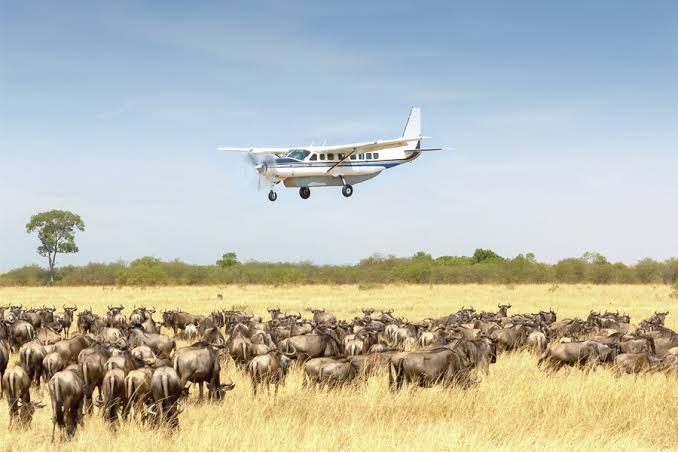
The Mara’s private conservancy airstrips also enable a specific experience that road access cannot. Flying into the conservancy directly means your first view of the Masai Mara landscape is from the air rather than through a windscreen on a dirt road. The aerial approach to the Mara. Crossing the Rift Valley escarpment and descending over the open plains. Is one of Kenya’s most spectacular arrival experiences.
During migration season, wildebeest herds are visible from altitude. It adds a dimension of first impression that road travelers do not have. For honeymoon couples, anniversary trips, or any occasion where the arrival experience matters, the Mara fly-in is worth the premium for reasons beyond pure time saving.
Amboseli: Road Is Often Adequate
Amboseli National Park near the Tanzania border is approximately 230 kilometers from Nairobi. The drive of three to four hours on reasonable roads is entirely manageable for a three to four-night Amboseli stay without sacrificing significant game drive time. Many Amboseli visitors choose the road option without meaningful loss to their itinerary. Departing from Nairobi early enough to arrive at the park before noon and fit an afternoon game drive on arrival day is the key. An Amboseli charter flight from Wilson Airport takes approximately 30 minutes and eliminates road time entirely.
This is more valuable for short Amboseli visits of one to two nights than for longer stays, where the road drive represents a smaller proportion of total time invested. Amboseli is one of the Kenyan parks where the honest answer is “fly in for short stays, road for longer stays” rather than a clear recommendation either way.
What the Flight Experience Actually Adds
The Aerial View and Arrival Character
Seeing East Africa From Above
Beyond the time-saving argument, charter flights in East Africa provide a bird’s-eye view of landscapes that ground-level game driving cannot reveal. The approach to the Serengeti from altitude shows the scale of the migration herds. Columns of wildebeest are visible as dark streaks across the yellow plain. Before you are in the vehicle at their level. The descent into Ruaha over the Great Ruaha River valley reveals the scale of the park’s landscape in a way that is impossible to appreciate from the ground.
The Masai Mara from above during migration season is a visual representation of what you are about to enter. It creates a specific excitement and sense of occasion that the road approach cannot manufacture. These aerial experiences add genuine value to the safari beyond the logistics of the journey.
Light aircraft in East Africa are typically small. Six- to twelve-seat turboprops operated by companies including Coastal Aviation, Safarilink, and Air Kenya. The window seat views are accessible to every passenger. The pilots are experienced at low-level approaches and often point out wildlife visible from the aircraft during approach and departure.
The flights are generally smooth in good weather and brief enough that any turbulence encountered is a short rather than extended discomfort. For travellers with significant aviophobia, the small aircraft environment can be more uncomfortable than a commercial jet. This is worth considering before committing to a fly-in-heavy itinerary.
Plan Your Safari
Fly-in safari planning in Tanzania and Kenya benefits from booking all charter flights simultaneously with camp accommodation. This ensures airstrip slots, flight timing, and camp check-in procedures are aligned from the start rather than coordinated separately. Charter flight availability for peak season dates should be confirmed at the same time as camp bookings. Some seasonal routes operate with limited aircraft availability and can book out as quickly as premium camp accommodation for July and August dates.
African Wild Trekkers designs and manages fly-in safari itineraries across Tanzania’s northern and southern park networks. We incorporate Coastal Aviation and other licensed charter operators for all inter-park and airport transfers. All flight bookings are confirmed and timed to align with camp arrival and departure schedules as part of our integrated itinerary service.
Contact African Wild Trekkers at africanwildtrekkers.com/contact with your Tanzania travel dates and intended parks. We will design your fly-in safari itinerary and confirm all charter flight availability within 24 hours.