Honey Badger Facts: Why This Small Animal Fears Absolutely Nothing
Africa’s Most Fearless Animal
The honey badger holds the Guinness World Record for the world’s most fearless animal. This distinction feels simultaneously absurd and entirely accurate once you understand the behavioral profile of this compact, grey-backed member of the mustelid family. Honey badgers regularly confront and drive off animals many times their size. Lions and leopards. And hyenas have all retreated from honey badger confrontations. They do so not through intimidation by appearance or sound. They rely on a combination of genuine physiological toughness and remarkable pain tolerance. And what behavioral ecologists describe as a complete absence of appeasement behavior. Most animals have behavioral circuits that trigger flight or submission when confronted by a superior threat. The honey badger appears to have none. It attacks. Every single time.
The honey badger’s fearlessness is not a behavioral quirk or an evolutionary novelty. It is the product of a suite of physical adaptations that make it genuinely difficult to kill and genuinely dangerous to bite. The skin is approximately 6 millimeters thick on the neck and back. Thick enough that a lion bite struggles to penetrate. It is also loose enough that a honey badger can turn within its own skin to bite an animal that has seized it from behind. Venom resistance allows honey badgers to survive bites from African puff adders and cobras that would kill most mammals within minutes. They typically fall unconscious after the bite but recover within hours. The combination of physical toughness, venom resistance, and zero behavioral inhibition about escalating conflict produces an animal that has earned its fearless reputation through actual encounters rather than mere reputation.
Honey Badger Biology and Behavior
Physical Adaptations and Hunting
Anatomy Built for Survival
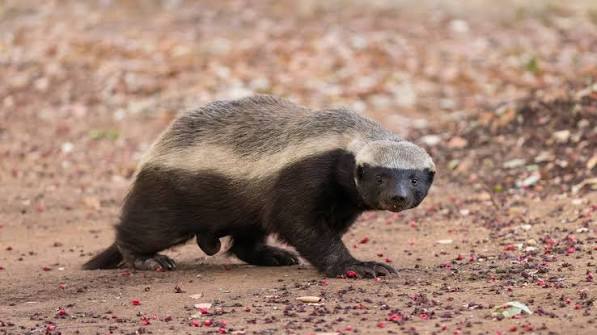
The honey badger is a member of the Mustelidae family. The same family as weasels, otters, wolverines, and European badgers. It shares the family’s characteristic long, low body plan and muscular build. Adults weigh 5 to 14 kilograms and measure up to 95 centimeters in body length. This makes them comparable in mass to a large domestic cat but significantly more compact and powerfully built. The black underparts and silver-white back and top of the head are distinctive in the field. This high-contrast coloration likely functions as a warning signal. Aposematism. Communicating the animal’s formidable defensive capabilities to potential predators before any physical contact is necessary. The claws are exceptionally long and powerful for their size, adapted for digging and for tearing open bee nests and termite mounds. And the buried prey items that form much of the diet.
The honey badger’s sensory system is adapted for locating prey underground, in crevices, and within bee nests. It has a keen sense of smell capable of detecting buried prey from the surface. And good hearing that detects the movement of prey animals in burrows. The diet is extremely varied. Insects; bee larvae; eggs; birds; small mammals; reptiles, including venomous snakes; roots; and berries. And the honey that gives the animal its name. This dietary opportunism makes honey badgers one of the most ecologically flexible carnivores in Africa. They are found in habitats ranging from rainforest to desert to high-altitude moorland. They dig with extraordinary speed and power. A honey badger can excavate a burrow large enough to hide its body within minutes when pursued. They will use any available hole or crevice as temporary shelter rather than maintaining a fixed home range or den site.
The Honeyguide Partnership
One of the honey badger’s most documented ecological relationships is its mutualistic association with the greater honeyguide bird. The honeyguide has the unusual ability to locate beehives in tree cavities and rock crevices. But it lacks the physical capability to break into most hives. The honey badger has the capability to break into any hive. It finds them through smell rather than visual search, making aerial detection less efficient. The honeyguide leads potential partners. Honey badgers, and historically also humans. To hive locations through specific guiding calls and flight patterns. It then feeds on the wax comb and bee larvae left after the badger has destroyed the hive and fed on the honey. This mutualistic partnership has been documented and studied extensively in the human-honeyguide context. The honey badger component is less well documented in the wild due to the difficulty of observing both species simultaneously in the field.
Honey badgers are largely solitary outside of mating. Males and females maintain large home ranges that overlap with the ranges of multiple individuals of the othersex. Home ranges of 200 to 500 square kilometers have been recorded in arid habitats. This reflects the low prey density that requires wide-ranging foraging. The solitary lifestyle reduces competition for food resources and allows each individual to exploit its entire home range efficiently. Dens are typically short, temporary shelters rather than permanent structures. The honey badger’s nomadic foraging pattern means that different parts of the home range are used at different times. A permanently fixed den would limit foraging efficiency. Females give birth to one to two young in a temporary burrow, raising the cubs alone until they are sufficiently mobile to accompany the mother on foraging excursions.
Where to See Honey Badgers in Africa
Safari Sightings and Best Destinations
Viewing Opportunities Across Africa
The honey badger lives across sub-Saharan Africa and parts of North Africa and the Middle East. It occurs in almost every habitat type from sea level to 4,000 meters. Despite this wide range, honey badger sightings are relatively uncommon on standard safari game drives. The animals are primarily nocturnal and solitary. They cover large home ranges without predictable routes or fixed daytime resting sites. Most honey badger sightings come from night drives in parks and private reserves. The animals can be spotted foraging in vehicle headlights and spotlights. The best African safari destinations for honey badger sightings are those with high-quality night drive programs and large areas of suitable habitat. These include South Africa’s Kruger private reserves, Botswana’s Kalahari and Okavango camps, South Luangwa in Zambia, and the Masai Mara in Kenya.
Kgalagadi Transfrontier Park, straddling the border of South Africa and Botswana in the southern Kalahari Desert, widely stands as one of the best African destinations for honey badger sightings. The park’s semi-arid landscape, with its open red dunes and sparse acacia scrub, makes spotting animals at distance easier than in denser bush. Honey badger sightings during night drives at Kgalagadi are frequent enough that the animals feature prominently in visitor trip reports from the park. Kgalagadi is also exceptional for other Kalahari-adapted predators, including black-maned Kalahari lions, cheetahs, leopards, and bat-eared foxes. This makes it one of Southern Africa’s most distinctive and rewarding wildlife destinations for travelers seeking species beyond the standard Big Five focus.
Honey Badger Conservation
The IUCN lists honey badgers as Least Concern, reflecting their wide distribution and adaptability across a range of habitats. However, local populations face pressure from persecution by beekeepers and farmers who view honey badgers as destructive pests. The animals readily raid apiaries and chicken coops within their range. Their extraordinary physical persistence in breaching fencing and enclosures makes them genuinely difficult to exclude. Poison baiting and trapping are the most common forms of persecution. These have reduced honey badger densities in agricultural areas across much of their range. Conservation programs that provide beekeepers with honey badger-proof hive stands and enclosures have been successful in reducing conflict in some areas. The Honey Badger Conservation Project maintains ongoing monitoring of populations and conflict reduction programs across southern and East Africa.
The honey badger’s remarkable fearlessness is not, from the animal’s own perspective, evidence of stupidity or recklessness. It is a rational response to a physical reality: most predators that attempt to prey on honey badgers find the experience sufficiently costly that they disengage. Lions in numerous documented encounters have disengaged from honey badger confrontations without making a kill. This is not because they could not physically overpower the animal. It is because the effort and injury risk of doing so exceeded the nutritional return of a five-kilogram prey item. The honey badger’s aggression is functional — it works. It is the product of millions of years of selection pressure in African ecosystems where the animals that survived long enough to reproduce were, reliably, the ones that refused to back down.
Plan Your Safari
Honey badger sightings are night drive discoveries rather than planned encounters. Camps with quality night drive programs and experienced spotlight guides are the most important variable. Kgalagadi for the Kalahari experience and Sabi Sand and South Luangwa for night drive quality. And the Masai Mara in East Africa is one of the most reliable honey badger destinations.
African Wild Trekkers builds night drive programs into safari itineraries at the camps where the after-dark experience genuinely adds species and behavioral encounters unavailable on daytime drives. This makes the 20 or 30 extra minutes in the bush after sunset one of the most productive decisions in any itinerary.
Contact African Wild Trekkers at africanwildtrekkers.com/contact with your travel dates, and we will design a safari itinerary that incorporates the best night drive destinations for honey badgers and Africa’s full range of nocturnal wildlife within 24 hours.