Uganda Weaver Birds: The Master Nest Builders of the Pearl of Africa
Uganda weaver birds represent one of the most diverse groups of birds in the country. It holds over 30 weaver species across wetland, savanna, forest, and highland habitats. Uganda weaver birds are most conspicuous at their colonial nesting sites where dozens to thousands of birds build elaborate woven nests in reeds, trees, and tall grasses. The male Uganda weaver birds weave intricate hanging nests while females inspect each structure critically before accepting or rejecting it. This nest-inspection behaviour is one of nature’s most extraordinary behavioural interactions. Uganda weaver bird colonies are visible at papyrus swamps, lake shores, and Acacia savanna trees throughout the country.
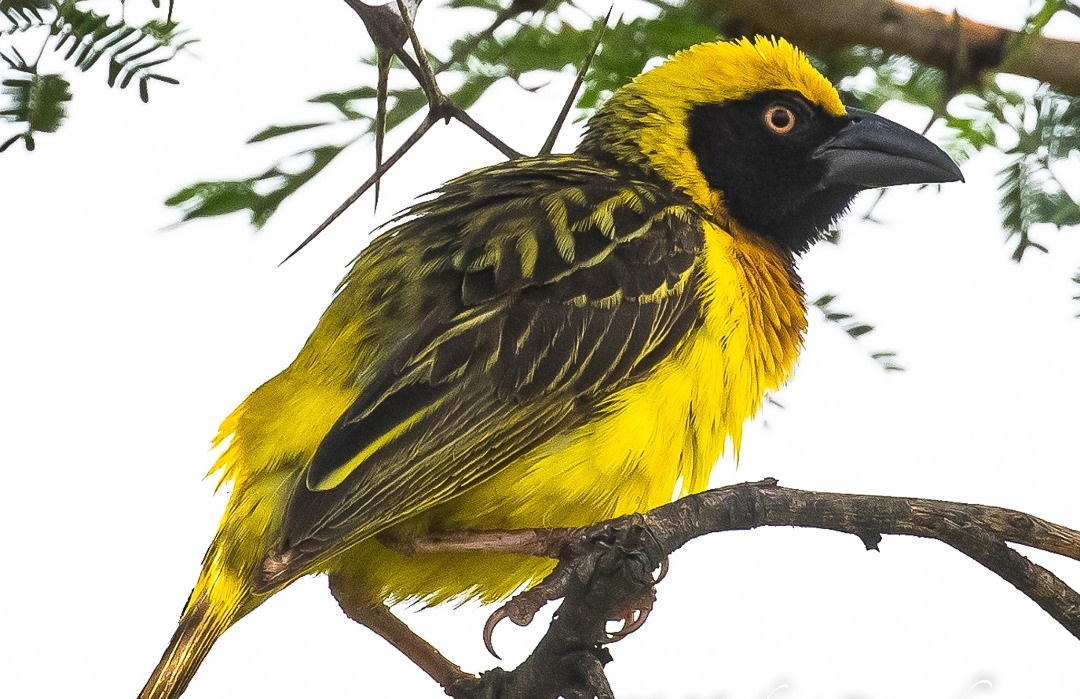
Uganda weaver bird identification challenges beginners because many species look similar. Males in breeding plumage are often brilliantly coloured in yellow, black, and olive combinations. Non-breeding males and females adopt dull brown streaked plumage that requires careful field observation. Studying Uganda weaver birds at a colonial nest site simplifies identification because multiple individuals appear together at close range. The nest structure itself provides identification clues. The entrance tunnel length, the nest chamber position, and the suspension method all vary between Uganda weaver bird species.
Uganda Weaver Bird Species at Key Sites
Wetland Uganda Weaver Birds
The Mabamba Swamp near Entebbe holds the richest wetland Uganda weaver bird community in the country. Black-headed weaver builds its colonial nest in papyrus over the water at Mabamba. Slender-billed weaver nests in the same papyrus habitat alongside its more common relative. Strange weaver inhabits forest edge patches adjacent to the Mabamba papyrus zone. The Mabamba Uganda weaver bird colony produces the most concentrated nesting activity of any single Uganda site. The same boat trip to Mabamba for shoebill also passes through extensive Uganda weaver bird colony sections.
Papyrus weaver is the most specialised Uganda weaver bird for papyrus habitat. This near-endemic weaver inhabits dense papyrus stands and rarely ventures to other vegetation types. Papyrus weaver colonies build nests deep within the papyrus stands and require a boat to observe adequately. Lake Bunyonyi, Lake Mburo, and the Kazinga Channel all hold productive papyrus Uganda weaver bird colonies. The yellow and black plumage of breeding male papyrus weavers creates spectacular colour contrasts against the green papyrus stems during the breeding season peak.
Savanna Uganda Weaver Birds
Village weaver is the most common Uganda weaver bird species in savanna and garden habitats. Male village weavers build egg-shaped woven nests in isolated trees and large gardens near human habitation. The male’s selection of nest attachment points, weaving technique, and structural completion is visible at close range in camp gardens. Masked weaver is the second most common savanna Uganda weaver bird and occurs across all national park camp sites. Both species allow very close observation at camp gardens throughout Uganda. Speke’s weaver forms very large colonies in Acacia trees on savanna plains at Murchison and Queen Elizabeth.
The Black-billed weaver is a forest edge Uganda weaver bird that inhabits the margins of Kibale and Budongo forests. This species lacks the yellow colouring of most Uganda weaver birds and appears olive-brown throughout the year. Red-headed weaver is the most dramatically coloured Uganda weaver bird species in the savanna zone. Its brilliant red head and pink bill create immediate identification at any savanna camp site where it builds nests in low shrubs. Cardinal quelea forms nomadic flocks in the dry northern Uganda savanna and appears erratically on the Uganda weaver birds list at Kidepo during certain seasons.
Uganda Weaver Bird Behaviour
Nest Building in Uganda Weaver Birds
Uganda weaver bird nest building is one of Africa’s most detailed and accessible bird behaviour observations. Male village weavers begin a new nest by attaching a loop of grass to a branch tip. Each subsequent grass strip interlocks with the previous ones through a weaving motion. A complete Uganda weaver bird nest takes two to four days to build from first strip to finished chamber. Female inspection occurs throughout this process. A female that enters the nest and tears it down forces the male to start again from scratch. This inspection behaviour in Uganda weaver birds drives nest quality to extraordinary precision.
Uganda weaver bird colonial nesting sites produce a constant, loud chattering that identifies the colony location from several hundred metres. Visitor camps at Murchison Falls, Queen Elizabeth, and Kibale often host active village weaver colonies in the garden trees. These camp colonies provide the most accessible Uganda weaver bird nest building observation available to any visiting safari client. Early morning light on an active Uganda weaver bird colony in the camp garden creates excellent photography opportunities at very close range and in good light conditions.
Photographing Uganda Weaver Birds
Uganda weaver birds at colonial nest sites suit a short to medium telephoto lens of 200 to 400mm. The close approach distances at camp garden colonies allow even a 70-200mm zoom to fill the frame effectively. Bright yellow breeding male Uganda weaver birds against green foliage require slight exposure compensation to avoid overexposing the yellow plumage. Nesting activity peaks in the morning from 06:00 to 09:00 and in the late afternoon from 16:00 to 18:00. Midday heat slows Uganda weaver bird nest building activity and reduces photography productivity. Setting up a camera position at the colony edge before dawn captures the first light activity in ideal illumination.
Video of Uganda weaver bird nest building captures the behaviour sequence better than still photography for many visitors. The weaving motion is continuous and best documented with short video clips showing the interlocking grass strips from close range. Many visitors photograph Uganda weaver bird nests without birds present. The intricate woven structure of a complete Uganda weaver bird nest is itself a remarkable natural object. Collecting fallen Uganda weaver bird nests from the ground under a colony is permitted and allowed as a souvenir of the colony visit.
Plan Your Safari
Plan Uganda weaver bird observation at every camp site garden throughout your Uganda safari as a daily background activity. Add a specific Mabamba boat trip near Entebbe to the beginning or end of the safari for the papyrus weaver colony experience. Request a birding camp walk at dawn for the best colony light and activity at any Uganda lodge garden.
African Wild Trekkers includes Uganda weaver bird colony visits in all birding safari itineraries. We identify the most productive colony sites at each park and brief clients on what to look for in the nest building behaviour and male-female interaction that makes Uganda weaver bird colonies so extraordinary to observe.
Contact African Wild Trekkers to plan a Uganda safari featuring Uganda weaver bird colonies. We respond within 24 hours and design birding itineraries that cover the wetland, savanna, and forest weaver species across the country’s finest colony sites.