info@africanwildtrekkers.com

Serengeti National Park: The Complete Guide to Tanzania’s Endless Plains
The Serengeti takes its name from the Maasai word siringet, meaning endless plains. It’s an accurate description. Grassland stretches to the horizon in nearly every direction, broken only by acacia trees and scattered granite outcrops called kopjes.
The park anchors the Great Migration, the largest movement of land mammals on earth. Over two million wildebeest, plus hundreds of thousands of zebra and gazelle, circle through the Serengeti and into Kenya’s Maasai Mara each year. But the park holds strong wildlife year-round, migration or not.
This guide covers what to see, when to go, and where to stay. Timing matters more here than in most parks, since the migration moves through different regions depending on the month.
Background and Location
The Serengeti sits in northern Tanzania, close to the border with Kenya. Lake Victoria marks its western edge, and the Great Rift Valley rises along its eastern side. To the north, the park connects directly to Kenya’s Maasai Mara, forming one continuous ecosystem across the two countries.
The park covers close to 15,000 square kilometers, an area larger than some countries. It was gazetted as a national park in 1951, making it one of Tanzania’s oldest protected areas. UNESCO named it a World Heritage Site in 1981, recognizing both its scale and its role in supporting the migration.
The Serengeti sits at the heart of a much larger protected system. Ngorongoro Conservation Area borders it to the southeast, and Maswa Game Reserve lies to the southwest. Together with the Maasai Mara, this network of parks and reserves allows the migration to move largely unimpeded across national borders, following rainfall rather than any fixed route.
Why Visit the Serengeti
Few places on earth match the Serengeti’s scale. The park itself covers nearly 15,000 square kilometers, and the wider ecosystem, including the Maasai Mara and Ngorongoro Conservation Area, stretches even further. That space supports one of the highest concentrations of large mammals anywhere in Africa.
The migration is the park’s defining event. Wildebeest move in a rough annual loop, following the rain in search of fresh grass. Watching hundreds of thousands of animals cross open plains, or a river thick with crocodiles, ranks among the most dramatic wildlife scenes on the planet.
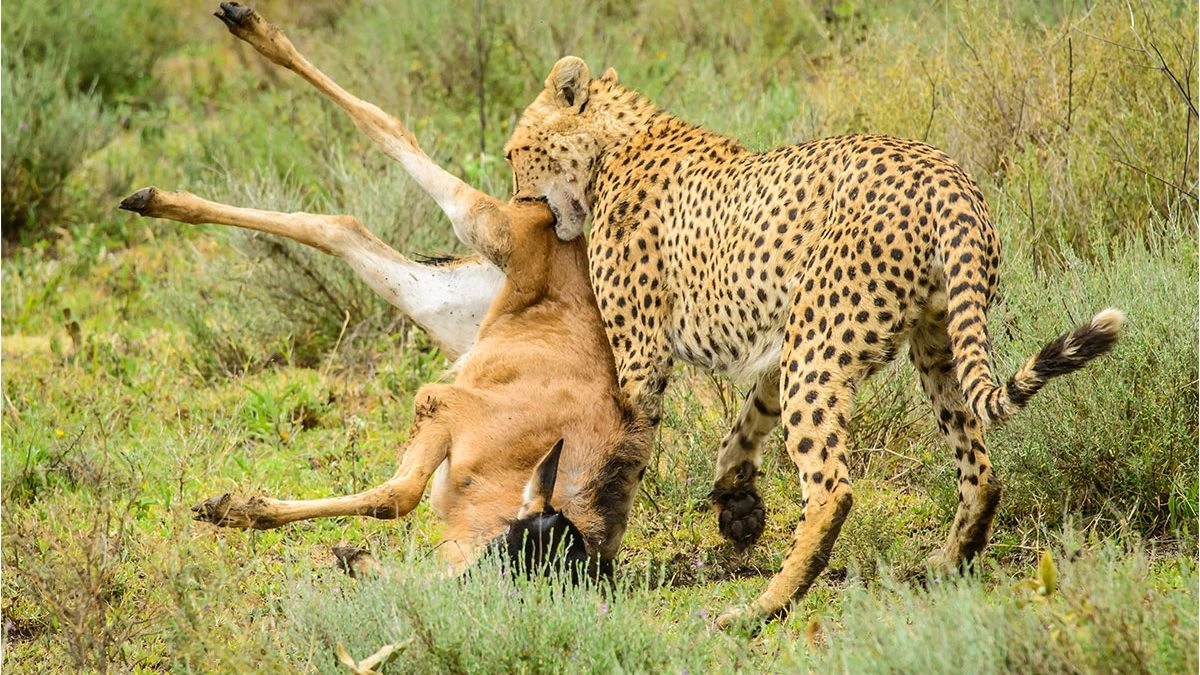
Beyond the herds, the Serengeti holds strong resident wildlife all year. Lion, leopard, and cheetah are all common sightings in the central region, regardless of where the migration happens to be. Few parks offer this much reliability alongside this much scale.
Understanding the Migration’s Route
The migration doesn’t follow a fixed calendar, but its rough pattern repeats each year, shaped by rainfall. Knowing where the herds are likely to be matters more here than in almost any other park, since it determines which region to book.
From December through March, the herds gather on the southern plains near Ndutu for calving season. Hundreds of thousands of calves are born within a few short weeks, drawing intense predator activity. This is one of the most action-packed windows of the entire year.
From April through June, the herds move north and west toward the Grumeti River in the Western Corridor. Crossings here face large Nile crocodiles, and the timing often overlaps with the wildebeest’s mating season. Fewer visitors travel during this wetter period, which keeps things quieter.
From July through October, the herds push into the northern Serengeti and cross the Mara River into Kenya. This is peak season, and the most famous river crossings happen here. Camps in this region book out furthest in advance.
By November, the short rains begin, and the herds start moving south again, closing the loop back toward Ndutu. Central Seronera, meanwhile, holds strong resident game viewing all year, regardless of where the migration currently sits.
Best Time to Visit
The Serengeti sits just south of the equator, so temperatures stay warm year-round. Rainfall and the migration’s location matter more than heat when planning a trip.
The long dry season runs from June through October, overlapping with the northern migration and Mara River crossings. This is the busiest and most expensive time to visit. The short dry season falls between late December and February, coinciding with calving season on the southern plains.
The long rains fall between March and May, and the short rains arrive around November. Some camps close during the wettest stretches, and certain roads become harder to navigate. Fewer visitors travel during these months, and rates drop at many properties as a result.
Getting There
Most visitors fly into Kilimanjaro International Airport, then continue to the Serengeti by a short domestic flight. Small aircraft connect to multiple airstrips scattered across the park, since its size makes road travel between regions slow.
A road transfer from Arusha is also common, especially for travelers combining the Serengeti with Ngorongoro Crater and Tarangire on the same circuit. The drive can take most of a day depending on which part of the park is the destination. Many itineraries fly into one region and drive out through another to see more varied scenery along the way.
What to See and Do
Game Drives
Game drives are the core activity everywhere in the Serengeti, run at dawn and again in the late afternoon. Central Seronera offers the most reliable year-round viewing, with strong lion and leopard populations regardless of season. Guides in each region know the local terrain well enough to find predators efficiently, even outside migration season.
River Crossings
The Mara River crossings in the north and the Grumeti River crossings in the west are the migration’s most dramatic moments. Wildebeest gather in large numbers on the riverbank, hesitating before a sudden, chaotic rush across, with crocodiles waiting below. Timing an exact crossing isn’t possible, but experienced guides read herd behavior well enough to position vehicles nearby.
Hot Air Balloon Safaris
A sunrise balloon flight offers a different view of the plains entirely, floating silently above wildlife that a vehicle would take hours to cover on the ground. Most flights end with a champagne breakfast set up in the bush after landing. This is one of the Serengeti’s most popular add-on experiences, and it’s worth booking well ahead.
Walking Safaris and Cultural Visits
Several areas of the Serengeti and its bordering reserves allow walking safaris with an armed guide, slowing the pace down to focus on tracks, insects, and smaller details. Maasai cultural visits are often arranged near the park’s eastern boundary, offering insight into a way of life built around cattle and the surrounding land.
Wildlife in the Serengeti
Lion, leopard, and cheetah are all well established throughout the park, with the Seronera Valley and the Moru Kopjes especially strong for sightings. Elephant and buffalo round out the Big Five count, and black rhino survive in small, closely protected numbers, mainly around the Moru Kopjes area.
The migration itself brings wildebeest, zebra, and Thomson’s gazelle through in huge seasonal numbers. Birdlife is rich throughout the park, with over 500 species recorded. The Grumeti River holds some of the largest Nile crocodiles found anywhere, a real presence during the western crossings.
Accommodation by Area
Central Serengeti (Seronera)
Seronera offers the strongest year-round game viewing in the park, making it a solid base regardless of migration timing. Namiri Plains sits in a quiet corner known for cheetah conservation work and strong sightings. Dunia Camp, run entirely by an all-female team, offers an intimate stay near the Moru Kopjes, while Lemala Ewanjan Tented Camp sits in the Seronera Valley itself, known for reliable game viewing and private plunge pools.
Northern Serengeti (Kogatende and Lamai)
This region hosts the famous Mara River crossings between July and October, and camps here book out furthest in advance. Lemala Kuria Hills sits close to the river with glass-fronted suites and private plunge pools. Singita Mara River Tented Camp offers an ultra-luxury stay with just a handful of tents overlooking the crossing point itself. &Beyond Klein’s Camp, further east near Lobo and Loliondo, adds night drives and Maasai cultural visits not available inside the park boundary.
Western Corridor (Grumeti)
The Grumeti region sees the migration between April and June, when herds face the river’s large crocodile population during crossings. Singita Grumeti offers one of Tanzania’s most luxurious stays here, hugging the riverbank in a private, low-density reserve. Mbalageti Tented Lodge provides a more accessible, mid-range option with sweeping views over the same corridor.
Southern Serengeti (Ndutu)
Ndutu hosts the migration’s calving season between December and March, making it one of the most action-packed regions during that window. Lodges here sit on either the Serengeti or Ngorongoro side of the boundary, so it’s worth checking which applies before booking. Ndutu Lodge offers a simple, well-located, and good-value stay, while Kati Kati Ndutu provides a comfortable tented camp experience within easy reach of both Ndutu and Seronera.
Combining the Serengeti With the Rest of Tanzania
Most itineraries pair the Serengeti with Ngorongoro Crater, given how close the two sit to one another and how different the experience feels. A day spent inside the crater’s enclosed ecosystem adds dense, reliable game viewing to complement the Serengeti’s open scale. Tarangire and Lake Manyara both work well as shorter add-ons on the way in or out.
Many travelers close a Serengeti trip with a few days on Zanzibar, reached by a short domestic flight. This combination pairs the intensity of a multi-day safari with a slower, beach-focused finish to the trip.
Frequently Asked Questions
Which part of the Serengeti should I visit for the migration?
It depends on timing: the south around Ndutu from December to March for calving, the west around Grumeti from April to June, and the north around the Mara River from July to October for the famous crossings.
Is the Serengeti worth visiting outside migration season?
Yes. Central Seronera holds strong resident lion, leopard, and cheetah populations year-round, regardless of where the migrating herds happen to be.
How many days do I need in the Serengeti?
Three to four days gives a solid introduction to one region, while five or more days allows for covering two areas, such as central Seronera plus a migration-focused region depending on the season.
Can I combine the Serengeti with Ngorongoro Crater?
Yes, and most itineraries do, since the two sit close together and offer very different styles of game viewing within the same trip.
Do I need to book far in advance for the northern Serengeti in migration season?
Yes. Camps near the Mara River crossings between July and October are the most in-demand in the entire park, and booking six months or more ahead is common.