Cheetah Watching in the Maasai Mara: A Complete Spotter’s Guide
Cheetah watching in the Maasai Mara delivers some of Africa’s most dramatic and intimate big cat encounters. The Mara’s open short-grass plains expose cheetah hunting in a visibility and proximity that the denser woodland of Uganda, Tanzania’s central Serengeti, and most southern Africa parks cannot consistently match. The Maasai Mara hosts a healthy and well-studied cheetah population — resident females raising cubs on the open plains, and coalitions of male cheetahs holding territory across the grassland areas east and south of the main reserve. Understanding where cheetahs hunt, when they are most active, and how to read their behavior transforms a lucky sighting into an informed wildlife observation. African Wild Trekkers guides who specialize in the Maasai Mara know individual cheetahs by face, family relationship, and territorial range — converting every encounter into a meeting with a specific known individual rather than an anonymous spotted cat.
Where to Find Cheetahs in the Maasai Mara
Cheetah Habitat and Territory
Cheetah in the Maasai Mara concentrate on the open short-grass plains east of the main reserve boundary toward the conservancy edges — flat grassland with termite mounds, scattered acacia trees, and low scrub vegetation that cheetah use as daytime resting cover and observation platforms for scanning the plain for Thomson’s gazelle and impala. The area around the Mara airstrip, the Olare Orok conservancy plains, and the open ground between the park boundary and the Talek River form the core cheetah habitat that guides target first on early morning drives specifically aimed at cheetah observation. Female cheetahs with cubs use smaller territories of 30 to 50 square kilometres around a den site and hunt the same patch of plain repeatedly — making mothers with cubs predictable to guides who track their movement daily. Territorial male coalitions of two to four brothers cover larger territories of 100 to 200 square kilometres, requiring a broader search strategy than the female-specific territorial knowledge guides build through daily tracking.
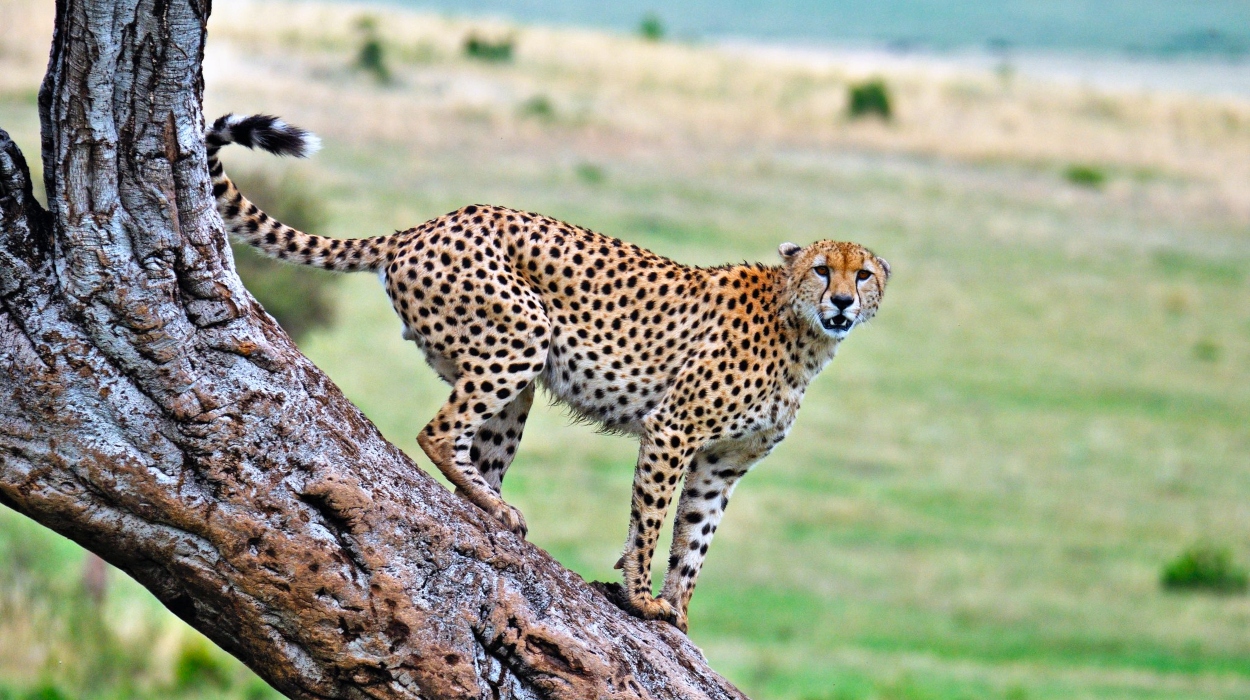
The termite mound is the cheetah’s most important hunting tool in the Maasai Mara. A cheetah climbing a two-metre termite mound gains a sighting line across hundreds of metres of open plain that the ground-level view cannot provide. A guide who sees a cheetah on a termite mound recognizes this as hunting preparation, not resting — the animal scans for prey, and the vehicle should approach slowly from downwind and park at a distance that does not disturb the scan. Sitting quietly with the engine off while a cheetah evaluates prey from a termite mound produces one of the Maasai Mara’s most sustained and watchable wildlife moments — the cat’s rotation as it sweeps the plain visually, the lowering of its head when prey is located, and the body drop into a stalking crouch can unfold over 20 to 40 minutes of genuine drama before the sprint begins.
Best Time of Day for Cheetah Watching
Cheetahs in the Maasai Mara are most active between 6 and 10 AM and again from 3:30 to 6:30 PM, avoiding the midday heat when their temperature regulation limitations prevent sustained exertion without dangerous overheating. The dawn 6 AM departure catches cheetahs at their most active hunting window — morning cool allows the 112 km/h sprint speed, and the low sun angle produces the golden sidelight that creates the most dramatic cheetah photography. Guides search for cheetahs immediately on departure rather than waiting to arrive at a specific location — a cheetah moving across the open plain at dawn is visible from several kilometres on flat Mara grassland and can be intercepted before reaching the hunting position that begins the most exciting phase of the encounter. The midday rest period positions cheetahs in shade under low acacia bushes or in termite mound shadow — less visually dramatic than hunting postures, but providing excellent portraiture photography when the animal is still and the guide can position close without disturbance.
January through March represents the single best cheetah watching window in the Mara. The short rains of November and December produce low short grass averaging 10 to 20 centimetres across the open plain — low enough that a cheetah in a hunting crouch remains visible from 200 metres and the sprint and kill can be observed from the vehicle across unobstructed ground. The July–October peak migration season also brings excellent cheetah watching alongside the wildebeest drama — Thomson’s gazelle fawning peaks during this period, providing abundant prey that concentrates cheetah hunting activity on fawn-rich areas of the short-grass plain near the Talek River drainage. African Wild Trekkers assigns guides with the deepest individual cheetah knowledge to clients who identify cheetah as their primary wildlife priority.
Camera Settings for Cheetah Photography
Capturing the Sprint and the Hunt
Photographing a cheetah sprint requires specific camera settings that most safari photographers do not have pre-set before the moment arrives. Set continuous burst mode at minimum 10 frames per second, shutter priority or manual at 1/2000 second minimum (1/3200 for the fastest sprint phase), ISO auto with a maximum ceiling of 6400, and continuous autofocus tracking that locks on the moving animal through the burst sequence. A 70–200mm lens captures the cheetah in environmental context during the stalk and early sprint. A 400–500mm lens fills the frame during the mid-sprint and kill approach. Having both focal lengths accessible on separate bodies or via rapid zoom adjustment covers the sprint’s changing distance from initiation to kill contact. The most common cheetah photography mistake is insufficient shutter speed — 1/500 second that freezes a stationary cheetah creates dangerous motion blur on a running cheetah whose strides cover three to four metres at full speed.
The anticipation phase before the sprint provides the highest-quality photography window. During the stalk, the cheetah moves slowly enough for precise focus, the distance is close enough for frame-filling telephoto compositions, and the light is whatever it was when prey was acquired. Portraits of a cheetah in full-focus stalk posture — low body, ears flat, tail rigid and horizontal, eyes fixed on prey — are among the Maasai Mara’s most compositionally satisfying wildlife images. They require only a steady hand and correct exposure rather than the burst-mode reflexes the sprint demands. African Wild Trekkers guides position the vehicle to optimize both the stalk photography and the sprint observation — downwind and at 45 degrees to the cheetah’s travel direction, providing a sightline on both the cheetah and the prey throughout the entire hunting sequence.
Identifying Individual Cheetahs
Individual cheetah identification in the Maasai Mara uses the facial tear-mark pattern — the dark lines running from the inner eye corner to the mouth — which varies enough between individuals to permit reliable visual identification by trained guides. Tear-mark thickness, curvature, and length differ consistently between individuals, and guides who work the same territory daily build a recognition library of every resident cheetah’s facial pattern. They call out specific individuals by name within seconds of a sighting. Knowing that the female with the three cubs is the same individual who raised two previous litters successfully in the same territory gives the encounter biographical depth — a specific known individual with a documented history rather than an anonymous spotted cat. Research organizations like the Mara Predator Conservation Programme document individual cheetah identities and publish sighting records that guides integrate into their daily behavioral briefings.
Photographing the tear-mark pattern during a close stationary encounter — when the cheetah rests on a termite mound and faces the vehicle — provides the documentation image that contributes to the population database alongside being an excellent portrait. Submit your tear-mark photographs to the Mara Predator Conservation Programme’s iNaturalist project page after your safari and your sighting becomes part of the individual tracking record that researchers use to monitor territory shifts, reproductive success, and population trends. This participatory dimension — where traveler photographs contribute directly to conservation science — is one of the most satisfying intellectual by-products of a Maasai Mara cheetah encounter. African Wild Trekkers guides brief clients on this submission opportunity as part of the post-drive debrief before camp return.
Understanding Cheetah Behavior at Sightings
Reading the Hunt Sequence
A cheetah hunt unfolds in four distinct behavioral phases that guides read in real time. The detection phase begins when the cheetah locks visual contact with specific prey — ears flatten, body lowers, and the previously relaxed posture shifts abruptly to rigid, focused attention that the prey has not yet detected. The stalk phase involves the cheetah closing the distance while using cover — low grass, termite mounds, and the prey’s blind spots — to approach within 50 to 70 metres before the sprint becomes viable. The sprint phase covers 50 to 70 metres in under four seconds, ending in either a successful trip and suffocation kill or a failed pursuit where prey outmaneuvers the cheetah at close range. Understanding which phase you are watching prevents the common visitor error of reacting loudly to the detection phase — when nothing dramatic happens visually — and missing the building tension that makes the sprint’s emotional release so intense when it finally occurs.
Post-hunt behavior provides some of the most sustained and intimate cheetah observation in the Mara. After a successful kill, the cheetah rests for 5 to 15 minutes recovering from the sprint’s cardiovascular output before beginning to eat. This recovery period allows close vehicle observation of the breathing rate, the alert scanning for approaching lions or hyenas that will steal the kill, and the first feeding behavior that reveals the cheetah’s prey preference. Guides understand the kill-theft dynamic that defines cheetah conservation challenges — lions steal approximately 10 to 15 percent of cheetah kills in the Maasai Mara, spotted hyenas steal an additional 5 to 10 percent — and position the vehicle to observe whether a rival species approaches while the cheetah feeds. Watching a cheetah abandon a partially consumed kill when a lion coalition appears over the ridge delivers a conservation biology narrative in real time that no textbook description matches for emotional immediacy.
Plan Your Safari
Cheetah watching in the Maasai Mara is best experienced from a private conservancy camp with an experienced guide who knows the resident cheetah population individually. Contact African Wild Trekkers to confirm which conservancy’s guides currently have the deepest cheetah knowledge for your specific travel dates. We match cheetah-priority clients with guides whose daily behavioral tracking produces the highest encounter rates.
Your Maasai Mara safari package includes private conservancy camp accommodation, an experienced cheetah-specialist guide, a private 4×4 game drive vehicle with unrestricted conservancy access, full-board meals, Wilson Airport domestic flight, and all park and conservancy fees throughout your stay.
Contact African Wild Trekkers at africanwildtrekkers.com/contact with your travel dates and we will confirm Maasai Mara cheetah-focused itinerary availability and send a complete proposal within 24 hours.