East African Primate Safari: The Complete Guide to Apes Monkeys and More
East Africa’s Primates: The Most Diverse on Earth
Home to one of the world’s most diverse primate communities. At the summit is the mountain gorilla. The world’s most iconic great ape, found only in Uganda, Rwanda, and the Democratic Republic of Congo. Below that are chimpanzees in Uganda, Tanzania, and Rwanda. Beyond those are an extraordinary diversity of monkeys, colobines, and lesser primates distributed across the region’s forests, savannah margins, and montane ecosystems. For primatology enthusiasts, wildlife photographers, and travelers who want to understand our closest evolutionary relatives in their natural environment, East Africa is simply the finest primate safari destination in the world. It is accessible within a single regional itinerary of two to three weeks.
This guide covers the full spectrum of East Africa’s most important primate species. Where to find each and what the trekking or observation experience involves. And how to structure an itinerary that covers the maximum primate diversity within a realistic travel window. It addresses both the headlining great ape species—gorillas and chimpanzees—and the full cast of supporting primates. These include colobus, mangabeys, baboons, vervets, and the lesser-known nocturnal species. Together they make East Africa’s primate community one of the most remarkable assemblages of evolutionary diversity accessible to wildlife travelers anywhere on earth.
The Great Apes: Mountain Gorillas and Chimpanzees
The Headliners of East Africa Primate Safari
Mountain Gorillas: The Pinnacle Primate Experience
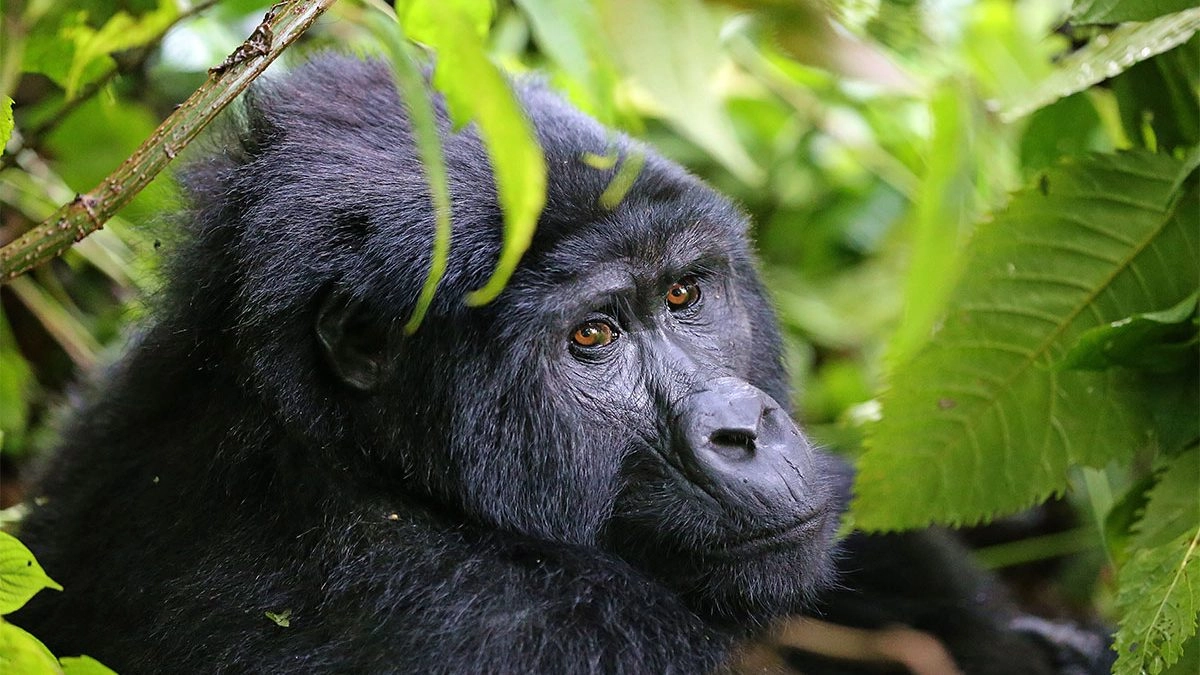
Mountain gorillas in Uganda’s Bwindi Impenetrable Forest and Rwanda’s Volcanoes National Park are the summit of East African primate tourism. They are the most famous, most sought-after, and most emotionally impactful of all the region’s primate encounters. Habituated gorilla families in both countries allow hour-long observation sessions at close range. Typically a 7-meter minimum distance, though gorillas sometimes approach observers more closely. Watching a silverback male—who can weigh 200 kilograms and serves as the family’s primary protector—go about his morning routine while juveniles play around him creates an encounter of profound evolutionary resonance. Full details of the trekking experience at both Bwindi and Volcanoes National Parks appear in the dedicated gorilla trekking guides. This section focuses on the species’ position within the broader East African primate framework.
Mountain gorillas are critically endangered. The current total population across Uganda, Rwanda, and the DRC is approximately 1,000 individuals, with roughly half accessible to trekkers through habituation programs. The conservation success of these trekking programs is one of conservation biology’s most celebrated examples of tourism-linked wildlife protection. They fund gorilla protection and ranger employment while providing a sustainable tourism economic incentive for local communities to support rather than poach the animals. Visiting gorillas directly funds the continuation of a viable wild population that researchers considered genuinely at risk of extinction as recently as the 1980s.
Chimpanzees: Complex, Chaotic, and Endlessly Fascinating
Chimpanzees inhabit multiple East African countries, but the finest and most reliably accessible trekking experiences are in Uganda, Tanzania, and Rwanda. In Uganda, the best sites are Kibale Forest, Budongo Forest, and Kaniyo-Pabidi in Murchison Falls. In Tanzania, the best sites are Mahale Mountains and Gombe Stream. Rwanda, it is Nyungwe Forest. Uganda’s Kibale Forest provides the continent’s best chimpanzee encounter in terms of group size and habituation level. And the richness of social behavior observable during the permitted viewing period. The M Group at Tanzania’s Mahale Mountains is one of the best-studied chimpanzee communities in the world. It provides a uniquely intimate experience in the extraordinary setting of the Mahale Mountains above Lake Tanganyika. Rwanda’s Nyungwe Forest holds the largest remaining chimpanzee population in the country and offers a forest environment quite distinct from either Uganda or Tanzania.
Behavioral diversity is what distinguishes chimpanzee observation from gorilla observation for many primatologists and interested visitors. Chimpanzees are more dynamically social, more vocal, and more physically active than gorillas during observation periods. Hunting cooperation, tool use, competitive social interactions, and the famous pant-hoot vocalization that echoes through the forest canopy all occur regularly during trekking encounters. Chimpanzees share approximately 98.7 percent of our DNA. For observers interested in the cognitive and social complexity of our closest relatives, the chimpanzee observation experience provides material for reflection that the more serene gorilla encounter does not offer in quite the same intellectually active form.
Old World Monkeys: The Supporting Cast of East African Forests
Colobus, Mangabeys, and the Diverse Monkey Community
Black-and-White Colobus: East Africa’s Most Photogenic Monkey
The black-and-white colobus monkey is one of East Africa’s most visually striking primates. It is also one of the most accessible for wildlife photography. Its dramatic black-and-white coloring, flowing white mantle, and remarkably long white tail make it instantly recognizable. Colobus monkeys are canopy-dwellers who move through the forest in family groups. Their dramatic arboreal leaping—crossing gaps between trees in long horizontal leaps with the white tail streaming behind—creates photographic opportunities of extraordinary aesthetic quality. Multiple colobus species exist across East Africa. The Guereza colobus is the most widespread. Kirk’s red colobus, found primarily on Zanzibar’s Jozani Forest, is a critically endangered endemic with a colorful red-and-cream coloring quite different from the standard black-and-white pattern.
Kirk’s red colobus in Zanzibar’s Jozani Forest is one of East Africa’s most specific primate travel draws. It is a species found nowhere else in the world, restricted to the forest patches of Zanzibar Island. It is observable at very close range due to the habituation that decades of forest tourism have produced. A visit to Jozani Forest on a Zanzibar stay combines perfectly with the standard island beach and Stone Town itinerary. Seeing Kirk’s red colobus leaping through the forest canopy at close range is a primate highlight that most Zanzibar visitors who enter the forest describe as unexpectedly memorable alongside the island’s better-known attractions.
Olive Baboons and Vervet Monkeys: The Ubiquitous Savannah Primates
Olive baboons and vervet monkeys are the primates that East African safari visitors most commonly encounter on a daily basis, regardless of itinerary. Both species are widespread across savannah and woodland habitats throughout Tanzania, Kenya, and Uganda. Baboon troops of thirty to a hundred individuals are a feature of virtually every major East Africa national park. They frequently cross game drive tracks, visit lodge compost areas, or groom at waterhole margins. Their complex social structure is complete with linear dominance hierarchies and coalition formation. And intergenerational knowledge transfer makes them subjects of substantial ongoing primatological research. Guides with natural history training can provide interpretive depth to baboon encounters that elevates them well beyond the “nuisance primates” category that some safari visitors initially assign them.
Vervet monkeys provide similar savannah primate observation opportunities. They are particularly common in the woodland-grassland transition zones of the northern Tanzania parks and Kenya’s Mara ecosystem. Their alarm call system is one of animal communication’s most studied examples. It uses distinct vocalizations for aerial predators, terrestrial predators, and snakes. Each triggers specific escape behaviors. You can observe this system in real time when predators are active near vervet groups during game drives. Watching a vervet group freeze and scan the sky in response to a martial eagle alarm call demonstrates the specific cognitive discrimination underlying their warning system in ways that large predator encounters do not always provide.
Nocturnal Primates: Bushbabies and Pottos
East Africa’s Least-Known Primates
Finding Bushbabies on Night Drives
East Africa’s nocturnal primates—primarily the various bushbaby species (galagos) and the potto—are among the least known to general safari visitors despite being genuinely common and observable with appropriate effort. Bushbabies are small-bodied, enormous-eyed nocturnal primates that inhabit forest edges, woodland, and even suburban gardens across the region. Their distinctive reflective eyes appear as bright orange discs in a torch beam. You can locate bushbabies on night drives in private concession areas by shining a spotlight into the canopy and scanning for these characteristic eye reflections. Several bushbaby species occur in East Africa, ranging from the tiny northern lesser galago to the larger thick-tailed greater galago. The greater galago’s distinctive territorial call. Resembling a baby’s cry. Echoes through woodland areas throughout the region on warm nights.
For primate-focused travelers on a comprehensive East Africa primate safari, specifically requesting night drives with spotlight scanning for nocturnal primates adds a genuinely different dimension to the species list. Standard daytime trekking cannot provide this. These are not headline experiences in the gorilla-trekking sense. But for primatologists and natural history enthusiasts, they represent the completion of an East Africa primate survey that the habituated great apes and accessible colobus monkeys alone cannot fully deliver.
Plan Your Safari
A comprehensive East Africa primate safari itinerary covers Rwandan or Ugandan gorillas, Ugandan or Tanzanian chimpanzees, and Zanzibar’s Kirk’s red colobus. And the golden monkeys of the Virunga volcanoes across three to four weeks of travel. Building this primate circuit alongside a Tanzanian or Kenyan savannah safari component creates an East African journey of extraordinary biodiversity range. It combines both the great ape encounters and the open-savannah wildlife spectacle into a single definitive regional itinerary.
African Wild Trekkers builds Tanzania safari and Zanzibar primate components into East Africa primate itineraries coordinated with our Uganda and Rwanda regional partners. Contact us to discuss a primate-focused itinerary that includes Tanzania’s chimpanzees at Mahale and Zanzibar’s Kirk’s red colobus alongside the savanna wildlife of the Northern Circuit.
Contact African Wild Trekkers at africanwildtrekkers.com/contact with your primate safari priorities and travel dates, and we will design your East Africa primate itinerary and confirm all availability within 24 hours.