Nile Crocodiles of the Mara River
Biology and Scale of the Mara’s Crocodile Population
How Large Do Mara River Crocodiles Grow?
The Mara River supports one of Africa’s largest and oldest crocodile populations, with individuals that have occupied the same stretches of river for decades and grown to sizes that place them among the largest Nile crocodiles anywhere on the continent. Adult male Nile crocodiles in the Mara reach lengths of 4.5 to 6 metres and weights of 500 to 800 kilograms — masses that make them significantly larger than any predator their prey encounters on the open savanna. The largest documented Mara crocodiles have lived in the current river system for an estimated 70 to 100 years, having arrived as small juveniles and grown continuously through decades of migration-season feeding. These ancient individuals occupy the most productive crossing points within their territory and may wait at the same bank location across multiple consecutive migration seasons.
Female crocodiles in the Mara are substantially smaller than males — typically 2.5 to 3.5 metres — and maintain nesting sites along the sandy banks and vegetated margins away from the main river current during the nesting season from June through August. The nesting period coincides with the beginning of the wildebeest crossing season, creating a situation where female crocodiles balance the demands of nest guarding with the feeding opportunity of the migration — a trade-off that guides who follow specific females observe in detail each season. Hatchlings emerge from nests of 25 to 80 eggs in late September or October at a size of approximately 28 centimetres, making them vulnerable to monitor lizards, herons, and large catfish in the river’s shallower margins.
Crocodile Hunting Strategy at River Crossings
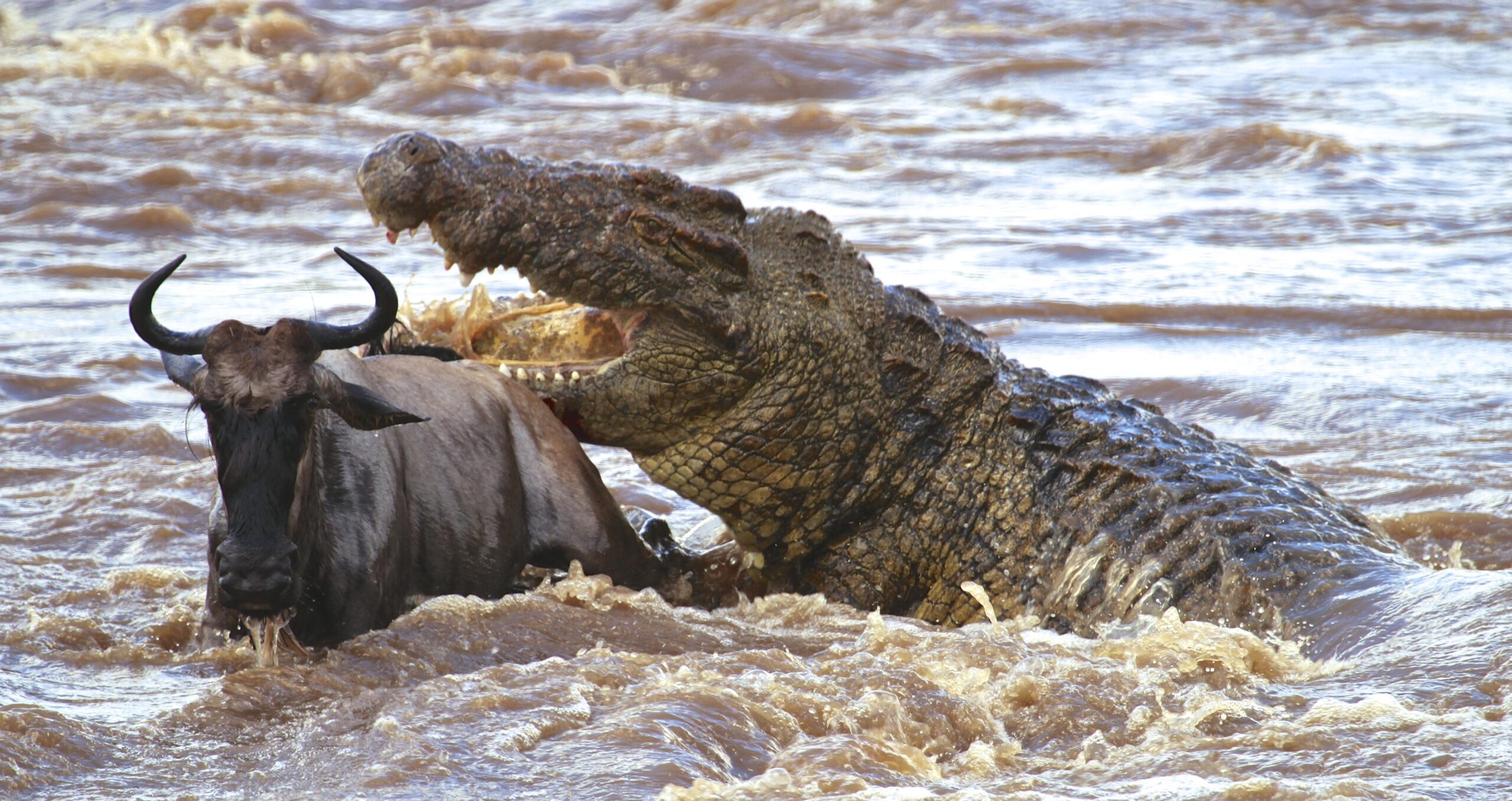
The Nile crocodile’s hunting strategy at wildebeest river crossings exploits the confusion and water noise that hundreds of simultaneously crossing animals create to approach prey from below the surface with minimal detection risk. A crocodile targeting a specific wildebeest in a crossing herd positions itself 10 to 15 metres downstream and underwater, using the river’s current to drift into position without the swimming motion that would create surface disturbance detectable by the prey. The strike covers this remaining distance in a single explosive lunge from the submerged position — the crocodile uses its powerful tail to drive forward at a burst speed reaching 40 kilometres per hour over one metre — and the jaws close on whatever body part is closest, typically the head, neck, or leg.
The death roll — the crocodile’s method of drowning and dismembering prey too large to swallow whole — requires the animal to submerge with its prey and rotate the body repeatedly to tear through flesh, hide, and eventually bone. A 5-metre Mara crocodile can kill and dismember a fully grown wildebeest in minutes through this technique, consuming what it can immediately and caching the remainder underwater where decomposition softens remaining tissue for subsequent feeding. The smell and visual disturbance of a crocodile kill at a crossing attracts competitors quickly — other crocodiles, Marabou storks, vultures, and occasionally lions that wait at the water’s edge for carcasses — creating a scavenging cascade around the original predation event that extends the feeding opportunity across multiple species.
Where and When to Watch Mara River Crocodiles
Crossing Point Viewing and Year-Round Basking
The best crocodile viewing in the Mara River concentrates at three types of locations: migration crossing points where crocodiles aggregate during July through October in anticipation of the herd; basking beaches where individuals haul out year-round for thermoregulation; and pool sections where resident crocodiles maintain consistent positions that guides track from vehicles along the river bank. The main crossing points — the Purungat Bridge area, the Fig Tree crossing, and various Mara Triangle river bends that the herd uses in different years depending on current water levels — concentrate both crocodiles and dramatic visual events. Outside migration season, these same crossing points host basking groups of six to fifteen crocodiles in the sandy margins that provide the thermoregulation surface these ectotherms require for digestion and immune function.
Year-round crocodile viewing from the river bank access roads within the Mara Triangle provides close encounters with basking individuals that are entirely predictable in their location. Specific sandbanks and rocky outcrops that receive morning sun at the angle that most effectively raises body temperature attract the same individuals on most clear mornings. Guides who know these spots drive directly to them without the search time that unpredictable predator viewing on the open savanna requires. This produces reliable crocodile encounters as supporting wildlife between the game drive’s main big cat focus. The Mara River’s hippo pools also concentrate crocodiles that share the hippo’s preferred deep-pool habitat, and boat or raft-based viewing — available at some points along the river outside the reserve — provides eye-level encounters with basking crocodiles at distances of less than ten metres that vehicle-based viewing cannot achieve.
Understanding Crocodile Behaviour at Close Range
Crocodiles at basking sites near vehicles show minimal disturbance response to engine noise and calm human presence because the Mara’s individuals have experienced vehicle traffic for decades and associate it with no threat. This habituation allows observation and photography at ranges of 15 to 30 metres that reveal behavioural details impossible to appreciate at greater distances — the thermoregulatory gaping (open-mouthed basking that increases heat loss from the mouth’s blood-rich lining), the subtle eye movement tracking approaching threats or prey, and the social hierarchy interactions between different-sized individuals competing for the same basking position. A large male displacing a smaller individual from a preferred bank requires no physical contact — the approach and size display alone resolves the competition in seconds, demonstrating social dynamics that operate through non-violent communication rather than the combat that the animals’ fearsome physical equipment would suggest.
The Mara’s crocodile population also includes numerous juveniles from one to three years old that congregate in shallower tributary streams entering the main river. Smaller prey — frogs, fish, small birds — provides age-appropriate food for animals whose size has not yet allowed them to compete for position at the main crossing points. These juvenile aggregations provide an entirely different visual register from the enormous adults at crossing points. Dozens of 60 to 90-centimetre crocodiles basking in a shallow stream margin create a scene more reminiscent of a reptile documentary than the dramatic single-predator encounters the main river produces. Guides who know the tributary locations with reliable juvenile concentrations incorporate these visits into wildlife drives that give guests a complete picture of the crocodile population’s age structure rather than only the largest and most photogenic adults.
Crocodile Conservation in the Mara
Threats and Protection
Nile Crocodile Status in Kenya
Nile crocodiles in Kenya receive formal protection under the Wildlife Conservation and Management Act and CITES Appendix I listing that prohibits commercial trade in wild-caught individuals. The Mara River population appears stable based on guide and researcher count data maintained over decades. The river’s size and productivity support a crocodile density that the annual wildebeest migration replenishes through the enormous prey biomass it delivers each July through October. Conflict with fishermen along the Mara River outside the national reserve boundary represents the primary ongoing threat to crocodile populations in the community land stretches of the river, where individuals that attack fishing nets or boats create retaliatory pressure from fishing communities whose economic losses justify human-crocodile conflict in their own risk assessment.
Research into the Mara’s crocodile population continues through the work of scientists affiliated with the Mara Research Station and international institutions who use PIT tagging, photographic identification of individual scute patterns, and radio telemetry to track population size, age structure, and movement patterns within the river system. This ongoing research produces the data that guides draw on when explaining crocodile biology to guests and that informs conservation management decisions at the Kenya Wildlife Service level. Guests who engage with this research context — asking guides about specific research programmes and what they have revealed about the animals on the current drive — access a depth of ecological understanding that transforms crocodile viewing from visual spectacle into an encounter with one of the most comprehensively studied large reptile populations anywhere in Africa.
Plan Your Safari
Mara River crocodile viewing works best when planned around the crossing season from July through October and combined with river-side camp accommodation that provides early morning access to crossing points before crowds arrive. African Wild Trekkers selects river-adjacent camps and provides guides with detailed knowledge of current crocodile aggregation patterns at crossing points and basking beaches.
The package covers accommodation at river-positioned camps, morning crossing point drives timed for peak crocodile activity, park and conservancy fees, internal flights, and specialist naturalist guides who can explain crocodile biology and hunting behaviour during observation periods at the river bank.
Contact African Wild Trekkers at africanwildtrekkers.com/contact with your travel dates and we will design your Mara River safari with crocodile viewing included within 24 hours.