When Tanzania vs. Kenya: Which East African Safari Destination Is Right for You?
Tanzania and Kenya share the same ecosystem, much of the same wildlife, and a border that cuts through one of the world’s great wilderness landscapes—the Serengeti-Masai Mara. Yet the two countries deliver meaningfully different safari experiences, and the choice between them depends on your priorities, your budget, the time of year you travel, and what you most want to take away from East Africa. This guide compares the two destinations honestly so you can decide which is right for you — or whether combining them in a single trip delivers the best of both worlds.
Wildlife: What You See and Where
Big Five and Migration Across Both Countries
Tanzania’s Wildlife Advantage
Tanzania holds a raw numbers advantage in wildlife. The Serengeti National Park alone covers 14,763 square kilometers of protected wilderness—more than four times the size of Kenya’s Masai Mara National Reserve. The Ngorongoro Crater concentrates the world’s highest density of large mammals within a single caldera. Tarangire’s elephant herds dwarf those in most Kenyan parks during the dry season. Tanzania’s southern circuit—Ruaha, Selous, and Mahale—adds vast, remote wilderness areas with few tourists and extraordinary lion, elephant, and hippo populations that most Kenyan visitors never encounter. Tanzania simply has more land under protection and more wildlife using it.
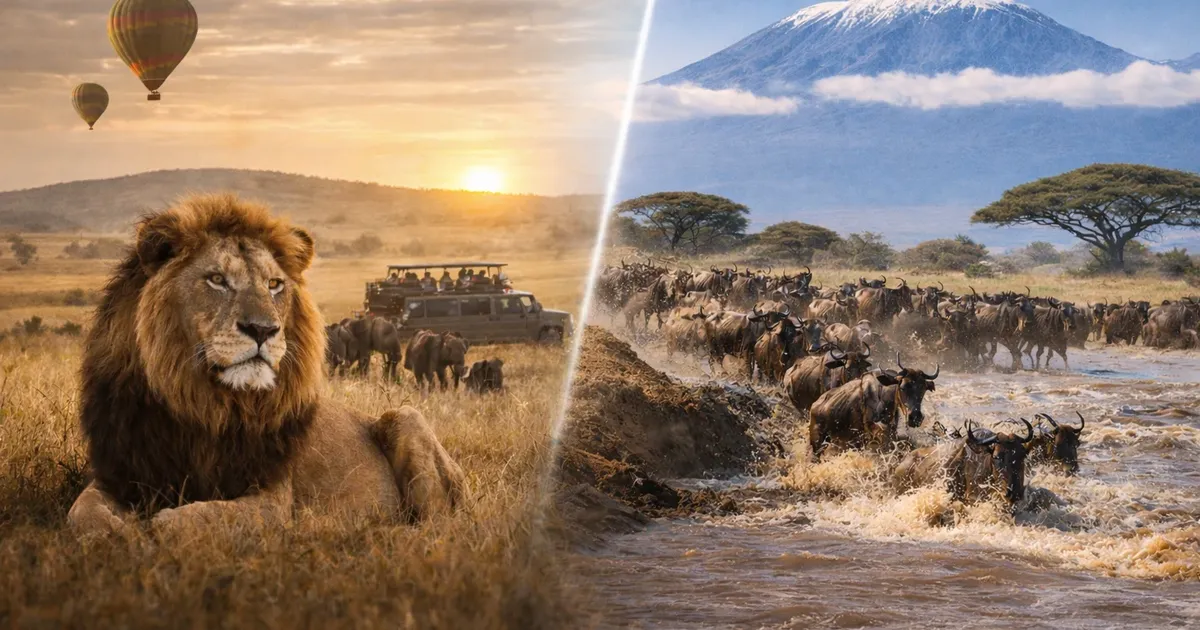
The Great Wildebeest Migration begins in Tanzania’s Serengeti with the January-February calving season in the Ndutu area and spends approximately eight months of the year in Tanzania before crossing the Mara River into Kenya in July-August. Travelers who visit Tanzania in January-June have the migration entirely within Tanzania’s borders, while those visiting in July-October can choose to see it in either country. Tanzania offers better access to the migration for a longer portion of the annual cycle, making it the more versatile destination for migration-focused itineraries.
Kenya’s Wildlife Strengths
Kenya’s Masai Mara delivers the same river crossing spectacle that makes the Tanzanian Serengeti famous but in a smaller, more accessible reserve that many travelers find easier to navigate. The Mara’s higher concentration of safari vehicles at key crossing points during peak season means river crossings happen in the company of other vehicles.
Some travellers enjoy the communal excitement of this; others prefer the quieter crossings accessible from Tanzania’s Serengeti side. Kenya’s Amboseli National Park offers the world’s finest elephant viewing against the backdrop of Kilimanjaro on clear mornings, delivering a photographic experience that nothing in Tanzania quite replicates.
Kenya’s northern regions—Samburu, Laikipia, and the Matthews Range—host species not found in Tanzania’s northern circuit: the reticulated giraffe, Grevy’s zebra, the long-necked gerenuk, and the beisa oryx. These endemic northern species make Kenya a compelling complement to Tanzania for travelers who want to diversify their wildlife list.
Kenya’s private conservancy system, particularly in the Laikipia Plateau, also delivers night drives, walking safaris, and community-owned land management models that create exceptional wildlife density without the constraints of national park regulations.
Cost: Comparing Tanzania and Kenya Safari Prices
What You Pay in Each Country
Tanzania’s Higher Park Fee Structure
Tanzania charges some of Africa’s highest national park fees, particularly for the Serengeti and Ngorongoro Conservation Area. In 2026 the Serengeti charges approximately USD 70 per person per day for non-resident adults, and Ngorongoro adds crater service fees on top of the conservation area fees. These costs reflect the management required to protect vast ecosystems, but they mean that Tanzanian safaris—all other factors equal—carry higher park fee components than Kenyan equivalents. The Ngorongoro crater service fee of approximately USD 295 per vehicle per descent adds substantially to the cost of crater-day itineraries.
Kenya’s Masai Mara National Reserve charges approximately USD 80 per person per day for non-residents, placing it at a similar level to Tanzania’s Serengeti fee. Kenya’s private conservancies charge conservancy fees on top of reserve fees but in return offer exclusive game drives without the vehicle concentrations of the national reserve. Budget for total park and conservancy fees across a five-day Tanzania safari at around USD 350 to USD 500 per person and for a similar Kenya itinerary at USD 300 to USD 450 per person.
Accommodation and Total Trip Cost Comparison
Mid-range and luxury accommodation in Tanzania’s northern circuit is priced comparably to equivalent Kenya properties, with five-star private camps in both countries running USD 700 to USD 2,000 per person per night. The overall cost of a five-day safari is therefore broadly similar between the two countries at equivalent accommodation tiers.
Where Tanzania delivers substantially more value is in the sheer size of the parks—a USD 5,000 Tanzania safari at mid-range puts you in a vastly larger wilderness than an equivalently priced Kenya Mara safari, with correspondingly fewer vehicles per square kilometer in most areas outside peak season.
Both countries are generally more affordable when a single operator books the combined itinerary rather than separate companies handling each leg. African Wild Trekkers runs combined Kenya-Tanzania itineraries from a single Nairobi or Kilimanjaro arrival, covering both countries’ parks in one seamlessly coordinated trip.
Clients who book both legs together benefit from unified logistics, a single guide team who knows both systems, and pricing that reflects the efficiencies of booking the full circuit rather than piecing it together from two separate operators.
Accessibility and Safari Experience
Getting to and Around Each Country
Flight Connections and Internal Travel
Both Tanzania and Kenya are well-served by direct flights from Europe, North America, the Middle East, and Asia. Nairobi’s Jomo Kenyatta International Airport has historically been the dominant East Africa hub, with more direct routes and higher flight frequencies than Kilimanjaro International Airport or Dar es Salaam. This means that travelers with limited time sometimes find Kenya fractionally more accessible as a starting point—less connection time and more scheduling flexibility on flights.
Tanzania has improved its international connectivity significantly, and Kilimanjaro is a convenient gateway for northern Tanzania safaris, but Nairobi remains the more connected hub for most travelers.
Internal flying in both countries works similarly, with small prop planes linking the main airstrips within and between parks. In Kenya, the domestic aviation network between Nairobi, the Mara, Amboseli, Samburu, and Lamu is well-developed and competitively priced.
In Tanzania, internal flights between Kilimanjaro, the Serengeti, Ruaha, Selous, and Zanzibar are reliable but can be more expensive than Kenyan equivalents on a per-kilometer basis. Both countries’ bush airstrips have improved significantly in recent years, and flying is the preferred way to move between distant parks in either destination.
Vehicle Concentrations and Park Experience
The Masai Mara National Reserve, particularly around the Mara and Talek river crossings during the July-September peak migration season, can feel crowded—dozens of vehicles sometimes converge on a single crossing location. Kenya’s private conservancies adjacent to the reserve offer exclusive game drives in areas that the national reserve’s vehicle concentrations cannot match.
In Tanzania’s Serengeti, park sections away from the central Seronera area and the northern Mara River crossings maintain much lower vehicle density even during peak season. The southern and western Serengeti corridors see a fraction of the traffic of the central circuit.
when solitude and space are your primary wildlife priorities, Tanzania’s size works in your favor throughout the year. If river crossings are your specific target and you travel in peak season, Kenya’s Mara delivers them with comparable frequency and arguably better logistics from the Nairobi gateway. If a combination of both is your goal, a ten-to-fourteen day trip covering both countries resolves the comparison entirely.
African Wild Trekkers’ most popular extended East Africa itinerary covers Amboseli, the Serengeti, Ngorongoro, and Zanzibar in fourteen days, delivering Kenya’s Kilimanjaro backdrop and Tanzania’s migration and caldera in a single seamless circuit.
Beach Extensions: Kenya vs Tanzania
Diani Beach Versus Zanzibar
Which Beach Destination Suits Your Trip
Kenya’s Diani Beach on the south coast and Tanzania’s Zanzibar archipelago both deliver classic Indian Ocean beach experiences, but they have distinct characters. Diani is a developed beach strip with resort hotels, kitesurfing schools, dive centers, and a lively tourist community that includes both international visitors and Nairobi weekend travelers.
The Ukunda airstrip makes the flight from Nairobi under an hour. Diani suits travelers who want a beach extension within Kenya’s borders without the complexity of crossing into Tanzania.
Zanzibar offers more cultural depth — Stone Town’s UNESCO architecture, the spice farm history, Arabic and Swahili cultural layers, and a more remote feel on the island’s northern and eastern coasts. Zanzibar’s resorts range from boutique eco-lodges to large all-inclusive hotels, and the island’s diving and snorkeling on the surrounding reef system ranks among East Africa’s best.
Adding Zanzibar to a Tanzania safari requires either a short domestic flight from Kilimanjaro or Dar es Salaam or a ferry from Dar; both are straightforward logistics. The beach quality on Zanzibar’s best strips is exceptional, and the island’s cultural character makes it more than just a beach destination.
Plan Your Safari
The Tanzania vs. Kenya decision depends on what you most want from your East Africa trip—sheer wilderness scale, specific wildlife targets, season timing, or a preference for combining both countries in one circuit. African Wild Trekkers operates in both countries and builds itineraries that emphasize one or the other or cover both in a single two-week program with seamless cross-border transfers.
The team has run Kenya-Tanzania combined circuits since the company’s founding and knows both countries’ parks, seasonal patterns, and camp options in detail. A consultation with the team before booking takes the guesswork out of the Tanzania vs. Kenya decision by matching your specific priorities to the right itinerary. The team also advises on the optimal time of year for your trip based on what you most want to see.
Contact African Wild Trekkers at africanwildtrekkers.com/contact with your Tanzania or Kenya travel dates, and we will recommend the ideal East Africa safari itinerary for your goals within 24 hours.