Tanzania and Kenya Safari: The Classic Two-Country East Africa Combination
Combining Tanzania and Kenya in a single East Africa safari itinerary has been the region’s classic travel format for decades, and it remains the most comprehensive way to experience what East Africa offers. The two countries share the Serengeti-Masai Mara ecosystem, the same sky, and the same wildebeest herd yet each brings something distinctly its own. Kenya’s Amboseli and the Masai Mara’s Nilotic culture, Tanzania’s vast Serengeti, the Ngorongoro Crater, and Zanzibar’s Indian Ocean coast together create an East Africa experience that no single country can match. This guide explains how to build the best combined itinerary.
Why Combine Tanzania and Kenya in One Trip
What Each Country Adds to the Circuit
What Tanzania Brings
Tanzania contributes the Serengeti’s scale 14,763 square kilometres of protected savanna that dwarfs anything Kenya offers. The Great Wildebeest Migration spends eight months of the year within Tanzania’s borders, from the calving season in the Ndutu area in January and February through the long northward journey toward the Mara River crossing in July. Tanzania adds the Ngorongoro Crater, one of the world’s great wildlife spectacles and the only place where you can reliably see black rhinos in open ground from a vehicle. Tarangire’s elephant herds, Zanzibar’s Indian Ocean coastline, and the remote southern circuit parks of Ruaha and Selous round out a wildlife portfolio that no single-country safari can replicate.
Tanzania’s safari experience also tends toward the uncrowded end of the spectrum, particularly in its southern and western park sections. The Serengeti’s vast size means that even during peak season, the park absorbs visitor numbers in ways that smaller reserves cannot. Travellers who have been to Kenya’s Masai Mara during high season and found the vehicle concentrations frustrating often return from Tanzania having encountered fewer vehicles per sighting and a more intimate wildlife experience. Tanzania’s contribution to a combined itinerary is depth, scale, and the caldera and calving season experiences that Kenya does not offer.
What Kenya Adds
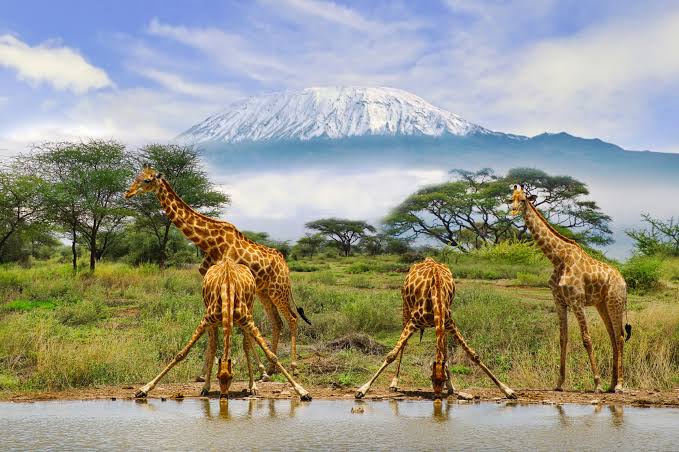
Kenya adds Amboseli and nothing else on the continent photographs elephants against snow-capped Kilimanjaro the way Amboseli does on a clear morning. The mountain sits just inside Tanzania’s border, but Kenya is where you stand to look at it from across the swamp, with a full-grown elephant bull in the foreground. Kenya also adds its northern circuit: Samburu and Buffalo Springs conservancies hold species endemic to the region the reticulated giraffe, Grevy’s zebra, the long-necked gerenuk, Beisa oryx, and the Somali ostrich that Tanzania’s parks do not offer. For wildlife list completers, Kenya’s north is a compelling addition to any East Africa circuit.
The Masai Mara contributes the southern end of the Great Migration river crossings when the wildebeest are in Kenya between August and October. It also adds Maasai community conservancies Olare Motorogi, Naboisho, Mara North, Ol Kinyei that offer exclusive game drives without vehicle concentrations, walking safaris, night drives, and community-owned tourism models with exceptional wildlife density. Kenya’s domestic aviation network and proximity to Nairobi’s international hub make it a convenient starting point for many international travellers, allowing the circuit to begin in Kenya and end with Zanzibar after crossing into Tanzania.
Best Combined Tanzania-Kenya Itinerary Routes
Ten-Day and Fourteen-Day Circuit Options
The Ten-Day Classic Circuit
A ten-day Tanzania-Kenya combined safari is the minimum length to do both countries justice. The standard routing starts with arrival at Nairobi, a flight to Amboseli for two nights, then a cross into Tanzania via the Namanga border or a flight to Kilimanjaro for the Serengeti and Ngorongoro section. Three nights in the Serengeti including at least two full days of game drives, one night and a full crater descent at Ngorongoro, and then either a direct Zanzibar flight for a beach finish or a return to Nairobi via the Mara. Ten days feels tight but delivers the essential elements of both countries: Amboseli elephants, Serengeti scale, Ngorongoro wildlife, and optionally a Mara crossing or Zanzibar beach finale.
The ten-day circuit requires efficient logistics internal flights rather than long driving days between parks — and African Wild Trekkers coordinates the cross-border mechanics, park fee payments, and airport transfers in both countries through a single booking. Clients do not need to manage visa or logistics for each country separately. The ten-day circuit suits travellers with limited annual leave who want the essential East Africa experience in the most efficient format possible.
The Fourteen-Day Extended Circuit
Fourteen days transforms the classic circuit from efficient to genuinely unhurried. The additional four days allow three full nights in the Serengeti rather than two, a full day at Ngorongoro with an early crater descent and afternoon game drive on the rim, two nights in Amboseli, and either two nights in the Masai Mara conservancies or three nights in Zanzibar enough time to feel the island rather than merely tick it. Travellers who have done a ten-day circuit and felt they rushed the Serengeti consistently cite the fourteen-day format as the right length for a comprehensive first trip to East Africa.
The fourteen-day circuit also allows more flexibility in the routing Tarangire can be added as a standalone night en route to or from the Serengeti, Samburu in Kenya’s north can replace or complement the Masai Mara, or the southern Tanzania circuit can replace the northern Mara component for travellers more interested in remote wilderness. African Wild Trekkers builds customised fourteen-day circuits based on each client’s specific wildlife priorities and travel dates, selecting the combination of parks that delivers the best conditions for that time of year.
Crossing the Kenya-Tanzania Border
Namanga Border Crossing by Road
The most common land crossing between Kenya and Tanzania for safari travellers is the Namanga crossing, located on the A104 road between Nairobi and Arusha. The crossing is open daily and well-staffed, and the process for safari clients with a pre-approved e-visa for Tanzania is usually straightforward. Your guide handles the paperwork on both sides, paying vehicle charges and assisting with any customs questions. The drive from Nairobi to Namanga takes approximately two to three hours, and from Namanga to Arusha is another two hours, making it a full half-day of road travel. Most operators flying between the two countries bypass the border crossing entirely, which is the preferred option for time-sensitive itineraries.
Travellers using the land crossing need a Tanzania visa in addition to their Kenya visa or East Africa Tourist Visa. The East Africa Tourist Visa does NOT cover Tanzania a detail that causes genuine problems for travellers who do not research it in advance. African Wild Trekkers confirms visa requirements for both countries explicitly during the booking process and flags the Tanzania e-visa application timeline so clients arrive at the border with all documentation in order. The team has managed hundreds of cross-border transfers and has contingency plans for the occasional delays that occur at peak times.
Flying Between Countries
Flying between Kenya and Tanzania typically from Nairobi Wilson Airport to Kilimanjaro International Airport, or to the Serengeti’s Lobo or Seronera airstrips is the preferred option for most safari clients. The flight takes under two hours, eliminates several hours of road travel, and avoids the border crossing process entirely. Regional airlines serving this route operate scheduled services, while charter flights reach airstrips that scheduled services do not cover. The cost is meaningful but reflects the time saved and the comfort of arriving at your Tanzania camp relaxed rather than road-weary.
African Wild Trekkers coordinates all inter-country flights as part of the combined booking, selecting the most appropriate carrier and routing for each client’s itinerary. The team monitors flight schedules in both countries and adjusts itineraries when changes occur, maintaining contact with clients at every transition point. For clients who have never crossed between East African countries before, the operator’s on-the-ground presence at each transfer eliminates the uncertainty that comes with managing flight connections in unfamiliar airports.
Season Planning for a Combined East Africa Safari
Which Months Work Best for Both Countries
July to October: Peak Season in Both
The months of July through October represent peak safari season in both Tanzania and Kenya. Dry conditions concentrate wildlife around water, grass is short enough for good visibility, and the Great Wildebeest Migration is either crossing the Mara River (July-September) or moving south back through Tanzania (October). A combined circuit in this window delivers the best game viewing conditions in both countries simultaneously. The trade-off is price peak season commands the highest accommodation rates in both countries and vehicle concentration at the most famous locations. Book at least twelve months ahead for July and August if you want specific camps.
The Masai Mara conservancies shine particularly brightly during this window, with exclusive game drives away from the national reserve’s vehicle concentrations. The Serengeti’s northern section near the Mara River hosts the crossings on the Tanzania side, and clients in camps near Kogatende or Sand River witness crossings with far fewer vehicles than the Kenyan side sees. African Wild Trekkers positions Tanzania clients to watch crossings from the Tanzanian bank where possible, delivering a more intimate spectacle. The July-October window is the peak of the East Africa safari calendar for good reason, and a combined itinerary in this period delivers the most dramatic wildlife experience the region offers.
January to March: Calving Season and Quieter Parks
January through March is the calving season in Tanzania’s southern Serengeti — one of East Africa’s most underrated wildlife spectacles and a compelling reason to visit in what many consider the off-season. Kenya’s parks are also good during this period, with excellent game viewing in Amboseli and the Masai Mara outside the main migration rush. Accommodation rates are lower, parks are less crowded, and the landscape glows green from the short rains that end in December. A combined circuit in January-March places you at the Ndutu calving grounds when hundreds of thousands of wildebeest calves arrive, surrounded by predators taking advantage of the abundance.
The main limitation of the January-March window is that the long rains begin in April in both countries and some roads become impassable. Staying within the January-March window avoids the worst of the wet season. February is arguably the single best month for a Tanzania-focused trip — calving peaks, skies clear after the short rains, and the Serengeti feels vast and quiet. Adding a Masai Mara night during this period gives you the reserve in its most peaceful state. African Wild Trekkers runs dedicated calving season itineraries that combine Ndutu, the Serengeti, Ngorongoro, and optionally Amboseli into a fourteen-day circuit timed for February.
Plan Your Safari
A Tanzania-Kenya combined safari is the most comprehensive East Africa experience available, and the itinerary options are almost limitless once you understand the seasonal patterns and each park’s strengths. African Wild Trekkers builds combined circuits that balance both countries’ best features against your travel dates, budget, and specific wildlife priorities. The team manages all cross-border logistics, visa guidance, internal flights, and park bookings as a single integrated package.
Every combined Tanzania-Kenya itinerary from African Wild Trekkers includes a licensed guide familiar with both countries, a well-maintained safari vehicle for road sections, internal and inter-country flight coordination, all park fees, accommodation, and full board. The team confirms each component in writing before any deposit is taken and stays reachable throughout the trip in case any logistical question arises on the ground.
Contact African Wild Trekkers at africanwildtrekkers.com/contact with your Tanzania-Kenya travel dates and group size and we will build a personalised two-country East Africa itinerary within 24 hours.