Wellness Safari Africa: Yoga, Mindfulness & Healing in the African Bush
Why the African Bush Is the World’s Greatest Wellness Setting
Wellness safari Africa experiences have grown from a niche luxury offering to a mainstream safari category not because wellness trends arrived in the bush from elsewhere. But because anyone who has spent time in genuinely wild African landscapes intuitively understands that the environment already delivers the core outcomes that wellness tourism infrastructure has been commercially engineering for decades.
The neuroscience of what happens to human physiology in natural environments. Reduced cortisol levels, decreased heart rate and blood pressure, improved sleep quality, enhanced immune function.
And the specific cognitive restoration that psychologists call attention restoration theory. Describes precisely what safari travellers have reported experiencing for as long as safari travel has existed. The African bush, where attention is captured by genuine wildness rather than the manufactured novelty that urban wellness facilities must constantly refresh, provides a neurological environment that clinical researchers studying nature’s effects on human health consistently identify as among the most potent natural restoration settings available.
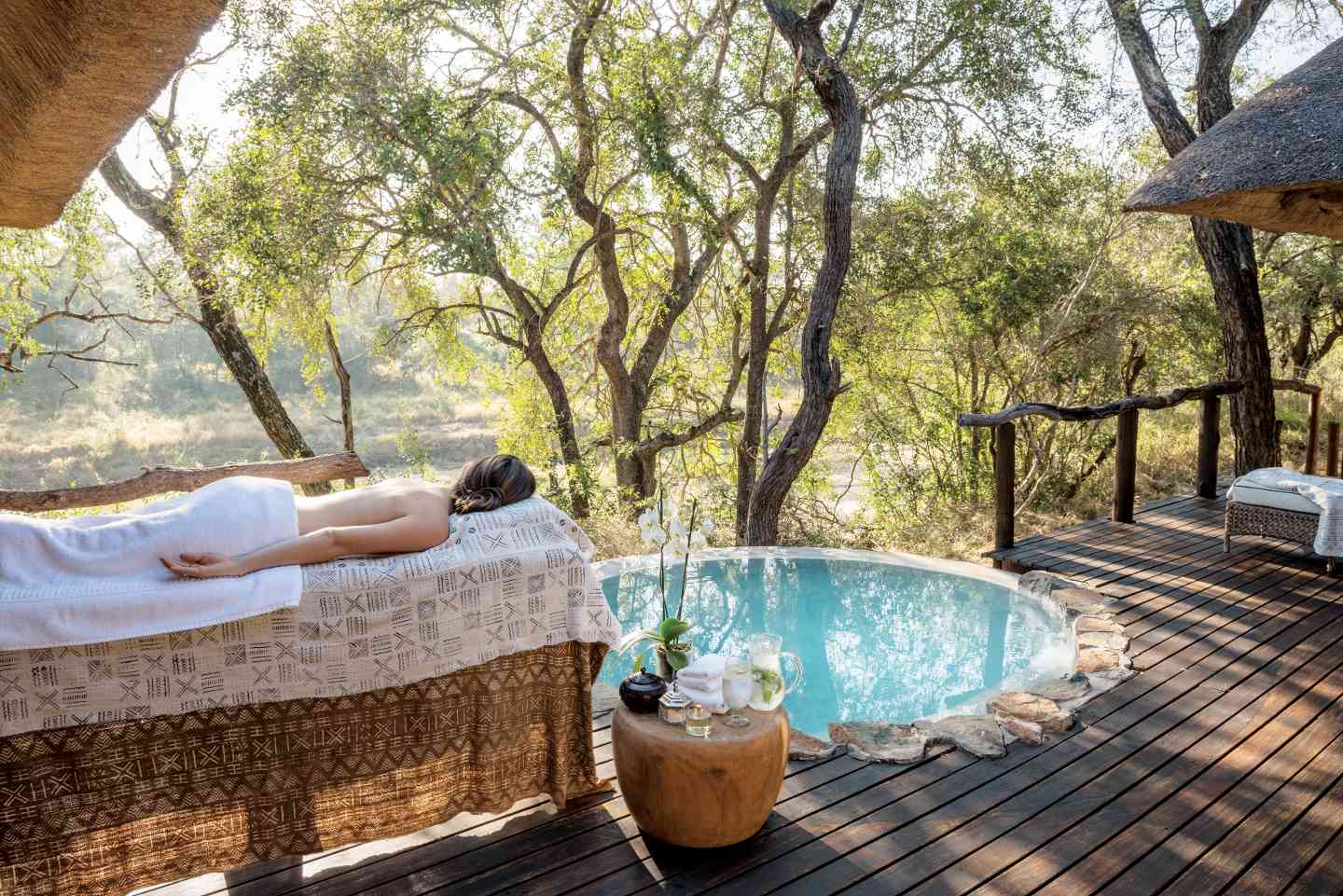
The addition of structured wellness practices. Yoga, meditation, breathwork, spa treatments, nutritional intention. To what was already a physiologically and psychologically restorative environment creates something that neither wildlife safari nor conventional wellness retreat can replicate independently.
A yoga session at dawn on a private deck overlooking a Ugandan papyrus swamp where hippos are calling from the water and African fish eagles are beginning their morning territorial displays combines the physical and meditative benefits of practice with a sensory context that eliminates the mental effort of tuning out background noise, managing time pressure. And engaging the protective social vigilance that urban environments demand even during structured relaxation.
The practice simply goes deeper than it can in any other setting because the environment itself is doing much of the cognitive and physiological groundwork that practitioners spend years of meditation training trying to achieve artificially.
Wellness Safari Experiences Across the Continent
East Africa’s Leading Wellness Safari Destinations
Uganda has emerged as a genuinely compelling wellness safari destination partly because its ecological diversity. From the chimpanzee forests of Kibale to the papyrus swamps of Queen Elizabeth to the mountain terrain around Bwindi.
Creates a range of restorative environments within a small geographic area that prevents the repetitive sensory monotony that single-ecosystem wellness retreats can produce after several days. Mihingo Lodge on the shores of Lake Mburo offers yoga pavilions overlooking one of Uganda’s most accessible wildlife areas, with zebra, impala. And buffalo regularly grazing within view of morning practice sessions.
The lodge’s locally informed holistic programme incorporates traditional Ugandan plant medicine and community health knowledge alongside contemporary yoga and massage, creating a wellness offering that is distinctively East African rather than a generic spa programme transplanted into a bush setting. The proximity of Lake Mburo to Kampala. Approximately three hours’ drive. Makes it accessible for shorter wellness retreats of three to five days that can precede or follow a longer gorilla trekking safari without requiring additional flights.
Kenya’s Laikipia Plateau has produced several wellness safari operators who have deliberately developed their programmes around the specific restorative qualities of the highland savanna environment. Ol Malo Lodge, sitting on a Laikipia escarpment with panoramic views over the Ewaso N’yiro River and its surrounding wilderness, offers guided meditative walks that combine wildlife tracking with mindfulness practice.
A synthesis that forces genuine present-moment awareness because the possibility of encountering elephant, lion, or buffalo at close range on foot demands the specific attentional state that mindfulness training works to cultivate. The lodge’s yoga programme uses an open-air deck at escarpment edge, with the view functioning as a meditation object that eliminates the need for artificially maintained internal focus and allows practitioners of all levels to access meditative states that experienced practitioners describe as unusually deep and stable compared to their home practice environments.
Southern Africa’s Wellness Safari Landscape
South Africa has the most developed wellness safari infrastructure on the continent, with the combination of excellent domestic flight connections, world-class spa culture imported from the Cape Town hotel sector. And proximity to both the Big Five wildlife of Kruger and the coastal whale-watching environments of the Western Cape creating diverse wellness safari itinerary options within a single country.
The Shamwari Private Game Reserve in the Eastern Cape has developed a particularly comprehensive wellness programme that integrates African body treatments using rooibos, aloe vera. And buchu plants indigenous to the region, morning yoga overlooking the reserve’s Big Five landscape, nutritional programming developed in collaboration with functional medicine practitioners. And evening sound bath sessions under stars that are remarkably dark by South African standards despite the reserve’s accessibility from Port Elizabeth.
Shamwari’s wellness programme is explicitly designed around a seven-day minimum stay that allows the nervous system regulation benefits of bush immersion to accumulate beyond the temporary relaxation that shorter stays produce.
Botswana’s remote Okavango Delta camps, while not primarily marketing themselves as wellness destinations, provide wellness safari experiences through their environmental qualities rather than formal programming: the extraordinary silence of papyrus channels accessible only by mokoro canoe, the meditative quality of watching elephants cross open water at sunset from a fixed point on a delta island, the sleep quality that total darkness and natural sounds produce.
Research has consistently shown that natural sound environments produce deeper and more restorative sleep than urban environments allow. Several Okavango operators including Wilderness Safaris and &Beyond have incorporated wellness elements into their traditional safari programmes in response to guest demand, offering morning yoga sessions on camp decks, guided nature mindfulness walks. And nutritional menus that emphasise whole-food preparation from ingredients that operators increasingly source from local community gardens surrounding their remote locations.
What Wellness Safari Delivers Beyond Conventional Spa Tourism
The Neuroscience of Bush Restoration
The physiological effects of time in genuinely wild natural environments are now sufficiently well-documented in peer-reviewed literature that corporate wellness programmes and medical practitioners are beginning to recommend nature immersion as a clinical intervention rather than simply a lifestyle preference.
Research published in the journal Frontiers in Psychology found that participants who spent four days in wilderness environments without digital devices showed a 50 percent improvement in creative problem-solving performance compared to baseline, with improvements attributed to the shift from directed attention.
The effortful cognitive mode required for work tasks, navigation. And social obligation in urban environments. To the involuntary attention engagement that natural environments produce without cognitive effort. The Sustained Natural Attention Restoration effect documented in this and subsequent studies explains why safari travellers consistently report returning from Africa feeling not just rested but mentally clearer and more creative than before departure. A qualitative difference from the relaxation that conventional spa tourism produces that most travellers are unable to articulate precisely but report unanimously.
Researchers have studied the Japanese practice of shinrin-yoku or “forest bathing”. Spending time in forest environments as a health practice. Extensively since the 1990s, with documented benefits including significant reductions in cortisol, adrenaline.
And other stress hormones, improvements in natural killer cell activity indicating enhanced immune function, and measurable reductions in blood pressure and resting heart rate maintained for up to 30 days after a single multi-day forest immersion experience. The physiological mechanisms include inhaling phytoncides. Volatile organic compounds that forest trees release. That have direct immunological effects, visual processing of fractal natural patterns that neurological research has shown produces measurable alpha brain wave increases associated with relaxation.
And the elimination of the low-level environmental stress responses that urban sensory environments constantly trigger. African forest and savanna environments deliver these same physiological mechanisms in settings that add the additional dimension of genuine wildness. The attentional engagement produced by being in an environment where other organisms are large, mobile. And unpredictable generates a specific quality of present-moment awareness that forest bathing in managed park environments cannot replicate.
Designing Your Own Wellness Safari
A wellness safari does not require booking a programme marketed specifically as such. The core wellness benefits of African safari travel are available in any genuinely remote, wildlife-rich setting with minimal artificial lighting, minimal digital connectivity.
And skilled naturalist guides who create the intellectual engagement that extends bush immersion beyond passive relaxation into genuine learning and attention restoration. Travellers who bring their own practice. A morning yoga sequence, a meditation habit, a journalling routine. Find that the African bush provides the optimal environment for these practices without requiring any specialised wellness infrastructure.
Bringing a travel yoga mat or a journal adds negligible weight and logistical complexity to a safari packing list while creating a framework for intentional daily practice that deepens the restorative effect of the environment substantially beyond what passive relaxation alone achieves.
The most effective self-designed wellness safari itineraries combine shorter game drive sessions with more extended time in a single location. Three to four nights at one camp rather than moving every day. Because the cumulative physiological benefits of environmental immersion increase non-linearly with duration.
The first day in a new location involves adaptation and orientation that partially maintains the stress-response activation of urban life. The second and third days produce the most significant cortisol reduction and attentional restoration.
And the fourth and fifth days deliver the deep creative and cognitive restoration that travellers return home reporting as qualitatively different from any previous holiday experience. This argues for itineraries that prioritise depth in a few locations over the variety of multiple quick stops, even though the instinct of travellers planning African safaris often runs in the opposite direction.
Plan Your Safari
A wellness safari in Africa can build around formal programmes at lodges with dedicated wellness infrastructure, or around creating the conditions for your own practice within conventionally excellent safari settings. Or most effectively, a combination of both. The key is choosing settings with sufficient environmental quality and staying long enough in each location for the full physiological benefits of bush immersion to accumulate.
African Wild Trekkers can identify accommodations across Uganda, Kenya, Tanzania. And Rwanda where the specific environmental qualities. Silence, darkness, wildlife proximity, landscape scale, and naturalist expertise.
Create the conditions for genuine wellness restoration alongside the wildlife encounters that bring most guests to Africa in the first place. We can build itineraries that balance activity with contemplation, movement with stillness. And wildlife observation with the quality of human presence that genuinely restorative travel requires.
Contact African Wild Trekkers at africanwildtrekkers.com/contact with your wellness goals and travel dates and we will design a safari where the African bush does what it has always done. Restore the humans who come to it with sufficient attention and sufficient time.