Bush Survival Skills Africa: Essential Wilderness Knowledge for East Africa’s Savanna
Bush survival skills represent the accumulated practical knowledge of communities that lived in the African wilderness for thousands of years. These skills — finding water in dry country, building shelter, starting fire, and navigating by stars — are not museum curiosities. Experienced guides, rangers, and tracker communities still use them daily. Moreover, learning even a basic introduction during a walking safari changes how you experience the bush entirely. Every termite mound, dry riverbed, and animal trail becomes a source of practical information rather than background scenery.
Finding Water in Dry Country
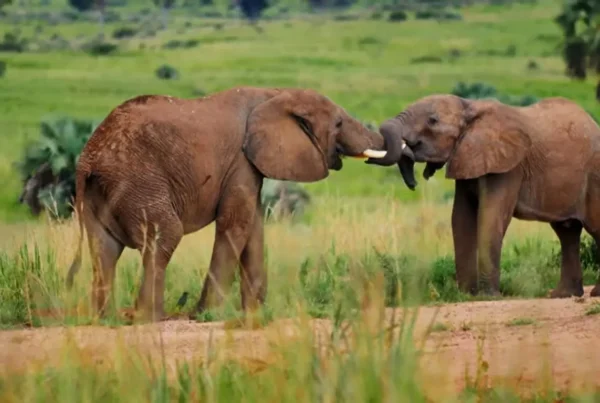
Animals track to water with a reliability that makes animal trails one of the most dependable water-finding tools in dry country. Multiple trails converging from different compass directions indicate a water source at the convergence point. Additionally, elephant paths cut directly to known water through terrain that detours other species. Elephants maintain these routes across generations. Green vegetation in a dry landscape signals underground water accessible to deep-rooted plants. Furthermore, digging at the outer bend of a dry riverbed reaches the water table at 30 to 60 centimetres in many East Africa drainage systems.
Morning dew collection requires no digging at all. Grass leaves collect dew heavily in the cool predawn hours in highland and coastal areas. Wiping an absorbent cloth across grass surfaces and wringing it out collects enough moisture to supplement hydration through a hot morning. San communities in the Kalahari collect dew from morning grass as a standard dry-season water source.
Fire by Friction
The bow drill method produces fire from friction alone. A straight, dry hardwood spindle rotates against a flat softwood hearthboard. This generates a fine carbon dust that accumulates in a notch cut in the board. When the dust reaches ignition temperature, it forms a glowing coal. Transfer this coal into a prepared tinder bundle and blow gently — the tinder ignites within seconds. The entire sequence takes 3 to 8 minutes for an expert and 20 to 40 minutes for a beginner using good dry wood.
Selecting the right wood matters as much as the technique. In East Africa, Maasai and Samburu communities most commonly use commiphora and grewia species for the hearthboard. These species are soft, dry, and low in resin. The spindle uses a slightly harder wood from the same group. Guides who demonstrate fire-making identify these species by leaf shape and bark texture, adding a practical botanical lesson to the survival skill.
Shelter Construction
A simple lean-to shelter suitable for one night requires only a few strong branches and a covering of dense grass. The frame — a ridgepole resting between two forked uprights — supports a layered thatch of long grass bundles applied from the bottom upward in overlapping rows. Twenty centimetres of thatch depth provides reasonable rain resistance for a single event. Wind direction determines shelter orientation — the open front faces away from the prevailing wind. Two people working efficiently complete this construction in 45 minutes to an hour, using no tools or fastening materials beyond the structural integrity of interlocking branches.
Navigation Without Technology
The Southern Cross constellation provides a south bearing from anywhere in East Africa on clear nights. The long axis of the cross extended 4.5 times its own length beyond the foot star points toward true south. Combining this bearing with the known direction of the nearest habitation produces a travel bearing accurate to within 5 to 10 degrees. Additionally, solar noon — when the sun reaches its highest point — provides a reliable midday compass bearing on any clear day. East Africa straddles the equator, making solar bearing a directly usable field tool across the region.
Plan Your Safari
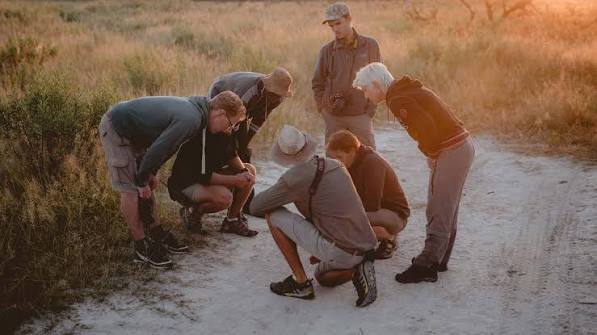
Survival skill sessions operate as optional components of walking safaris at several East Africa camps. Kenya’s Laikipia Plateau camps with Samburu community guides offer excellent fire-making, water-finding, and plant identification demonstrations. Tanzania’s Ruaha walking camps incorporate similar survival content. These sessions add 30 to 60 minutes to a standard walk and require no prior experience beyond the walk itself.
African Wild Trekkers includes walking safari options with survival skill content in East Africa itineraries. Contact us to build a walking-focused safari experience that reveals the full practical knowledge of East Africa’s wilderness environments.