Mpanga Forest Uganda: Fort Portal’s Accessible Birding Reserve
Mpanga Forest Uganda is a Central Forest Reserve covering approximately 453 hectares of tropical rainforest on the outskirts of Fort Portal in western Uganda. The reserve sits just 14 kilometres from Fort Portal town on the main road to Kampala, making it the most easily accessible forest birding destination in the Fort Portal circuit. The National Forestry Authority manages Mpanga Forest Uganda and maintains a well-developed trail system, resident trained guides, and a small visitor centre at the forest entrance. Mpanga Forest Uganda regularly produces 100 to 150 bird species in a morning of guided walking. Birders combining this reserve with Kibale National Park and Bigodi Wetland Sanctuary in a western Uganda circuit record some of the most impressive three-day bird lists available from any East Africa safari base.
Mpanga Forest Uganda’s position between the Kibale National Park forest block and the highland zones of the Rwenzori creates a transitional bird community. This transitional character includes both lowland Congo Basin species and highland Albertine Rift species in the same small reserve. The combination makes Mpanga Forest Uganda unusually species-rich for a reserve of its size. Several species are easier to find at Mpanga than in the larger Kibale National Park, partly because the smaller forest area concentrates the bird community into accessible territories along the trail network. This concentration effect dramatically increases the encounter rate per hour of walking time.
Birding in Mpanga Forest Uganda
Key Bird Species at Mpanga Forest Uganda
Mpanga Forest Uganda is particularly well regarded for its hornbill diversity. Black-and-white casqued hornbill, African grey hornbill, and African pied hornbill all occur in the reserve and guides find them reliably on a morning walk. The black-and-white casqued hornbill is the most spectacular of these species and its loud calls and enormous casqued bill make it conspicuous in the canopy. Blue-throated roller inhabits the forest interior and is one of the most sought-after species at Mpanga. The combination of iridescent blue plumage and its perch-hunting behaviour from exposed branches make it one of the most striking Uganda forest birds available at a non-national-park site.
Great blue turaco moves through the Mpanga Forest Uganda canopy throughout the morning and every guided walk encounters it. Its extraordinary size, vivid green and yellow plumage, and loud calls make it unmistakable in flight above the trail. African emerald cuckoo inhabits the mid-story of the forest interior and calls persistently during the breeding season. Narina trogon is one of Mpanga’s most celebrated species and rewards patient listening and searching in the denser interior sections. The combination of these flagship forest species with dozens of more common birds makes Mpanga Forest Uganda a highly productive birding half-day for any visitor to the Fort Portal area.
Primates at Mpanga Forest Uganda
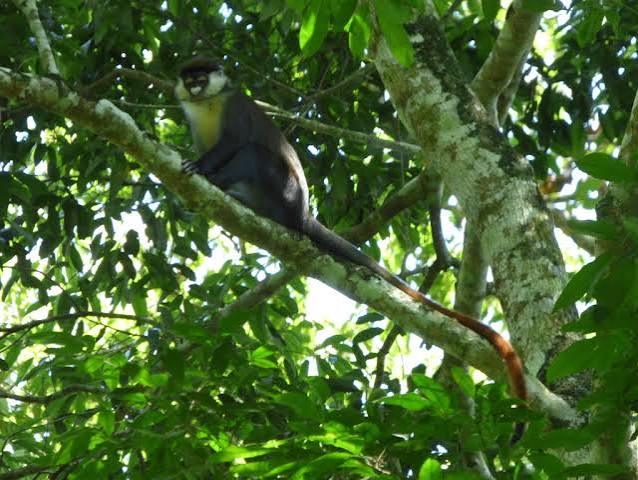
Mpanga Forest Uganda supports resident populations of red-tailed monkey, blue monkey, and olive baboon that appear regularly along the trail network. The monkeys at Mpanga have become reasonably accustomed to visitor presence along the main trails. They provide closer and more relaxed observation than forest primates in less-visited reserves. Black-and-white colobus inhabits the taller forest sections and is heard before it is seen. The loud crashing and calling of a colobus group moving through the canopy above the trail is one of the defining sounds of a Mpanga Forest Uganda morning walk.
Chimpanzees are resident in Mpanga Forest Uganda and their presence shows in regular calling and nest evidence. The forest reserve does not manage structured chimpanzee trekking in the way Kibale National Park does. Chimpanzee encounters at Mpanga are incidental and unpredictable rather than the primary objective of the guided experience. Visitors specifically targeting chimpanzees should visit Kibale National Park for the managed trek. Those who have already done a Kibale chimp track find that incidental Mpanga chimp calling adds an extra dimension to what is primarily a birding reserve experience.
Visiting Mpanga Forest Uganda
Mpanga Forest Uganda Trail System
Mpanga Forest Uganda has three main trail circuits ranging from 45 minutes to three hours in walking time. The shortest circuit covers the forest edge and most productive bird zones near the entrance. The medium trail penetrates deeper into the forest interior where quieter and more sought-after species inhabit territories away from road noise. The longest circuit reaches the heart of the reserve and provides the best chance of encountering the most forest-specialist species. A guide familiar with the current bird territory distribution within the reserve makes each of these circuits significantly more productive than self-guided walking on the same trails.
The Mpanga Forest Uganda visitor centre and guide office opens daily from 07:00. Morning walks starting at dawn are significantly more productive for birds than midday visits when forest activity drops considerably. The guides at Mpanga are resident at the forest and maintain up-to-date knowledge of which species are currently active in which trail sections. Their local expertise consistently produces more quality sightings than self-guided walking on the same trails. Guide fees are affordable and visitors pay them directly at the visitor centre before the walk begins. The entire process of booking and starting a guided walk takes under 15 minutes on arrival.
Mpanga Forest Uganda Practical Details
Mpanga Forest Uganda sits on the Fort Portal to Kampala tarmac road approximately 14 kilometres from Fort Portal town centre. The entrance and parking area are on the roadside and the visitor centre is visible from the main road. No 4WD vehicle is required to reach Mpanga Forest Uganda. The reserve is an excellent option for visitors with a free half-day at Fort Portal who want additional forest bird species before or after their Kibale National Park activity. Most visitors from Fort Portal arrive at Mpanga between 07:00 and 08:30 for the most productive morning birding window.
Combining Mpanga Forest Uganda with a morning Kibale chimpanzee track on the same day is possible if the Kibale track ends by midday and the drive to Mpanga completes before 14:00. An afternoon Mpanga walk following a morning Kibale chimp trek creates a comprehensive birding and primate day from the Fort Portal base. Birders covering both Mpanga Forest Uganda and the Bigodi Wetland Sanctuary in a single western Uganda itinerary can record well over 200 species across the two sites in two days of dedicated birding. This two-site combination is one of East Africa’s most productive and most accessible mid-altitude forest birding programmes.
Plan Your Safari
Mpanga Forest Uganda works as a half-day add-on to any Fort Portal itinerary without requiring dedicated travel planning. Schedule the Mpanga walk for a morning when Kibale or crater lake activities fill the afternoon. Book a guide at the visitor centre on arrival or in advance by contacting the National Forestry Authority Fort Portal office. Bring binoculars, a field guide to East African birds, and insect repellent for the forest trail sections.
African Wild Trekkers includes Mpanga Forest Uganda in Fort Portal itineraries for birding clients who want to maximise forest bird diversity beyond the Kibale National Park and Bigodi Wetland sanctuary programme. We pre-book guides and integrate the Mpanga walk into western Uganda circuits that cover all key birding destinations in the most productive sequence.
Contact African Wild Trekkers to include Mpanga Forest Uganda in your western Uganda birding safari. We respond within 24 hours and design itineraries that cover the full Fort Portal birding circuit from Mpanga Forest to Bigodi and Kibale National Park.