Gorilla Trekking Accessibility Rwanda: How Travelers With Limited Mobility Can See Gorillas
Gorilla trekking accessibility Rwanda has improved significantly as Volcanoes National Park developed porter services and ranger programs specifically designed to support travelers who cannot manage full-intensity forest treks. Every year, travelers in wheelchairs, visitors recovering from surgery, and seniors in their 80s complete gorilla encounters in Rwanda that they thought were beyond their physical reach. The terrain inside Volcanoes National Park varies enormously between gorilla groups, and park management carefully assigns trekkers to families that match their fitness level. African Wild Trekkers coordinates directly with park staff to ensure clients with mobility considerations receive the most appropriate group allocation before departure day.
Understanding the Terrain Variability
Easier Gorilla Groups at Lower Elevation
Several habituated gorilla families in Volcanoes National Park spend the majority of their time at elevations below 2,500 meters, in the lower bamboo forest and agricultural buffer zone, which involves minimal steep climbing and relatively flat approach trails. Park rangers radio the exact location of each gorilla family on the morning of every trek, and families found at lower positions allow guides to plan shorter, gentler approach routes for allocated trekkers. The Amahoro group consistently receives positive feedback from travelers with knee problems because this family’s range includes sections of compacted agricultural track before entering the forest proper. The Sabyinyo group offers another accessible option because their territory starts at the park boundary fence and involves less distance to reach their usual positions. Your African Wild Trekkers guide communicates your mobility situation to the park allocation team ahead of your scheduled trek date so the appropriate family is reserved for your group.
Challenges of Steep Sections
Some gorilla families in Volcanoes National Park hold territories at higher elevations between 2,500 and 3,000 meters, and reaching these groups involves sustained steep climbing on narrow, muddy tracks through dense vegetation. The Susa group, for example, involves one of the longest and most demanding approach treks in the park, and the trail includes sections where trekkers use tree roots as hand-holds to pull themselves uphill. These high-elevation options are generally unsuitable for travelers with limited mobility regardless of porter support, and your guide will not assign a client with knee, hip, or heart conditions to these groups. Rain makes the volcanic soil extremely slippery, and trails that feel manageable in dry conditions become genuinely challenging after overnight rainfall. Understanding this variability before arrival allows you to set realistic expectations and let your operator advocate for the right group allocation on your behalf.
How Altitude Affects Breathlessness
Volcanoes National Park sits at a base elevation of approximately 2,400 meters, and even the flattest gorilla approach involves moving through air noticeably thinner than what lowland travelers experience daily. Travelers arriving directly from sea-level destinations should plan to spend one or two nights in Musanze before their trek date to allow partial acclimatization. The acclimatization effect is modest at these altitudes compared to high-altitude mountaineering, but it meaningfully reduces breathlessness during the approach walk and improves the overall trekking experience. Cardiovascular conditions and COPD require medical clearance before booking a gorilla trek, and your doctor should know the specific elevation you will operate at. African Wild Trekkers recommends that all travelers with respiratory concerns consult their physician and obtain written clearance before confirming a gorilla permit purchase.
Porter and Ranger Support Services
Hiring a Porter for Physical Support
Volcanoes National Park provides trained porters at the trek briefing point who accompany individual trekkers through the forest and offer direct physical support on difficult terrain sections. Porters carry your daypack throughout the trek, freeing your hands for balance, and on particularly steep sections they assist by holding your arm, offering a shoulder to lean on, or steadying you on slippery descents. The porter fee is approximately $15 to $20 USD paid directly at the trailhead, and tipping an additional $10 to $15 for excellent support is standard practice. Porters assigned to mobility-limited travelers are selected for their patience, strength, and ability to communicate effectively rather than simply their trail speed. African Wild Trekkers strongly recommends every client hire a porter regardless of fitness level because the support transforms the experience from stressful to genuinely enjoyable.
The Wheelchair-Assisted Gorilla Encounter Program
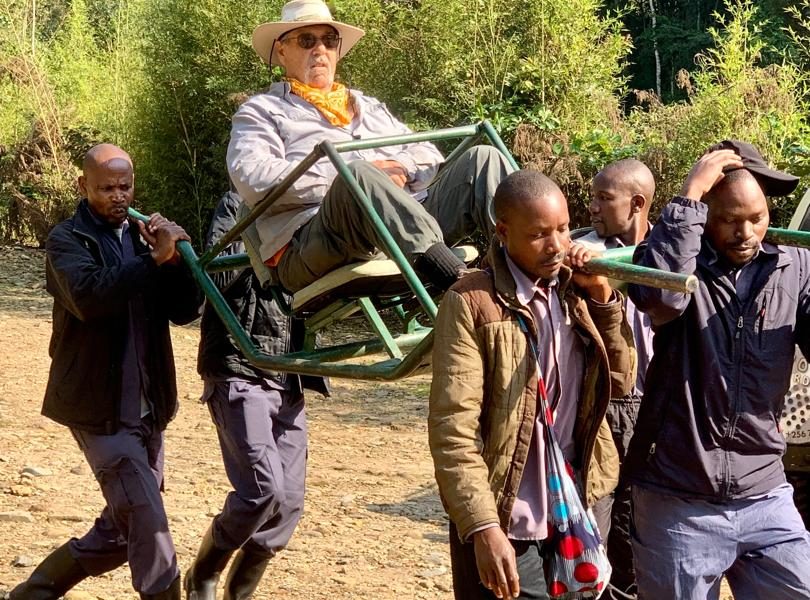
Rwanda Development Board launched a special accessibility program allowing travelers who cannot walk to the gorilla location to be carried in a specially adapted porter chair along accessible routes to observation points within the park. The program operates with a team of four trained porters who carry the chair in rotation and navigate the forest using widened paths cleared specifically for this purpose. This option is available on advance request through licensed tour operators including African Wild Trekkers, and the park limits the number of chair-assisted encounters per day to maintain quality and safety. The program extends the extraordinary gorilla experience to wheelchair users, post-surgical patients, and elderly travelers whose mobility would otherwise exclude them entirely. Travelers who use this program consistently report emotional experiences equal to or greater than those described by able-bodied trekkers, because the effort involved makes the encounter feel even more earned.
Stretcher and Emergency Evacuation Capability
Every gorilla trek group in Volcanoes National Park carries emergency stretcher capability through trained rangers, and the park maintains protocols for extracting a trekker who becomes incapacitated during the forest walk. This safety infrastructure means that mobility-limited travelers can enter the forest knowing that a medical emergency does not leave them stranded far from assistance. Rangers communicate via radio throughout the trek and coordinate with the park boundary medical station if an extraction becomes necessary. This capability does not mean the park encourages trekkers with serious conditions to push beyond their limits, but it does mean that unforeseen incidents have established response procedures. Understanding this safety net helps travelers with mobility concerns approach the trek with appropriate confidence rather than avoidance.
Preparing for Your Accessible Gorilla Trek
Fitness Preparation in the Months Before Departure
Travelers who know they will face mobility challenges should begin a gentle strengthening program at least eight weeks before departure, focusing on quadriceps, glutes, and ankle stability muscles that do the most work on uneven forest terrain. Walking uphill on grass or light trail surfaces for 30 to 45 minutes three times per week builds the specific endurance the gorilla approach demands without requiring gym equipment. Trekking poles provide enormous stability benefit on the gorilla trail, and carrying your poles during training walks acclimatizes your arms to the unaccustomed upper-body movement. A physiotherapist familiar with hill walking can assess your gait pattern and identify any compensations that might cause problems on the volcanic soil. Investment in preparation transforms the gorilla trek from a source of anxiety into a physical challenge you arrive confident to meet.
Gear Choices for Limited Mobility Trekkers
Trekking boots with ankle support and deep rubber lug soles grip the volcanic soil dramatically better than trail runners or light hiking shoes, and this single gear choice reduces slip incidents and fall risk substantially on wet terrain. Trekking pole selection matters for mobility-limited trekkers — choose poles with a wrist strap, a cushioned grip, and a robust locking mechanism that does not slip under load. Long sleeves and long trousers protect against the stinging nettles that line many approach trails and scratching against thorns, which are particular hazards for trekkers moving slowly and leaning into vegetation for balance. Knee sleeves or light knee braces reduce the cumulative strain of descent sections on any trekker with existing knee weakness. Pack light — your porter carries your bag — and focus every gram of pack weight on the essential items: water, rain jacket, and camera.
Communicating Your Needs to Your Operator
The most important accessibility step is communicating your specific mobility situation honestly and in detail to African Wild Trekkers at the time of booking rather than hoping the situation resolves itself by departure. Tell your operator which joints or conditions affect your movement, how far you normally walk comfortably, whether you use walking aids, and any medical conditions that the ranger team should know about. This information reaches the park allocation team and shapes the gorilla group assignment, porter briefing, and guide selection for your trek. Operators who know your needs in advance can advocate for you in ways that same-day disclosure at the trailhead cannot achieve. Rwanda’s gorilla trekking program is designed to include as many travelers as possible, and honest communication is the tool that makes inclusion work in practice.
Plan Your Safari
Book Your Accessible Gorilla Trek
African Wild Trekkers arranges accessible gorilla treks in Rwanda with porter support, appropriate group allocation, and full ranger briefings tailored to your mobility situation. Contact us at africanwildtrekkers.com/contact to discuss your needs.
What Your Package Covers
Your accessible gorilla trek package includes your $1,500 permit, private 4×4 transfer, porter coordination, an experienced guide, and accommodation chosen for accessibility near the park entrance. We handle every logistics detail.
Request Your Accessible Rwanda Quote
Share your mobility situation and travel dates and we will design a Rwanda itinerary that works for your specific needs. We respond within 24 hours at africanwildtrekkers.com/contact.