Lewa Wildlife Conservancy Kenya: UNESCO Heritage Site and Rhino Conservation Leader
Lewa Wildlife Conservancy Kenya covers 250 square kilometers on the northern Laikipia Plateau and holds UNESCO World Heritage status as part of the Mount Kenya World Heritage Site — a designation that reflects both the conservancy’s conservation achievement and the landscape integrity it maintains at the transition between Mount Kenya’s montane forest and the semi-arid Laikipia plateau. Lewa protects 15 percent of Kenya’s total black rhino population and a significant Grevy’s zebra population in a privately managed sanctuary that pioneered the community conservancy model now replicated across the Laikipia region, sharing tourism revenue with 12,000 people living in the conservancy’s adjacent community zones. The range of safari activities available at Lewa — horse riding, camel safaris, night drives, walking safaris, and helicopter game viewing in addition to standard vehicle drives — makes it one of Kenya’s most versatile luxury safari destinations for travelers who want wildlife variety alongside exceptional accommodation. African Wild Trekkers includes Lewa in Kenya safari circuits as both a rhino conservation destination and a luxury experience that consistently produces the most highly rated client feedback of any Kenya property in our portfolio.
Wildlife at Lewa
Black Rhino and Grevy’s Zebra
Lewa’s black rhino population represents one of Kenya’s most significant conservation achievements — the conservancy began protecting rhinos in the 1980s when Kenya’s national population had collapsed to approximately 300 animals, and the founding Craig family’s decision to convert cattle ranching land into a rhino sanctuary against considerable economic sacrifice created the template for the private conservancy conservation model that now protects species across the continent. The current black rhino population exceeds 70 individuals, making Lewa one of Africa’s most productive black rhino breeding facilities, and several individuals have been translocated from Lewa to establish rhino populations in new sanctuaries elsewhere in Kenya including the Meru Conservation Area and community conservancies in the Tsavo ecosystem. Each rhino translocation from Lewa represents a direct conservation multiplier that extends the conservancy’s impact beyond its own boundaries, and guides at Lewa can describe the destination of specific animals they have watched from birth that now protect the genetic diversity of Kenya’s wider rhino recovery program.
Grevy’s zebra finds Lewa’s open grassland and acacia scrubland ideal habitat, and the conservancy holds one of the largest Grevy’s zebra populations in Kenya — a significant statement given how restricted the species’ global range has become. The Grevy’s Zebra Trust’s monitoring program is active at Lewa, and the trust’s vaccination campaigns against diseases that cause significant mortality in the population operate from Lewa as a base, giving guests the occasional opportunity to observe conservation field work in action during extended conservancy stays. Seeing Grevy’s zebra at Lewa carries an added dimension compared to Samburu sightings because the conservancy’s community ranger network means every Grevy’s individual is known to the monitoring program, and your guide can explain specific animals’ life histories and the conservation interventions that have protected them through droughts, disease outbreaks, and human-wildlife conflict incidents over their individual lifetimes.
Alternative Safari Modes at Lewa
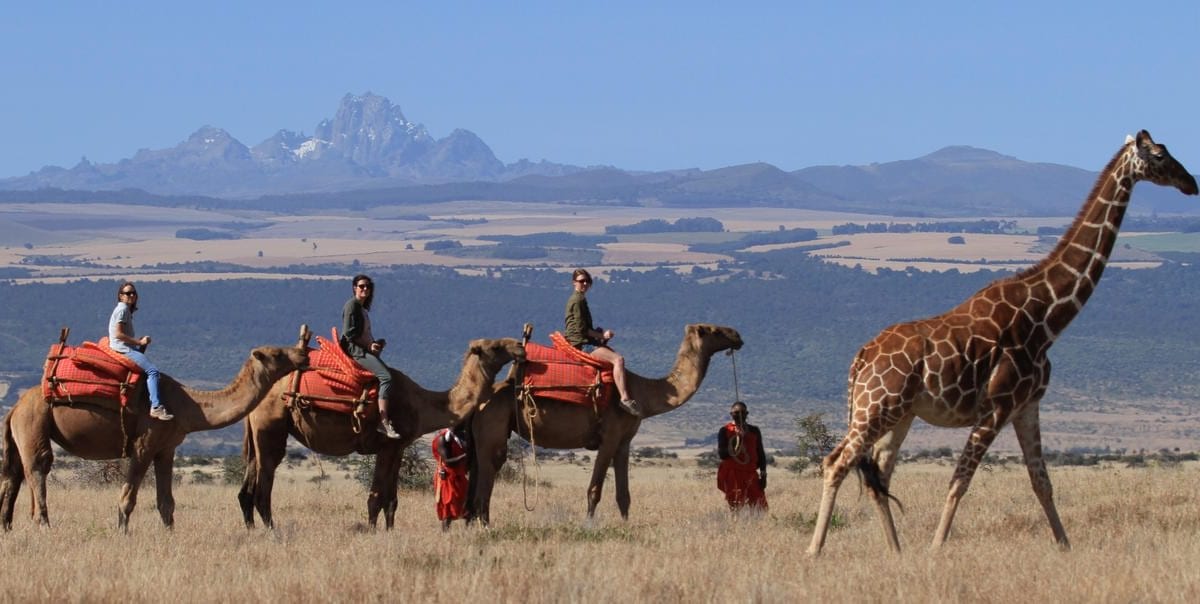
Horse riding safaris at Lewa create a wildlife encounter dynamic fundamentally different from vehicle-based game drives because many species — particularly plains zebra, wildebeest, and giraffe — react to horses as non-threatening herd animals rather than as predator-associated vehicles and allow approach distances impossible in a motor vehicle. Riding toward a giraffe that maintains its feeding posture as you approach on horseback provides a physical proximity that even the best vehicle-based sighting cannot replicate, and the sensory experience of wind, smell, and terrain texture that riding delivers through the same grassland that a game drive vehicle traverses creates a completely different quality of bush immersion. Lewa’s riding program operates across all skill levels from beginners led on a lead rein through gentle terrain to experienced riders who join guides on extended bush canters through the conservancy’s open grassland circuits. The camel safari option suits non-riders who want a non-motorized approach — camels move quietly through the scrubland at a pace that allows sustained animal observation rather than the episodic stop-and-look structure of vehicle drives.
Night drives at Lewa reveal a nocturnal community as diverse as the daytime wildlife list but almost entirely invisible to standard game drive visitors who leave the conservancy before dark. Aardvark — Africa’s most unusual-looking mammal — forages on termite mounds throughout the conservancy at night with a frequency that makes Lewa one of the continent’s most reliable aardvark locations. Porcupine, genet, civet, spring hare, and bush baby appear on most night drives, and the occasional serval cat or caracal sighting from the night drive vehicle produces the highlight of many clients’ Lewa visits despite being secondary to the rhino and predator focus of daytime game drives. The night drive also provides opportunities to observe lion and leopard in the behavioral state of active hunting preparation — patrolling territory boundaries, scent-marking, and vocalizing — that the bright light of day never delivers in the same uninhibited form.
Lewa’s Community Model
How Conservation Revenue Reaches Communities
Lewa Wildlife Conservancy directs a meaningful percentage of its commercial tourism revenue to the 12 community partnerships that collectively involve over 12,000 people in six locations around the conservancy’s boundaries. The programs funded through this revenue share include the Lewa Community Schools initiative that supports over 10,000 students through primary and secondary education in an area where school facilities historically lagged the national average, the Lewa Primary Health Care programme that has reduced child mortality rates in the surrounding communities through mobile health clinics and maternal health services, and the conservancy’s bursary fund that covers secondary and university education costs for students from conservancy community families who demonstrate academic merit. These programs create economic incentives for community members to support wildlife conservation rather than view the conservancy as a competitor for land that could otherwise produce agricultural income, and the longevity of the model — now operating for over three decades — demonstrates that the incentive alignment is durable rather than temporary.
The community ranger program employs people from surrounding communities as wildlife monitors, anti-poaching patrol members, and education ambassadors who serve as bridges between the conservancy’s wildlife management objectives and the local knowledge base that makes monitoring effective across a landscape too large for centrally stationed staff to cover alone. Community rangers who grew up adjacent to the conservancy bring intimate knowledge of landscape features, water sources, and wildlife movement patterns that outside staff take years to accumulate, and their standing within their communities allows them to gather intelligence on potential poaching activity through informal social networks that formal anti-poaching operations cannot access. Visiting Lewa generates the tourism revenue that makes this employment model economically viable, and understanding the community program during your visit adds a dimension of conservation meaning to every game drive hour that goes beyond personal wildlife experience.
Plan Your Safari
Lewa Wildlife Conservancy accommodation operates at very limited capacity across three primary properties — Lewa Safari Camp, Lewa Wilderness, and Sirikoi — and peak dates from July through October and over the December holiday period book out six to nine months in advance. African Wild Trekkers confirms availability immediately on enquiry and pairs Lewa with Samburu or Ol Pejeta to create complete northern Kenya circuits where the rhino focus of both conservancies reinforces each other while the different landscape characters provide visual variety across the days.
Your Lewa package includes conservancy fees, all activities — vehicle drives, horse riding, camel safari, night drives, walking — full-board accommodation, and light aircraft transfers from Wilson Airport Nairobi to Lewa’s private airstrip. Every activity is included in the all-inclusive rate, so there are no per-activity costs on arrival beyond tipping your guides.
Contact African Wild Trekkers at africanwildtrekkers.com/contact with your Kenya travel dates and we will design a complete northern Kenya itinerary around your Lewa visit within 24 hours.