Lemosho Route Kilimanjaro: The Best Overall Route to the Summit
Why the Lemosho Route Is Kilimanjaro’s Best Choice for Most Climbers
Most guides, altitude specialists, and returning climbers agree that the Lemosho Route is the finest overall Kilimanjaro climbing route. The reasons are consistent: the route delivers the highest summit success rate of the standard seven-day options and the most scenic terrain on the mountain. It begins in remote rainforest on the western approaches and traverses the full breadth of Kilimanjaro’s southern slopes before the final summit push. Climbers who want the best chance of reaching Uhuru Peak in the most rewarding conditions choose Lemosho in almost every case.
The Lemosho Route: Day-by-Day Itinerary
The standard Lemosho Route runs over seven or eight days. The eight-day version adds an acclimatisation day at the Lava Tower area that meaningfully improves summit success rates. The day-by-day progression covers five distinct ecosystem zones. Rainforest, moorland, alpine desert. And the arctic summit. Each of which looks and feels entirely different from the last.
Days 1 Through 3: Forest and Moorland
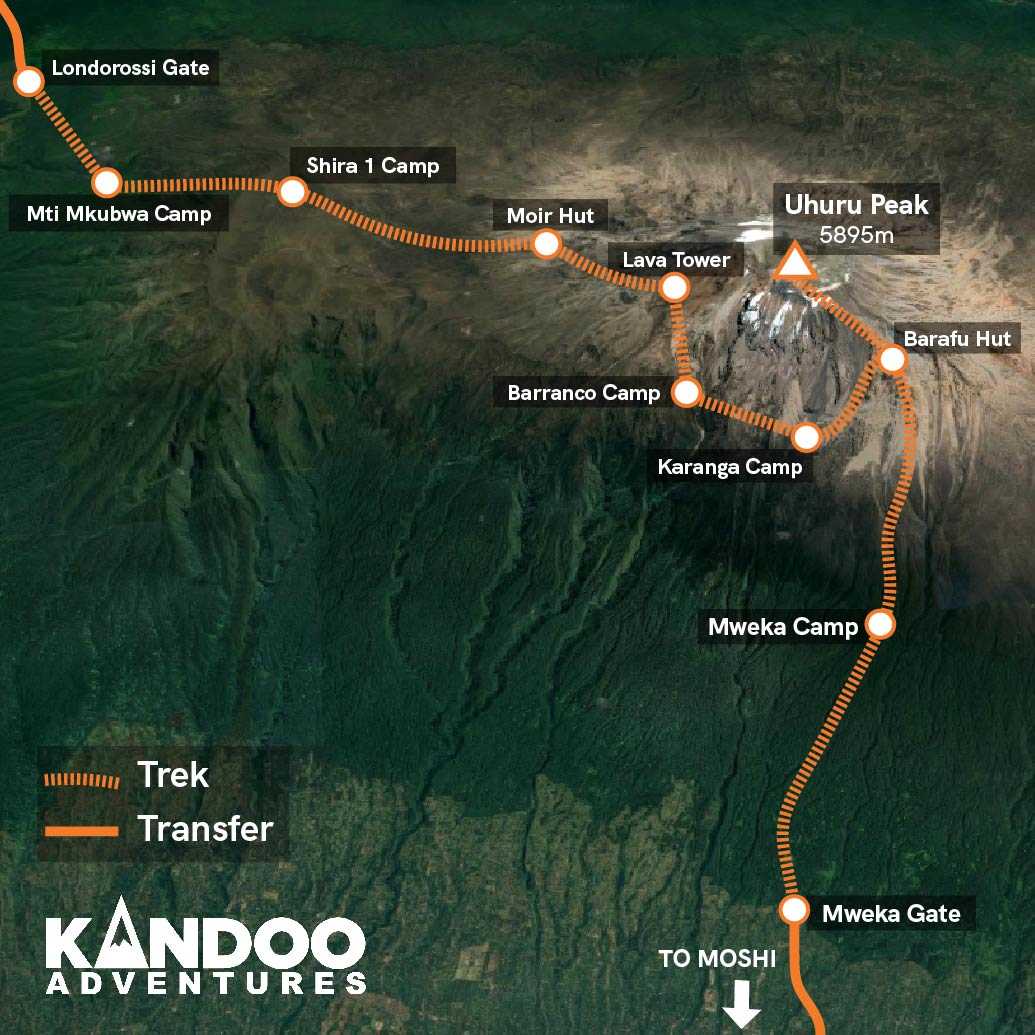
The Lemosho Route begins at Londorossi Gate on the western side of Kilimanjaro. This gate is accessed by a longer approach road than the more popular southeastern routes. Which immediately separates Lemosho from the crowded Machame and Marangu routes. The western gate sees far fewer climbers. The first days on the mountain deliver genuine solitude in pristine rainforest. The initial camp at Big Tree Camp sits in magnificent mountain forest at around 2,780 metres, with ancient podocarpus trees draped in lichen and colobus monkeys moving through the canopy overhead.
Day two exits the forest into the open moorland of the Shira Plateau, one of Kilimanjaro’s most visually striking zones. The plateau is a vast, gently rolling expanse studded with giant groundsels and lobelias. The alien-looking plant species adapted to high-altitude African conditions. Kilimanjaro’s summit cone becomes visible across the plateau for the first time. And the scale of what lies ahead becomes suddenly real. The camp at Shira 2 at 3,900 metres provides the first real altitude test of the climb. Clear nights here offer extraordinary star-gazing above the cloudline.
Days 4 Through 6: The High Alpine Zone
The Lemosho Route’s middle section traverses the mountain’s southern face via the Lava Tower. A dramatic volcanic rock formation at 4,600 metres. Before descending to the Barranco Wall. This high-low acclimatisation pattern is the route’s most important structural feature. Ascending high during the day and descending to sleep lower at night capitalises on the mountaineering principle of “climb high, sleep low.” This pattern primarily explains Lemosho’s superior summit success rates compared to shorter or more direct routes.
The Barranco Wall on day five is one of Kilimanjaro’s most memorable climbing sections. The Wall is a near-vertical 300-metre scramble up volcanic rock that most climbers find far more manageable than it looks from base camp. It requires using hands and feet and provides one of the mountain’s genuine physical challenges. The view from the top looking back across the Shira Plateau and forward to the summit cone is among the finest on the entire mountain. Climbers consistently rate Karanga camp below the Wall at 4,200 metres as one of the most atmospheric camp locations on any route.
Summit Night and Descent
Summit night on the Lemosho Route departs Barafu Camp at 4,600 metres around midnight, following the same final push as the Machame and Umbwe routes. The ascent to Stella Point on the crater rim takes five to seven hours depending on individual pace and conditions. The final section from Stella Point to Uhuru Peak at 5,895 metres crosses the crater rim in thin air at extreme altitude. The last 200 metres of elevation gain feel significantly harder than the preceding hours despite the gentler gradient. Most climbers reach Uhuru at dawn to find Africa spread below the cloud line in every direction. The glaciers of Kilimanjaro’s ice field glow in the morning light.
Descent from Uhuru to Barafu Camp takes two to three hours. After that, climbers descend further to Mweka Camp for the final night before the exit to Mweka Gate. The descent through the rainforest on the final day passes through the same botanical zones traversed on ascent in reverse. The transition from alpine desert back to lush montane forest over a single day creates a satisfying sense of completion. Mweka Gate staff award a summit certificate based on the highest elevation point you reached during the climb.
Success Rates and Physical Requirements
The Lemosho Route’s seven-day version achieves summit success rates of approximately 85 to 90 percent in normal conditions. The eight-day version with the additional acclimatisation day pushes this above 90 percent. These rates are significantly higher than the six-day Machame Route’s 80 to 85 percent and the five-day Marangu Route’s 65 to 70 percent. The longer acclimatisation time in Lemosho’s itinerary structure explains this difference. No route guarantees success — individual altitude response is unpredictable — but Lemosho gives the best statistical probability of reaching Uhuru Peak of the standard southern approach routes.
Kilimanjaro requires aerobic fitness and mental endurance more than technical climbing skill. The Lemosho Route involves no glacier travel, no roping up, and no technical equipment beyond trekking poles. A climber who can walk five to eight hours per day for seven consecutive days at sea level. And who has exercised regularly in the months before the climb. Has the physical foundation required for Lemosho. High-altitude experience is helpful but not essential. The mountain’s gradual acclimatisation profile makes Lemosho accessible to climbers who have never been above 3,000 metres before.
Plan Your Safari
Confirm Lemosho Route bookings at least three to four months before your preferred summit date, particularly for peak season dates in July through October and January through February. The western gate approach means that Lemosho itineraries start and end on a slightly different schedule from southeastern routes. When you build an itinerary that combines the climb with Tanzania safari add-ons, account for this scheduling difference.
African Wild Trekkers operates Lemosho Route climbs with experienced KINAPA-certified guides, high porter welfare standards, quality camping equipment, and excellent mountain food. Seven-day and eight-day itineraries are available. The eight-day version is consistently the better choice for first-time high-altitude climbers. You can combine Kilimanjaro climbs with Northern Tanzania safari extensions covering the Serengeti and Ngorongoro Crater and beach stays on Zanzibar.
Contact African Wild Trekkers at africanwildtrekkers.com/contact with your preferred Kilimanjaro dates and we will confirm availability and provide a complete itinerary and cost breakdown within 24 hours.