African Wild Dog Facts: The Most Successful Predator in Africa
Africa’s Most Endangered Predator
The African wild dog — also called the painted wolf, painted dog, or Cape hunting dog — is simultaneously the most successful hunter in Africa and the continent’s most endangered large carnivore. Wild dogs achieve an average hunting success rate of 60 to 90 percent depending on the study and the habitat. They kill prey far more reliably than lions (25 to 30 percent), leopards (20 to 30 percent), or cheetahs (40 to 50 percent). Yet fewer than 6,600 wild dogs remain in Africa. They are distributed across fragmented subpopulations in 14 countries, and the IUCN classifies the species as Endangered. The combination of extraordinary ecological achievement and critical conservation vulnerability makes the African wild dog one of the most compelling animals on the continent for safari travelers who seek them out.
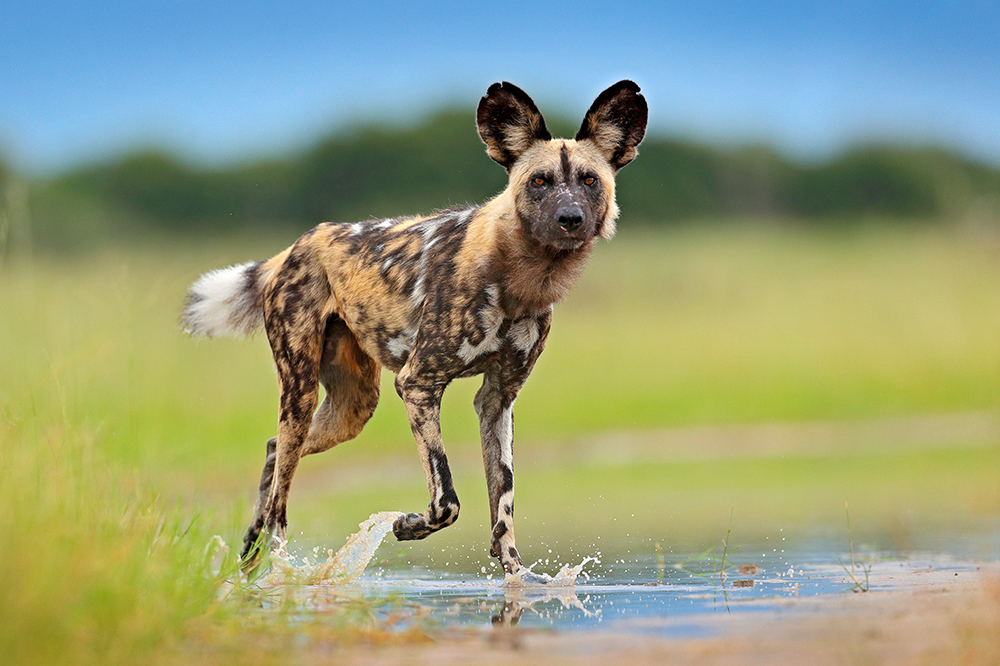
Wild dogs are unmistakable in appearance: large rounded ears and long legs. And a coat of irregular blotches in yellow, black, and brown. And that is unique to each individual. No two wild dogs have the same pattern. Which allows researchers and experienced guides to identify specific animals by sight alone. The painted coat, which gives the species its painted wolf name, is one of the most striking visual signatures of any African predator. A running pack of wild dogs. Strung out across the savanna at full pursuit speed, each animal’s coat a blur of color. Is one of the most distinctive wildlife images Africa produces.
Pack Behavior and Hunting
Social Structure and Cooperative Hunting
Pack Life and the Alpha Pair
African wild dogs live in packs ranging from 2 to 40 individuals. Most wild packs average 6 to 12 adults and subadults plus any current litter of pups. Unlike wolves, where multiple individuals may breed, wild dog reproduction centers on a single dominant pair. The alpha male and alpha female. Who are the only pack members that normally reproduce? Subordinate adults contribute to pup care through food provision, regurgitating meat for pups unable to travel with the pack on hunts. They also guard the den site and actively carry pups to safety when threats approach. This cooperative breeding system, in which non-breeding adults forgo reproduction to assist in raising another pair’s offspring, produces pup survival rates significantly higher than solitary predators achieve.
Wild dog society is characterized by remarkable levels of cooperation and what observers consistently describe as affectionate behavior between pack members. Pre-hunt greeting ceremonies appear to function as motivation and coordination mechanisms before the pack moves off to hunt. In these ceremonies, pack members mob each other, vocalize with high-pitched calls, and engage in physical contact. Injured or sick pack members receive food from healthy individuals. Old dogs that can no longer hunt effectively receive provisions from younger pack members for months. The social bonds within a wild dog pack are among the strongest of any African predator. Spending time with a wild dog pack on a long safari is frequently cited by experienced travelers as one of the most emotionally engaging wildlife experiences available on the continent.
The Hunt: Endurance Over Ambush
Wild dogs hunt by endurance rather than ambush. Unlike lions and leopards, which rely on concealment and explosive close-range acceleration, wild dogs pursue prey at sustained speeds of 50 to 60 kilometers per hour over distances of up to five kilometers. They run prey into exhaustion before delivering the kill. This pursuit strategy requires teamwork: lead dogs alternate positions to distribute the physiological cost of the sprint. The pack’s long-legged, deep-chested anatomy adapts specifically for aerobic efficiency rather than the muscular power that ambush predators favor. The prey’s options against this strategy are limited. Impala can outrun a wild dog in a short sprint but cannot maintain the escape pace for the duration of a full pack pursuit.
The kill itself is swift and cooperative. Once the lead dog closes on an exhausted prey animal, the pack disembowels it rapidly. This hunting method looks brutal to human observers but produces death within seconds in most cases. Faster than the prolonged suffocation that lions and leopards employ. The speed of the kill is one of the reasons wild dog hunting success rates are so high: the prey has no recovery time between the first contact and death. Following the kill, pack members feed with relatively little conflict. Food sharing among wild dogs is more egalitarian than among lions or hyenas. And pups receive priority in the feeding order rather than having to wait as they would in a lion pride.
Wild Dog Conservation Crisis
Threats and Protected Populations
Why Wild Dogs Are So Vulnerable
The African wild dog’s vulnerability to extinction stems from a combination of factors that make population recovery exceptionally difficult. Wide-ranging habitat requirements mean that packs travel up to 50 kilometers per day and require vast territories of 200 to 2,000 square kilometers. Wild dogs regularly move outside the boundaries of even large protected areas into surrounding farmland and human-settled areas. There, snares, roadkill, and direct persecution kill them. Disease transmission from domestic dogs in surrounding communities. Particularly canine distemper and rabies. Has devastated wild dog populations in several parts of their range. A single disease outbreak can wipe out an entire pack within days. Pack-level extinction events from disease are particularly damaging because each pack represents years of accumulated social knowledge and established territory.
Competitive exclusion by lions presents another significant constraint on wild dog population recovery. Where lions occur at high densities, wild dog packs frequently lose kills to lions and hyenas. Lion predation on wild dog pups at den sites also causes documented pup mortality in several populations. Wild dogs in areas of high lion density spend more time traveling to find kills that other predators have not already claimed. This increases their energy expenditure and reduces the pup feeding efficiency that drives pack growth. The most productive wild dog populations in Africa tend to occur in areas with moderate rather than very high lion density. A spatial dynamic that limits where wild dog conservation programs can succeed.
Best Wild Dog Viewing Destinations
The best places to see African wild dogs are the parks and reserves with the largest and most stable populations. There, packs have established territories that resident guides know well. Zimbabwe’s Hwange National Park and Mana Pools National Park hold some of the continent’s best wild dog populations. They stand as the primary destinations for travelers whose specific safari objective is a wild dog encounter. Zambia’s South Luangwa is another exceptional destination, with several habituated packs that guides track regularly. These packs produce reliable sightings during the dry season. Tanzania’s Selous Game Reserve — now partly Nyerere National Park — holds one of Africa’s largest wild dog populations and anchors the species in East Africa.
South Africa’s Kruger National Park has a small but growing wild dog population following decades of absence. The private reserves adjacent to Kruger. Sabi Sand, Timbavati, and Klaserie occasionally host packs that move through on wide-ranging patrols. Botswana’s Moremi Game Reserve and the Linyanti and Kwando concessions in northern Botswana produce good wild dog sightings during the denning season, when packs remain relatively stationary for weeks. The Endangered Wildlife Trust’s Wild Dog project in South Africa manages a metapopulation across fenced reserves. Several of these reserves—Madikwe, Hluhluwe-iMfolozi, and Pilanesberg—offer reliable wild dog sightings that larger unfenced ecosystems cannot guarantee.
Plan Your Safari
Wild dog sightings require staying in the right camps at the right time of year with guides who track specific pack movements daily. Denning season—roughly April through August depending on latitude—offers the most reliable sightings because packs remain in a fixed area for weeks rather than ranging across hundreds of kilometers. Zimbabwe and Zambia deliver the continent’s most consistent wild dog encounters.
African Wild Trekkers selects wild dog camps specifically for pack habituation quality and guide tracking expertise, building itineraries around denning season windows in Hwange and Mana Pools. And South Luangwa that maximize time with this remarkable predator.
Contact African Wild Trekkers at africanwildtrekkers.com/contact with your travel dates, and we will design a wild dog safari itinerary built around the best seasonal viewing windows within 24 hours.