Black Rhino vs White Rhino: The Complete Difference Guide
Two Rhino Species, Two Entirely Different Animals
The names are misleading, the appearance is confusing, and the differences matter far more than most safari travelers realize before their first rhino sighting. Black rhinoceros and white rhinoceros are not black and white. Both species are essentially the same shade of grey-brown. The colour difference between them is minimal and entirely dependent on the local soil conditions where they have been wallowing. The naming confusion traces to a mistranslation from Afrikaans. “Weit” meaning “wide”. Referring to the white rhino’s broad, square upper lip. Became “white” in English. “Black” was assigned to the other species by contrast rather than by any actual colour difference. Understanding the real distinctions between these two species. In size, behavior, diet, habitat use. And conservation status — transforms every rhino encounter. It shifts the sighting from a generic tick on the Big Five checklist into a genuinely specific and meaningful observation.
Both African rhino species are now seriously threatened. The combined population of both black and white rhinos in Africa represents a small fraction of the numbers that existed before the industrial-scale poaching of the twentieth and twenty-first centuries. The story of rhino conservation in Africa is simultaneously one of the continent’s greatest conservation failures and one of its most remarkable successes. The near-extinction of species that numbered in the hundreds of thousands within living memory is the failure. The recovery of white rhino populations from fewer than 50 individuals in the 1890s to over 18,000 today. Through intensive protection and breeding programs — is the success.
The Physical Differences
White Rhino: The Grazer
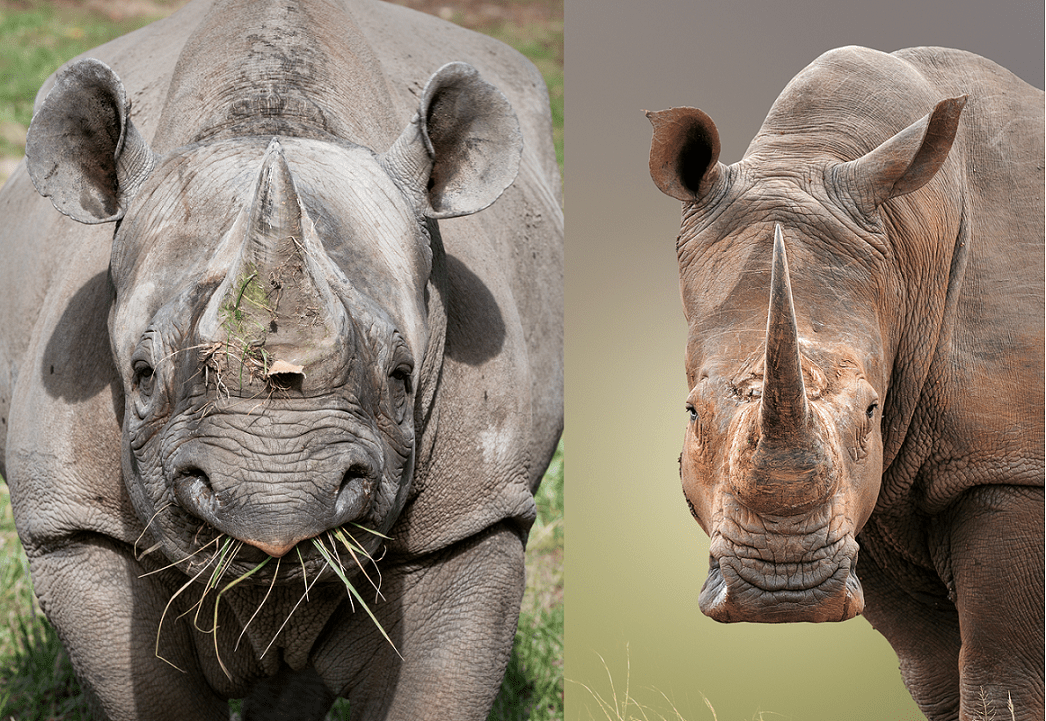
The white rhinoceros is the larger of the two species and the second-largest land animal in Africa after the elephant. Adult males weigh 2,000 to 2,300 kilograms and stand over 1.8 metres at the shoulder. The defining characteristic of the white rhino is its wide, square upper lip. This is an adaptation to grazing short grass that functions like a lawnmower. It crops vegetation flat as the animal’s enormous head swings from side to side across the pasture. This head is held low during feeding, almost parallel to the ground. This gives white rhinos a distinctive posture that makes them identifiable at distance even without a clear view of the lips. White rhinos have a pronounced hump on the back of the neck. Larger in males than females. And a generally heavier, more massive body outline than the black rhino.
White rhinos are grazers of open grassland. They prefer short-grass sward of the type found in South African highveld and Zululand. They are largely non-aggressive when unthreatened. They live in loose groupings of females with young and tolerate the presence of other rhinos at close range. This level of sociality distinguishes them sharply from the solitary and aggressive black rhino. Crash groupings of up to 14 white rhinos have appeared at good grazing areas. Females with calves form the most stable social units within populations. White rhinos prefer to rest in shade during the heat of the day. They are most active in the morning and evening, making dawn and dusk game drives the most productive timing for observing their natural grazing behavior.
Black Rhino: The Browser
The black rhinoceros is smaller and significantly more agile than the white rhino. Males typically weigh 800 to 1,400 kilograms — roughly half the mass of a large white rhino bull. The black rhino’s most diagnostic feature is its hooked, prehensile upper lip. It curls around branches and leaves and pulls them toward the mouth. This is an adaptation for browsing woody vegetation rather than grazing grass. This lip shape is visible at close range and is the single most reliable field identification character between the two species. The black rhino also carries its head higher than the white rhino, reflecting its browsing rather than grazing lifestyle. It has a more angular, lighter body outline with a less pronounced neck hump.
Black rhinos are solitary and territorial. Adult males and females maintain ranges through scent marking and dung middens. Females with calves form the most stable units but do not aggregate beyond the mother-calf pair. Black rhinos are notoriously temperamental. They have poor eyesight but acute hearing and smell. They will charge threats with little warning and considerable speed, reaching 55 kilometres per hour despite their bulk. This aggressive disposition, combined with their use of dense woody vegetation as habitat, makes black rhinos considerably more challenging to observe on foot than white rhinos. Walking encounters with black rhinos are among the highest-risk wildlife encounters in Africa. The reward, when a black rhino emerges from thicket and stands regarding your vehicle at close range, is a sighting that many experienced safari travelers describe as the most charged and memorable of their Big Five encounters.
Conservation Status and Population Numbers
White Rhino: A Conservation Success Story
The southern white rhinoceros is one of conservation history’s most remarkable recoveries. By the 1890s, intensive hunting had reduced the global population to fewer than 50 animals in a single reserve. That reserve is now part of Hluhluwe-iMfolozi Park in KwaZulu-Natal, South Africa. Strict legal protection, intensive management, and the establishment of iMfolozi Game Reserve allowed the population to recover. By 2012 the southern white rhino population had grown to over 20,000 individuals. This recovery enabled large-scale translocation programs that re-established white rhinos across their former African range. The IUCN now classifies the white rhino as Near Threatened rather than Endangered. A status that no one would have predicted possible from the population bottleneck of the 1890s.
The poaching crisis of the 2000s and 2010s significantly set back white rhino recovery. South Africa lost over 8,000 rhinos to poaching between 2008 and 2022. This was driven by demand for rhino horn in traditional medicine markets in Vietnam and China. Annual losses peaked at 1,215 animals in 2014. They have since declined following intensive anti-poaching operations, demand reduction campaigns, legal horn sales debates. And the dehorning of rhinos in high-risk areas. The northern white rhinoceros subspecies is effectively extinct. Only two females remain in Kenya’s Ol Pejeta Conservancy, where they live under 24-hour armed guard.
Black Rhino: Critically Endangered
The IUCN classifies the black rhinoceros as Critically Endangered. The current global population is approximately 6,000 individuals — down from an estimated 65,000 in the 1970s. This catastrophic decline was driven primarily by poaching during the 1970s and 1980s. It represents one of the most severe population crashes of any large mammal in the twentieth century. The population has recovered modestly from the historical low of fewer than 2,500 animals in 1995. Dedicated conservation programs in Kenya, Zimbabwe, South Africa, and Namibia have produced sustainable growth rates in several protected populations. Namibia holds the largest free-ranging black rhino population. These animals are adapted to the semi-arid conditions of the country’s dry northwest. They browse in communal conservancies managed by local communities.
Kenya’s Ol Pejeta Conservancy holds the largest population of black rhinos in East Africa. It is a fenced and intensively managed 360-square-kilometre reserve. Ol Pejeta’s rhinos receive daily ranger tracking. The population has grown consistently since the conservancy’s establishment. Visitor revenue from rhino tracking experiences, combined with the conservancy’s educational programs for international visitors, makes Ol Pejeta one of the most financially sustainable models for black rhino conservation in Africa. Visiting Ol Pejeta — and paying the rhino conservation levy that forms part of the entry fee — is a direct act of support for a population that represents a significant proportion of the global black rhino total.
Best Places to See Both Species
White rhinos are most reliably seen in South Africa. Hluhluwe-iMfolozi Park in KwaZulu-Natal is the reserve where the species was saved from extinction. It maintains the healthiest wild population. Kruger National Park’s south section holds white rhinos in good numbers. Private reserves adjacent to Kruger — Sabi Sand, Timbavati, Thornybush — have reintroduced white rhinos alongside their existing predator populations. Kenya’s Ol Pejeta, Lewa Wildlife Conservancy, and Ol Jogi Ranch together hold the largest concentrations of black rhinos in East Africa and offer dedicated tracking experiences. Zimbabwe’s Hwange National Park and Save Valley Conservancy have growing black rhino populations. Etosha National Park in Namibia offers the unusual experience of watching black rhinos come to artificial waterholes at night. The park’s famous floodlit waterholes are visible from hides where the animals drink and interact in complete safety under powerful spotlights.
Seeing both black and white rhinos on a single safari trip is achievable within a well-designed South Africa or Kenya itinerary. It requires choosing reserves that have genuine populations of both species rather than relying on chance encounters in mixed-species parks. The best rhino viewing combines dedicated conservation reserves with expert guides who know resident individuals.
Plan Your Safari
Seeing both black and white rhinos requires choosing reserves with genuine populations of both species and guides who know individual animals. The best rhino viewing combines dedicated conservation reserves. Ol Pejeta in Kenya, Hluhluwe-iMfolozi in South Africa — with expert tracking access. This reliably delivers close encounters rather than chance sightings.
African Wild Trekkers designs rhino-focused safari itineraries across South Africa, Kenya, Namibia, and Zimbabwe. We select reserves with proven rhino tracking access and incorporate conservation levy contributions that directly support the protection programs keeping these animals alive.
Contact African Wild Trekkers at africanwildtrekkers.com/contact with your travel dates and rhino viewing goals. We will design an itinerary that delivers close encounters with both African rhino species within 24 hours.