Canopy Walkway Africa: Walking Above the Forest in East Africa
A suspended canopy walkway places the visitor at the level of the forest’s most active biological zone. The canopy between 10 and 30 metres above the ground carries the majority of the forest’s bird species and most of its primate activity. From ground level, this zone is visible only as movement glimpsed through leaves far above.
From a suspended walkway, it becomes fully accessible. Birds feed at eye level. Colobus monkeys move through branches within arm’s reach. The structure of the forest becomes visible as a three-dimensional architecture rather than a flat green wall.
Moreover, the canopy walkway delivers a perspective on the forest that no ground-level walk or vehicle approach can replicate. It is one of East Africa’s most distinctive wildlife viewing formats.
Uganda’s Kibale Forest Canopy Walkway
Kibale National Park’s canopy walkway runs through the forest near the Kanyanchu visitor centre. The walkway stretches across several spans between large forest trees. It sits at 15 to 20 metres above the forest floor.
The walkway sways gently as visitors move across it. This movement is expected and part of the experience. It does not indicate any structural instability.
From the walkway’s highest sections, the forest canopy extends in an unbroken green surface to the horizon. Hornbills fly past at eye level. Grey-cheeked mangabeys move through the outer branches of the canopy trees adjacent to the walkway platform. Furthermore, the early morning hours produce the most active bird movement through the canopy. Arriving at the walkway by 07:00 maximises species diversity during the morning feeding period.
Tanzania’s Usambara and Mahale Canopy Access
Tanzania’s Eastern Usambara Mountains carry elevated viewing platforms and partial walkway structures in the Amani Nature Reserve. These sit at lower height than Uganda’s walkway but provide an equally valuable elevated perspective. The forest here holds extraordinary biological richness.
The Mahale Mountains on the eastern shore of Lake Tanganyika carry no formal walkway. However, guide-led elevated ridge walks above the forest canopy produce a similar above-canopy perspective. The Mahale chimp tracking routes cross ridges at 1,500 metres where the forest canopy lies below the walking trail.
Additionally, Rwanda’s Nyungwe Forest carries one of East Africa’s most developed suspended walkway systems. The Nyungwe walkway is longer and higher than Kibale’s and runs through primary forest with outstanding primate diversity.
Birds and Primates at Canopy Level
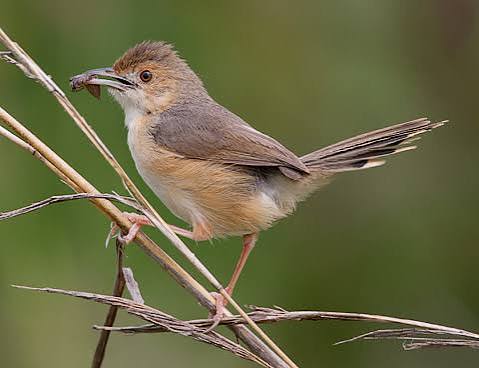
The canopy walkway experience transforms bird watching at East Africa’s forest sites. Species that remain invisible from ground level reveal themselves at canopy height. African green broadbills feed in the outer canopy within 5 metres of the walkway platform at Kibale.
Great blue turacos move through the highest canopy branches at Nyungwe in full view rather than as fleeting silhouettes against the sky. Red-tailed monkeys use the walkway’s support trees as part of their normal daily foraging route. They move past the walkway platform at close range without alarm.
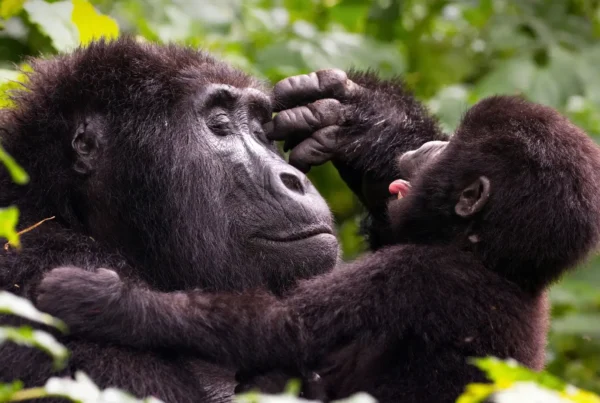
Colobus groups rest in the large canopy trees adjacent to the walkway during the middle of the day. Watching a colobus group rest, groom, and call from 3 metres on a suspended walkway platform produces one of East Africa’s most intimate primate encounters outside of a gorilla trekking session.
Plan Your Safari
Uganda’s Kibale canopy walkway visit is bookable as an add-on to the standard chimpanzee trekking permit at Kanyanchu. It takes 30 to 60 minutes and operates in the morning hours. Rwanda’s Nyungwe walkway requires a separate permit available at the park entrance.
The walkway visit at Nyungwe pairs naturally with the habituated colobus group tracking activity. Allow a full morning for the combined walkway and colobus session. A minimum camp stay of two nights at either destination provides enough time for both activities without rushing.
African Wild Trekkers includes canopy walkway experiences in Uganda and Rwanda itineraries. Contact us to plan a safari that takes you above the forest and into the heart of East Africa’s most biologically diverse wildlife zone.