Giraffe Facts: Why the World’s Tallest Animal Is Also Under Threat
The World’s Tallest Animal
The giraffe is the tallest living terrestrial animal on Earth and one of Africa’s most recognizable wildlife icons. Adult male giraffes stand up to 5.8 meters. Nearly 19 feet. And their silhouette against the African savanna sky is as distinctive as any animal on the continent. Despite this visibility and recognizability, most travelers on safari know remarkably little about giraffe biology. Many are surprised to learn that the giraffe is undergoing what conservationists have called a “silent extinction.” Giraffe numbers have declined by 40 percent in the past 30 years, falling from approximately 155,000 individuals in 1985 to around 117,000 today. This is a steeper proportional decline than the elephant’s over the same period, though it draws far less international attention and conservation funding.
The giraffe’s evolutionary story is one of extraordinary specialization for a single niche: feeding from the canopy of tall acacia and thorntree woodland. Every aspect of giraffe anatomy reflects optimization for a feeding strategy that gives giraffes exclusive access to food sources that no other savanna browser can reach. This includes the elongated neck, the long prehensile tongue, and the height of the eyes. And the specialized cardiovascular system is required to pump blood to a brain six feet above the heart. Understanding the giraffe through this evolutionary lens transforms encounters from “tall animal eating a tree” into something far more interesting: a walking solution to the problem of competitive exclusion from lower browse levels. And a case study in how dramatic morphological specialization can produce both remarkable advantages and significant vulnerabilities.
Giraffe Biology and Adaptations
The Neck, the Heart, and the Tongue
Cardiovascular Challenges of Being Tall
A giraffe’s heart must generate sufficient blood pressure to push blood 2.5 meters up the neck to the brain. This physiological challenge has produced a heart weighing approximately 12 kilograms. Three times the size of a human heart. And blood pressure is roughly double that of humans. A complex network of small blood vessels at the base of the skull called the rete mirabile dampens the pressure wave as blood flows downward when the giraffe lowers its head to drink. This prevents brain hemorrhage from the sudden shift in blood pressure. When the giraffe raises its head again quickly, specialized valves in the jugular vein prevent blood from flowing backward and potentially causing the animal to faint. The engineering required to maintain consciousness through the transition from drinking to upright posture is extraordinary by any standard.
The giraffe’s 45-centimeter tongue is another remarkable adaptation. Dark bluish-black in color—a pigmentation that may protect the tongue from UV radiation during the long hours it remains exposed while the animal feeds—and prehensile in function, the tongue can wrap around acacia branches and strip leaves between thorns with precision. And manipulate food in ways that other ungulates cannot replicate. The tongue’s length gives giraffes access to the top surfaces of thorntree canopies that shorter browsers cannot reach. The combination of height and tongue reach means that a large male giraffe browses in a zone of the African woodland entirely unavailable to any other herbivore. This feeding niche exclusivity is one of the primary reasons giraffes can coexist with the enormous density of competing herbivores in East and Southern Africa’s savannas without competing directly for the same food resources.
Giraffe Subspecies and Coat Patterns
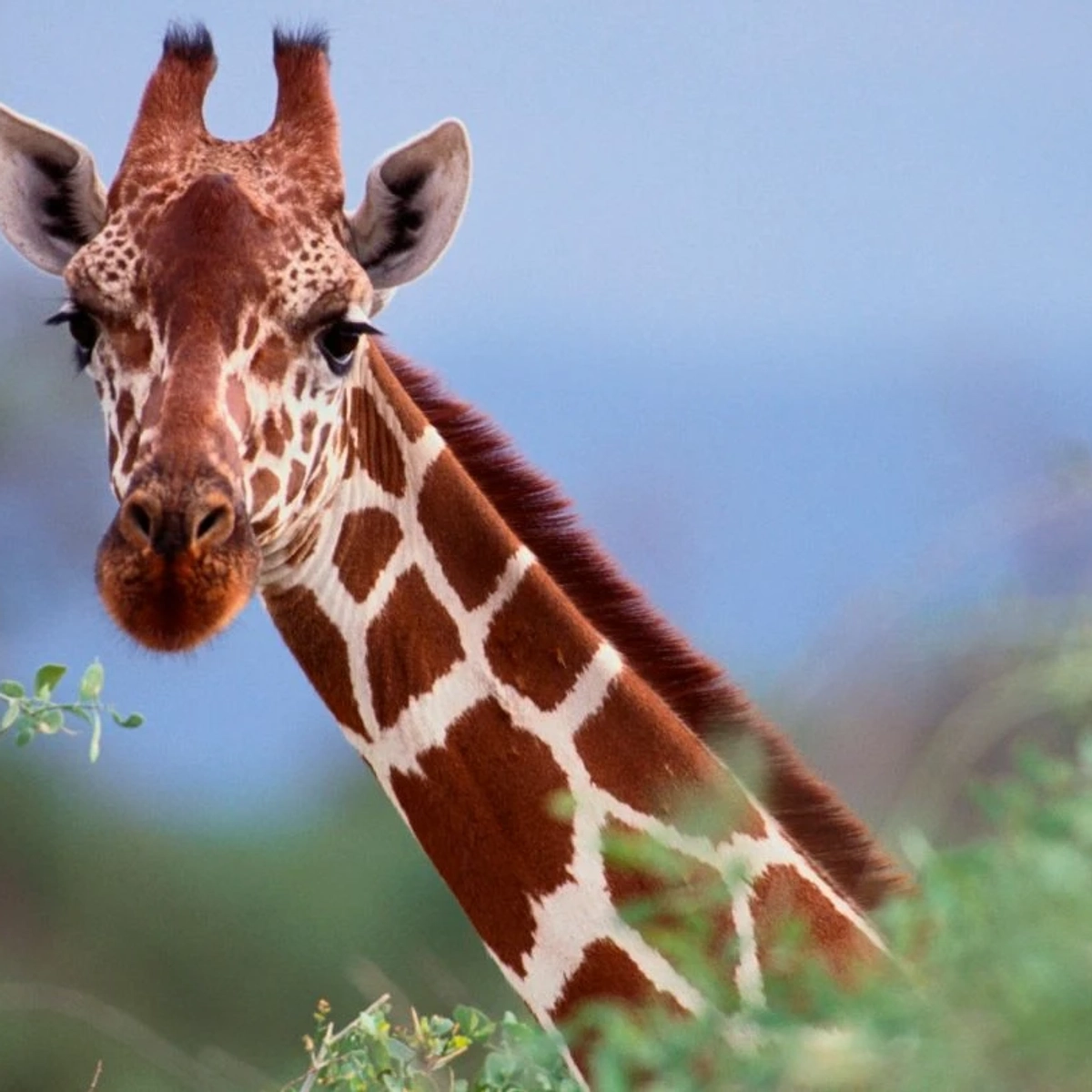
Genetic analysis reclassified what was once a single giraffe species into four species and several subspecies. This revision has significant conservation implications because it means some previously lumped populations are actually distinct species with very small numbers. The Masai giraffe, found in Kenya and Tanzania, is the most commonly seen subspecies on East African safaris. It features irregular, jagged-edged patches on a cream background. The reticulated giraffe of northern Kenya has bold, large, regular polygonal patches separated by narrow white lines. The most photogenic and photographed of the giraffe subspecies. The Rothschild giraffe, one of the rarest, has a pattern that stops at the knee, leaving its lower legs entirely white. And lives in small numbers in Kenya and Uganda. The southern giraffe, comprising the South African and Angolan subspecies, is the subspecies seen on Southern African safaris.
The coat pattern of each giraffe is unique to the individual — no two giraffes have identical patch arrangements. This allows researchers working with long-term populations to identify individuals by sight and build detailed records of social relationships and life histories. Giraffe coat patterns are not random: they correlate with body temperature regulation, with darker patches acting as thermal radiators that help dissipate heat. The pattern intensifies during the first year of life in some subspecies, suggesting developmental processes that researchers continue to study. The skin under the patches contains the highest density of sebaceous glands in the giraffe’s coat, secreting an oily substance with antimicrobial and possibly insect-repellent properties.
Giraffe Social Behavior and Conservation
Society and the Silent Extinction
Giraffe Social Structure
Giraffes were historically described as having a loose, non-bonded social structure. Individuals associating and disassociating freely without the stable long-term bonds that characterize elephant or wild dog society. Recent research using long-term data from tagged populations has overturned this picture considerably. Female giraffes form stable, long-term social bonds with specific other females that persist across years. Grandmother females play a documented role in the survival of calves born to their daughters. The long-lived knowledge that older female giraffes carry. About seasonal food sources and water locations. And predator risks. Contributes to calf survival in ways that parallel the matriarch function in elephant herds. The mechanism is less well understood, and the bonds are less visible than in elephants.
Male giraffe behavior centers on competition for mating access expressed through “necking.” Combat in which two males swing their necks and use their heads as clubs to strike each other’s flanks and neck. These contests can be genuinely violent: a powerful neck swing from a large bull can knock a rival off its feet. The bony protuberances on a giraffe’s head—ossicones—can cause lacerations and bruising. Despite the apparent violence, necking rarely produces serious injury. The combat more commonly functions as a testing process that allows males to assess each other’s strength and condition without the risk of a more damaging physical fight. Safari travelers who encounter two large bull giraffes necking. An event most common in the dry season when competition for females is most intense. You are watching one of the African savanna’s most unusual and spectacular behavioral events.
Threats and Conservation Needs
Habitat loss, poaching for meat and hide, and human-wildlife conflict at the expanding agricultural frontier across East and West Africa drive the giraffe’s population decline. Unlike rhinos and elephants, whose declines draw international attention and conservation funding, giraffes have disappeared quietly from large portions of their historical range with minimal organized response. The reclassification of giraffes into multiple distinct species. Some with populations below 5,000 individuals. Has only recently begun to shift the conservation community’s attention toward a group of animals that most people still assume to be widespread and abundant. The West African giraffe, found only in a small area of Niger, numbers approximately 600 individuals and is as critically endangered as the mountain gorilla without attracting comparable conservation resources.
Conservation programs in Kenya, Tanzania, Uganda, and Southern Africa address giraffe population declines through habitat protection, anti-poaching patrols, translocation of individuals to establish new populations in areas where giraffes have been locally extirpated, and community education programs that reduce the bushmeat hunting that drives decline in many parts of the range. The Giraffe Conservation Foundation maintains population databases for all giraffe subspecies and coordinates international conservation responses. But funding remains a fraction of what equivalent-status large mammals receive. For safari travelers who find themselves drawn to these animals. And many do, particularly when they observe the unexpected complexity of giraffe social and parental behavior. Supporting giraffe-specific conservation organizations is one of the most effective wildlife conservation contributions available.
Best Places to See Giraffes
Kenya offers the most diverse giraffe viewing on the continent. Nairobi National Park, a 30-minute drive from the city center, hosts Masai giraffes visible against the Nairobi skyline. One of the most unusual wildlife juxtapositions anywhere in the world. The Nairobi Giraffe Centre, run by the African Fund for Endangered Wildlife, allows visitors to hand-feed Rothschild giraffes at close range and contributes directly to Rothschild giraffe conservation and captive breeding. The Masai Mara and Amboseli both have large Masai giraffe populations that are reliably visible throughout the year. Samburu National Reserve in northern Kenya supports reticulated giraffes in numbers that make it the premier destination for this subspecies.
Tanzania’s Serengeti and Ngorongoro areas support abundant Masai giraffe populations across both the open plains and the acacia woodland that giraffes prefer. South Africa’s Kruger and Pilanesberg both have substantial southern giraffe populations. And Uganda’s Murchison Falls National Park hosts Rothschild giraffes. One of the few places in the world where this subspecies can be seen on a standard game drive. Botswana, Namibia, and Zimbabwe all have healthy southern giraffe populations across their main safari parks. Giraffes are reliably visible on virtually every game drive throughout Southern Africa. Despite the conservation concerns surrounding giraffe populations at a continental level, safari travelers across Africa’s main circuits continue to see giraffes consistently, making them one of the most reliably encountered animals on any African safari.
Plan Your Safari
Giraffe sightings are consistent across most of Africa’s main safari destinations. But the different subspecies require different destinations. Reticulated giraffes in northern Kenya, Rothschilds in Uganda and Kenya’s Giraffe Centre, Masai in Kenya and Tanzania, and southern giraffes in Southern Africa. An itinerary designed around subspecies diversity requires specialist input on routes and timing.
African Wild Trekkers designs itineraries across East and Southern Africa that deliver multiple giraffe subspecies alongside the full range of Big Five and primate encounters, building routes that maximize species diversity without creating itineraries that prioritize ticking boxes over genuine wilderness immersion.
Contact African Wild Trekkers at africanwildtrekkers.com/contact with your travel dates, and we will design a safari itinerary that includes exceptional giraffe encounters alongside Africa’s full wildlife spectacle within 24 hours.