Cheetah Facts Africa: Speed, Hunting Strategy & Why They’re Declining
The Fastest Land Animal on Earth
The cheetah is the fastest land animal on the planet, capable of accelerating from 0 to 100 kilometers per hour in approximately three seconds and sustaining top speeds of up to 120 kilometers per hour over short distances. These numbers are remarkable, but they tell only part of the story. The cheetah’s speed is the product of an entire suite of anatomical specializations: a semi-retractable claw system that provides grip like running spikes, a highly flexible spine that functions as a spring to extend stride length, and enlarged nasal passages for rapid oxygen intake. And a high-set tail used as a rudder for sharp directional changes at full speed. These adaptations come with physiological costs that shape the cheetah’s ecology as significantly as the speed itself. A full-speed chase lasts 20 to 60 seconds. After that, the cheetah must rest for 15 to 30 minutes to lower its body temperature before it can feed. This creates a vulnerability window during which lions, leopards, and hyenas frequently steal kills from cheetahs that are physically unable to defend them.
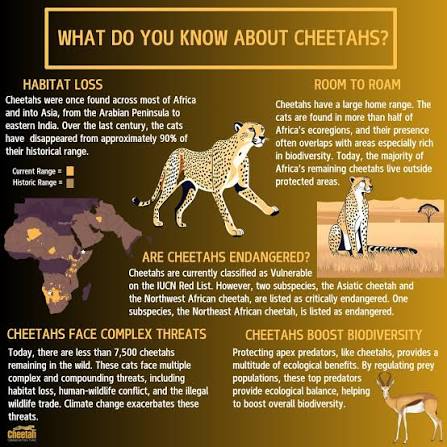
The IUCN classifies the cheetah as Vulnerable, with an estimated 7,100 individuals remaining across sub-Saharan Africa and a small population in Iran. The last surviving Asiatic cheetahs, numbering perhaps 40 individuals. The African population has declined from approximately 100,000 individuals a century ago. And the rate of decline shows no sign of reversing. Understanding why cheetahs are declining and what makes their conservation so difficult. And where the best opportunities remain to see them on safari is the context that makes any cheetah encounter on the African savanna feel like the privilege it genuinely is.
Cheetah Hunting and Biology
How Cheetahs Hunt
The Hunting Sequence
Cheetahs hunt almost exclusively by sight, searching for prey from elevated vantage points. Termite mounds, fallen trees, and rocky outcrops. That allows them to survey open grassland for vulnerable targets. Thomson’s gazelle is the preferred prey in East Africa, a species of similar size and overlapping habitat that cheetahs have co-evolved with for millions of years. The hunting sequence begins with a slow stalk that closes the distance to within 50 to 100 meters, followed by a sprint that accelerates through several gear changes as the cheetah adjusts direction to match the prey’s evasive turns. A key adaptation at high speed is the ability to change direction almost instantaneously. The cheetah’s tail acts as a counterweight and rudder that allows cornering at speeds that would throw most animals into a tumble.
The kill follows a trip-and-suffocate sequence: the cheetah reaches the prey with a swipe of its dew claw to trip or destabilize it, then secures a suffocating throat hold while the animal is on the ground. Unlike lions and leopards, which are powerful enough to maintain a grip on struggling prey much larger than themselves, cheetahs are limited in the prey size they can safely kill. A full-grown adult wildebeest or buffalo is far beyond what a cheetah can safely overpower. The preference for gazelle-sized prey reflects not only the hunting biology but also the metabolic reality: cheetahs need to make multiple smaller kills per week rather than the larger, less frequent kills that more powerful predators can exploit.
Kleptoparasitism: Life Under Threat
The same speed that makes cheetahs exceptional hunters leaves them exceptionally vulnerable to kleptoparasitism. The theft of their kills by other predators. Lions take cheetah kills with casual regularity in any habitat where the two species coexist. Spotted hyenas, particularly in groups, drive cheetahs from carcasses almost as reliably. Even large raptors like the tawny eagle can displace a cheetah from a fresh kill before the animal has recovered enough from its sprint to resist. Studies in the Serengeti found that cheetahs lost between 10 and 15 percent of their kills to other predators within the first minutes after making them. In areas with high predator density, the percentage is considerably higher. The energetic and nutritional cost of this kleptoparasitism. Having to hunt again immediately after a physiologically demanding sprint. It is one of the factors limiting cheetah reproductive success in high predator density areas.
Cheetah mothers with cubs face the most severe version of this challenge. A female with three or four cubs must hunt far more frequently than a solitary animal to feed them all. While simultaneously monitoring for lions and leopards. And hyenas that would kill the cubs if they located the family. Cheetah cub mortality is among the highest of any large African felid. Studies suggest that 70 to 90 percent of cheetah cubs die before reaching independence, primarily due to lion and leopard predation on cubs while the mother is hunting. In areas with very high lion densities, cheetah reproduction is so compromised that populations effectively require immigration from lower-density areas to remain stable. This dynamic partly explains why the best cheetah populations in Africa tend to coincide with open grassland habitats where lions are at moderate rather than very high density.
Cheetah Conservation Crisis
Genetic Bottleneck and Human Conflict
The Genetic Bottleneck
Cheetahs went through a severe population bottleneck approximately 10,000 to 12,000 years ago. A period in which the global population may have fallen to just a few hundred individuals, possibly as few as 7. The genetic consequences of this bottleneck persist to the present day. Modern cheetahs are genetically nearly identical to each other, with genetic diversity so low that skin grafts between unrelated individuals are accepted without rejection. This is an outcome that would normally require genetic near-identity between donor and recipient. This low genetic diversity does not appear to affect the cheetah’s immediate survival or reproductive capacity. But it may reduce the species’ ability to adapt to environmental change and potentially increase the population’s vulnerability to novel pathogens or parasites to which the entire species has similar susceptibility.
The conservation implications of low genetic diversity are debated among researchers. But the practical reality is that cheetah populations outside of large protected areas face severe and compounding pressures that genetic vulnerability does not help. Cheetahs range over territories of 500 to 1,500 square kilometers and regularly cross from protected areas into farming and ranching land where livestock predation leads to killing. The capture of wild cheetahs for the illegal pet trade. Particularly for Gulf State buyers, with cubs smuggled out of East and West Africa. Removes animals from wild populations. Smuggled animals face mortality rates that make surviving the journey to a buyer the exception rather than the rule. Disease transmission from domestic dogs at the wild-farmland interface compounds the predation conflict. And range restriction pressures that cheetah populations face continent-wide.
Best Places to See Cheetahs
The Masai Mara in Kenya and the Serengeti in Tanzania deliver the most reliable and highest-quality cheetah sightings in Africa. The short grass plains of both ecosystems provide ideal cheetah habitat. Open enough that the cats can spot prey from termite mounds and hunt across unobstructed ground, with sufficient Thomson’s gazelle populations to sustain resident families year-round. Guides in the Mara are familiar with specific female cheetahs and their current cub numbers. And radio communication between camps means that an active hunt or a mother with cubs is rapidly communicated to all vehicles in the area. The experience of following a cheetah family across the Mara plains during a morning hunt. At speeds and distances from the vehicle that no other safari ecosystem routinely achieves. Consistently ranks among the most exciting wildlife encounters available anywhere in Africa.
Namibia offers a different and compelling cheetah experience. The country holds the world’s largest free-ranging cheetah population. Approximately 3,500 animals, representing roughly half the global total. Largely because Namibia’s commercial farmland provides habitat that cheetahs use alongside their range on protected conservancy land. The AfriCat Foundation at Okonjima Reserve rehabilitates cheetahs from conflict situations and maintains a population that can be tracked and observed on foot. The Namibian cheetah is an animal of the thornbush rather than the open savanna. Tracking one through the dry Namibian landscape. On foot, with an expert guide reading fresh tracks. It is one of the most immersive predator experiences available anywhere in Southern Africa.
Plan Your Safari
Cheetah sightings are most reliable in open grassland ecosystems with high gazelle populations and experienced guides who know resident family territories. The Masai Mara and Serengeti deliver the best cheetah viewing in East Africa. Namibia’s conservancies offer outstanding cheetah encounters in a completely different landscape and context.
African Wild Trekkers designs itineraries focused on cheetah-viewing quality, working with camps whose guides have the tracking skills and resident animal knowledge to turn a possible sighting into a consistent, extended encounter with Africa’s fastest predator.
Contact African Wild Trekkers at africanwildtrekkers.com/contact with your travel dates, and we will design a safari itinerary built around the best cheetah viewing windows and destinations within 24 hours.