Nile Crocodile Facts: The Oldest & Deadliest Reptile in Africa
Africa’s Prehistoric Predator
The Nile crocodile is the largest freshwater reptile in Africa and the second largest in the world, exceeded only by the saltwater crocodile of Asia and Australia. Adults reach 5 to 6 meters in length and weigh up to 750 kilograms, making them the most formidable aquatic predator in Africa by a considerable margin. Their evolutionary lineage traces back over 200 million years. Crocodilians survived the mass extinction that killed the non-avian dinosaurs and outlasted ice ages and continental drift. And arrived in the twenty-first century physiologically and behaviorally almost identical to the form their ancestors took in the Cretaceous. What visitors see when they watch a crocodile slide off a sandbank into the Grumeti River or the Mara is not merely a large reptile. It is a creature whose basic body plan has been refined by 200 million years of selection pressure into something so effective that evolution saw no need to change it.
Nile crocodiles kill approximately 200 to 300 humans per year across Africa. Significantly more than any other crocodilian species and more than almost any other predator except the mosquito. Most fatalities occur when people washing, swimming, or collecting water at river edges are taken by animals that have been invisible in the water. This confirms the crocodile’s fundamental hunting strategy: concealment, patience, and explosive speed at the point of contact. For safari travelers in boats and on riverbanks, the risk is minimal when they maintain appropriate distance and awareness. But the Nile crocodile is not a reptile to approach casually at any African water source.
Crocodile Biology and Behavior
Physiology and Hunting
Physical Adaptations for Predation
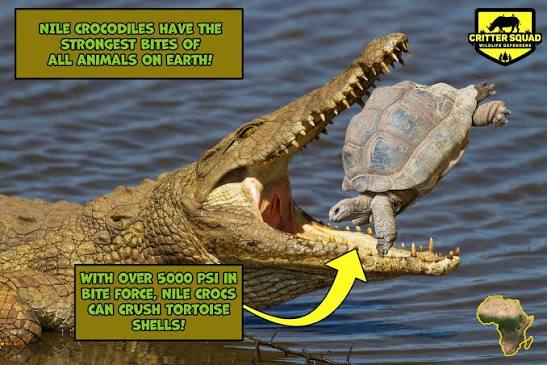
The Nile crocodile’s anatomy is a masterpiece of predatory efficiency refined over geological time. The eyes, ears, and nostrils sit on top of the skull. Allowing the animal to monitor the surface while almost entirely submerged. A configuration nearly identical to the hippo’s, though the two are entirely unrelated. The skin is armored with bony scutes called osteoderms that resist penetration from most weapons and protect the animal in territorial disputes with rivals. The jaws generate the highest bite force of any living animal. Over 22,000 newtons, compared to approximately 2,000 for a lion. The interlocking teeth design grips rather than cuts, holding prey in a vice-like grip from which escape is nearly impossible once a crocodile commits to an attack.
The death roll — the rapid axial rotation that Nile crocodiles use to tear chunks from large prey or drown struggling victims — is one of the most efficient killing mechanisms in the animal kingdom. A crocodile that has secured a grip on a wildebeest leg during a river crossing will spin continuously, using the weight of its body and the resistance of the water to exert rotational torque on the prey animal’s limb. This force far exceeds the strength of the leg’s musculature and connective tissue. Large prey drowns first. Then multiple crocodiles consume it piece by piece over several days, with coordinated death rolls around a single carcass dividing it into manageable sections.
Thermoregulation and Activity Patterns
Crocodiles are ectotherms—they regulate body temperature through behavioral thermoregulation rather than metabolic heat generation. This is why crocodiles bask on sandbanks throughout the hottest hours of the day: they are not resting after feeding but actively managing core temperature to maintain the physiological efficiency required for digestion, immune function, and activity. An optimally warm crocodile digests food, heals wounds, and responds to stimuli faster than a cold one. The behavioral investment in basking is the price of this efficiency. In cooler conditions—particularly at high altitudes or during dry-season cold nights in Southern Africa—crocodile activity drops significantly and feeding becomes infrequent until temperatures rise again.
The efficiency of the crocodilian metabolism is extraordinary. A large crocodile can survive on a small fraction of the caloric intake required by a mammal of equivalent mass. And individuals have survived without food for months or even years in periods of drought. This metabolic flexibility allows crocodiles to inhabit variable, often seasonal environments where prey availability fluctuates dramatically across the year. When the wildebeest migration brings hundreds of thousands of animals to the Mara River, the resident crocodile population feeds intensively. When the migration moves on, the same crocodiles enter a period of lower activity. They live off fat reserves and wait for the next opportunity with the patience that makes them such effective ambush predators.
Crocodile Reproduction and Parental Care
One of the most counterintuitive facts about Nile crocodiles is that they are attentive parents. Female crocodiles lay 25 to 80 eggs in nests excavated from riverbanks or deposited under vegetation. They guard the nest continuously for the three-month incubation period. Fasting throughout, exposing themselves to high temperatures and dehydration. And aggressively defending the nest site against predators, including monitor lizards, baboons, and other crocodiles. When the eggs hatch, the mother excavates the nest in response to the hatching calls of the young. She gently carries them to the water in her mouth. The same mouth capable of generating 22,000 newtons of bite force is now used with the delicacy required to transport a 30-centimeter hatchling without injury.
Both parents guard the young crocodiles in shallow water for the first weeks or months after hatching. The young remain together in crèche groups that the mother continues to protect for an extended period. Hatchling mortality is still extremely high. Monitor lizards, herons, fish. And other crocodiles take a significant proportion of each clutch in the first year of life. But the parental investment that both adults provide gives Nile crocodile hatchlings better survival odds than most reptile species. Which provides no parental care whatsoever after laying eggs. This parental behavior, completely unexpected in a reptile with a reputation built entirely on its predatory efficiency, is one of the most interesting and underreported aspects of Nile crocodile natural history.
Best Places to See Nile Crocodiles
The most spectacular Nile crocodile viewing in Africa is at the Mara River crossing points in Kenya’s Masai Mara during the Great Migration from July through October. Resident crocodile populations of 30 to 50 large individuals per crossing point wait for the wildebeest herds to enter the water. The resulting predation events—crocodiles surging from the river to seize calves and adults mid-crossing—are among the most dramatic wildlife spectacles anywhere on the planet. The crossing points are easily reached from any camp in the Mara ecosystem. Guides with radio communication networks typically position vehicles at active crossings before the herds commit to entering the water.
Outside of the migration window, the Grumeti River in Tanzania’s western Serengeti hosts large crocodile populations that receive the migration from June to July. The permanent rivers of South Luangwa, Lower Zambezi, and Mana Pools support resident crocodile populations visible year-round on sandbanks and in river shallows. Uganda’s Kazinga Channel boat cruises consistently reveal large crocodiles at close range alongside hippos and waterbirds. Botswana’s Chobe River and the Okavango Delta waterways both support healthy crocodile populations that boat safaris put visitors close to. For pure crocodile viewing volume, the Rufiji River in Tanzania’s Nyerere National Park. Where some of the largest individuals in Africa have been recorded. Stands as one of the continent’s premier destinations for travelers with a specific interest in these ancient reptiles.
Plan Your Safari
Crocodile sightings are most dramatic during predation events at wildebeest crossings in the Masai Mara. But exceptional crocodile encounters are available year-round at river-based safari destinations across East and Southern Africa. Combining a boat safari—on the Kazinga, Zambezi, or Rufiji—with vehicle game drives gives you both close-range riverbank observations and broader ecosystem context.
African Wild Trekkers builds itineraries that incorporate the best river safari experiences across Africa, timing Masai Mara visits around the migration crossing window and pairing boat-based activities in Uganda and Tanzania. And Zambia with complementary game drive and walking safari options.
Contact African Wild Trekkers at africanwildtrekkers.com/contact with your travel dates, and we will design a safari itinerary that includes the best crocodile viewing destinations alongside Africa’s full range of wildlife encounters within 24 hours.