Africa’s Most Spectacular Bird Gathering
A million flamingos on a Rift Valley soda lake is one of the most visually extraordinary natural events on the African continent — a living pink tide stretching across kilometres of water, filling the air with honking calls and the constant movement of thousands of individual birds feeding, displaying, and taking flight in dense pink clouds above the alkaline surface. Africa hosts two flamingo species: the greater flamingo, which is Africa’s largest flamingo and the species that occurs across the continent from the Rift Valley to Southern Africa’s coastal wetlands; and the lesser flamingo, which concentrates in extraordinary numbers on East Africa’s soda lakes and is responsible for the most spectacular flamingo aggregations anywhere in the world. Understanding the biology that enables these birds to thrive in conditions of extreme alkalinity that would destroy most other organisms, and knowing where and when to see the largest concentrations, transforms the flamingo from a background element of a lake view into one of Africa’s most fascinating ecological stories.
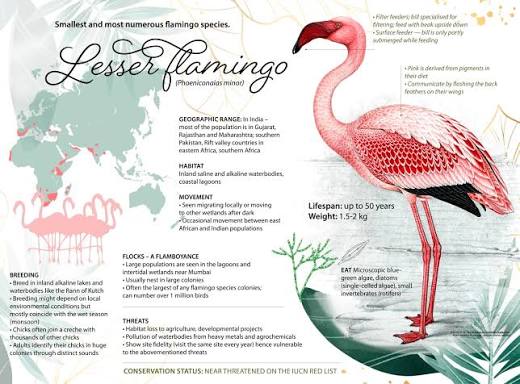
The pink coloration that makes flamingos so distinctive and visually arresting is not inherent to the bird — it comes entirely from the carotenoid pigments in the food they eat. Flamingos that are fed a diet lacking carotenoids in captivity gradually lose their color, becoming white within a year or two of dietary change. In the wild, the carotenoids come primarily from the algae, crustaceans, and small invertebrates that flamingos filter from the water, all of which contain carotenoid pigments absorbed from their own food sources or produced metabolically. The intensity of the pink is therefore a direct signal of feeding success and food quality — a deeply pink flamingo has been feeding well on carotenoid-rich food, while a paler bird indicates either poor food availability or reduced foraging efficiency, making flamingo coloration a genuine honest signal of individual condition.
Flamingo Biology and Feeding
Physiology and the Soda Lake Adaptation
How Flamingos Feed in Alkaline Water
Africa’s Rift Valley soda lakes — Nakuru, Bogoria, Magadi, and Natron — are among the most chemically extreme environments on Earth, with pH values reaching 10 to 12 and temperatures in some areas exceeding 60 degrees Celsius at the lake surface. These conditions are lethal to virtually all organisms except for the blue-green algae Arthrospira (spirulina) that forms the primary food source of the lesser flamingo, and the specialized micro-organisms and invertebrates that lesser flamingos also consume. The flamingo’s bill has evolved a highly specialized filtering apparatus: the bill is held upside down at the water surface, and a uniquely shaped pumping tongue creates a suction that draws water through a series of fine hair-like lamellae that filter algae and micro-invertebrates from the water column at a rate of approximately four pumping cycles per second. This filtration system allows flamingos to process large volumes of water efficiently, extracting the food particles while excluding the highly caustic water itself from excessive ingestion.
The lesser flamingo’s ability to feed exclusively on Arthrospira algae in near-boiling, intensely alkaline water with no competition from other filter feeders gives it exclusive access to one of the most productive food resources in East Africa’s Rift Valley ecosystem. Lake Bogoria in Kenya, for example, produces an estimated 12 tonnes of algae per hectare per year — an extraordinary biomass productivity in a lake that would otherwise appear to be a near-sterile chemical wasteland. The flamingo population of East Africa, estimated at one to two million birds historically concentrated primarily on Lake Nakuru and Lake Bogoria, represents the only system capable of converting this algal productivity into bird biomass, and the flamingos’ importance as a link between the lake ecosystem and the wider food web — providing food for fish eagles, marabou storks, and other predators that feed on flamingos — gives them disproportionate ecological significance relative to any other waterbird.
Breeding and Chick Development
Flamingos breed in large aggregations at highly specific sites — typically shallow, isolated soda lake islands or mudflats far from shore that provide protection from terrestrial predators. Lake Natron in northern Tanzania is the primary lesser flamingo breeding site in East Africa, hosting approximately 75 percent of the world’s lesser flamingo breeding population in years when conditions are suitable. The caustic soda of Lake Natron, which encrusts the legs of any animal that enters the water without the flamingo’s specialized thick skin, creates a moat against predators that makes nesting there viable even in the absence of other protection. Flamingo nests are conical mud mounds about 30 centimetres high, designed to keep the single egg above the hot lake surface and the caustic surface water, and both parents share incubation of the single egg across approximately 28 days.
Flamingo chicks are born covered in grey down, with a straight bill that does not develop the characteristic curved flamingo shape until several months of age. Within a few days of hatching, chicks from multiple nests congregate in large crèches of hundreds or thousands of young birds guarded by a small number of adult helpers, while the majority of adults disperse to feeding areas and return periodically to find and feed their own chick. The chick recognition system — based primarily on individual vocal recognition that develops within the first few days of life — allows parents returning to a crèche of thousands of identical-looking grey chicks to locate their own offspring reliably and feed it preferentially. Parents feed chicks with a highly nutritious red liquid called crop milk, produced in the digestive tract and regurgitated directly into the chick’s bill, which provides complete nutrition for the first weeks of life before the chick develops the bill filtering capacity to feed independently.
Best Places to See Flamingos in Africa
Kenya’s Lake Nakuru National Park has been the most consistently reliable destination for large flamingo concentrations in East Africa, though the flamingo population has fluctuated significantly as the lake’s chemistry and water level have changed in response to rainfall variability and human water use. In peak years, Lake Nakuru’s south shores are lined with flamingos in numbers that turn the entire shoreline deep pink — one of Africa’s most photographed wildlife images. Lake Bogoria, north of Nakuru in Kenya’s Rift Valley, has increasingly become the more reliable of the two Kenyan soda lakes for flamingo viewing as Nakuru’s chemistry has fluctuated, and the hot springs and geysers at Bogoria’s northern end add a dramatic geological element to the flamingo viewing.
Tanzania’s Lake Manyara National Park, lying at the foot of the Rift Valley escarpment, hosts flamingo populations that vary with water conditions but can deliver impressive congregations in the right year. Ngorongoro Crater’s Lake Magadi has a resident flamingo population that adds a pink foreground element to every crater floor visit, though numbers are modest compared to the Rift Valley soda lakes. In Southern Africa, Botswana’s Makgadikgadi Pans — an enormous salt flat that fills seasonally with shallow water — attracts one of the largest flamingo concentrations on the continent in years with good rainfall, with estimates of up to one million birds feeding on the Pans in peak wet seasons. The Makgadikgadi also serves as a breeding site in suitable years, producing one of the most significant flamingo breeding events in Southern Africa.
Plan Your Safari
Flamingo concentrations at the Rift Valley soda lakes are variable — the birds follow algae productivity across the lake system and may shift from Nakuru to Bogoria to Natron on timescales of weeks. Getting accurate current information from operators with Rift Valley contacts before booking a specific flamingo destination is the most important planning step for travelers who specifically want the million-bird experience.
African Wild Trekkers incorporates Lake Nakuru, Lake Bogoria, and the Rift Valley lake circuit into Kenya itineraries alongside the Masai Mara and Amboseli, timing visits to whichever lake is currently holding the largest flamingo aggregation based on real-time information from our Kenya contacts.
Contact African Wild Trekkers at africanwildtrekkers.com/contact with your Kenya travel dates and we will design an itinerary that includes the best current flamingo viewing alongside the Masai Mara and Amboseli game drives within 24 hours.