info@africanwildtrekkers.com

info@africanwildtrekkers.com

blog

Warthog Facts: Pumba Is Real & Here’s What You Need to Know

The Real Pumba

The Lion King gave the warthog its most famous cultural moment, but Pumba’s real counterparts are considerably more interesting than even Disney managed to convey. The common warthog — Phacochoerus africanus, the most widespread of Africa’s three warthog species — is one of the most entertaining and behaviorally engaging animals on the African savanna, and the fact that most safari travelers dismiss it as a minor supporting character to the more glamorous Big Five animals is one of the great missed opportunities in wildlife observation. Warthogs kneel on their calloused front knees to graze — a postural adaptation unique among pigs for feeding on very short grass. They reverse into burrows tail-first so that their tusks face outward toward any threat. They run with their tails held vertically like radio antennas, in a behavior that may help family members track each other through long grass. They produce the most remarkably varied vocabulary of grunts, growls, and squeals of any African pig. They are, in short, deeply worth watching carefully.

Warthogs are found in virtually every savanna and woodland ecosystem across sub-Saharan Africa, making them one of the most reliably encountered large mammals on any game drive. Their abundance and accessibility are precisely why they tend to be overlooked in favor of rarer or more visually striking species, but experienced safari guides consistently single out warthogs as one of the animals that rewards close observation most generously — particularly when families with piglets are seen, which produces some of the most endearing behavioral scenes available on any African game drive.

Warthog Biology and Adaptations

Anatomy, Feeding, and Burrows

The Warthog’s Unusual Physical Features

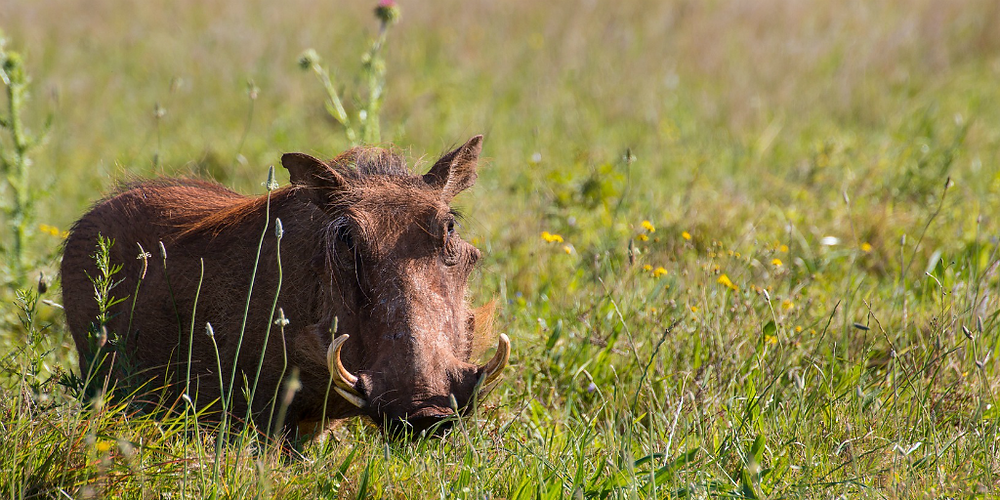
The common warthog is a medium-sized pig — adults weigh 50 to 150 kilograms, with males significantly larger than females — with a broad, flattened face, prominent facial warts (actually thickened skin pads beneath the eyes and on the sides of the face rather than true warts), and curved upper and lower tusks. The upper tusks are the largest and most visible, curving upward and outward from the snout in a fashion that makes large boars look considerably more formidable than their overall physical build suggests. The tusks are used in combat between males during the breeding season, in defense against predators, and for digging roots and tubers. The warthog’s build is robust and low-slung, with short legs and a large head relative to body size — an anatomy that reflects a lifestyle combining fast running across open ground with extensive digging and rooting in hard African soils.

The kneeling posture adopted for grazing is one of the warthog’s most distinctive and identifiable behaviors. The wrist joints of the front legs develop thick, calloused pads specifically to withstand the wear of repeated kneeling on hard ground during feeding, and warthogs move forward on their knees while grazing short grass, shifting their weight from knee to knee as they progress across the feeding area. This posture is most commonly seen in open grassland where the grass is too short for the warthog to reach it in a normal standing posture, and disappears when the animals switch to rooting for underground food items, which is accomplished standing. The kneeling behavior is visible from considerable distance across open ground and is one of the most reliable field identification cues for warthog versus the similarly sized bushpig, which does not kneel to feed.

Burrows, Tail Running, and Social Life

Warthogs depend heavily on burrows for protection from predators, shelter from extreme temperatures, and raising young, but they are not proficient excavators themselves. Most warthog burrows are appropriated aardvark holes — enlarged as necessary to accommodate the warthog’s body — and the availability of suitable aardvark burrows is a significant factor in warthog habitat use. The behavior of reversing into the burrow tail-first is not, as often claimed, purely defensive: entering backward gives the animal a forward-facing view from within the burrow entrance, allowing it to monitor approaching threats. If a predator does approach, the warthog’s tusks are positioned at the burrow entrance, making entry by a pursuing predator — typically a leopard or a young lion — distinctly hazardous. The combination of tusk defense from within the burrow and the physical difficulty of reaching an animal in a tunnel has made burrow use a highly effective anti-predator strategy that likely contributes significantly to the warthog’s remarkable ecological success across Africa’s savanna habitats.

The vertical tail running — the characteristic posture in which warthogs hold their tails straight up as they trot away from disturbance — is most pronounced in families with young piglets. Piglets follow their mother closely, and the raised tail may function as a visual signal that allows piglets to track the mother’s position through long grass or when moving at speed. Warthogs are also fast over short distances — capable of 55 kilometres per hour in a sprint — and their default response to a threat is to run rather than confront, reserving tusk defense for the burrow. This combination of flight speed, burrow defense, and the genuine deterrent of sharp tusks gives warthogs a comprehensive anti-predator toolkit that explains their population abundance in ecosystems that support high densities of large predators.

Warthog Predators and Piglet Behavior

Warthog piglets are among the most appealing young animals on the African savanna — small, uniformly grey, mobile from birth, and prone to sudden explosive bursts of activity that look exactly like a miniature version of the adult trot-with-tail-raised behavior. Litters of two to four piglets are common, born in the dry season in burrows that the mother excavates or prepares several weeks before parturition. The piglets emerge from the burrow at approximately three to four weeks of age and begin accompanying the mother on foraging trips, running to the burrow in single file at her heels when the family is alarmed. The sight of a warthog family running home in the afternoon — mother at the front, four piglets with vertical tails in a line behind her — is one of the most reliably charming behavioral scenes on any East or Southern Africa game drive.

Warthog piglets are targeted by a wide range of predators — eagles, jackals, caracals, servals, leopards, cheetahs, and lions all take piglets opportunistically — and the first months of a warthog piglet’s life are a high-mortality period that naturally selects for the rapid development of alertness and speed that adult warthogs demonstrate. Adults are more difficult prey: the combination of flight speed, tusk defense from within burrows, and the surprisingly effective charge-and-tusk attack that a cornered adult warthog delivers to pursuing predators makes mature warthogs a more energetically costly prey item than their abundance might suggest. Leopards are the primary warthog predators in most ecosystems, and the skill of locating and capturing an adult warthog before it can reach its burrow is a learned hunting behavior that young leopards develop with practice over time.

Where to See Warthogs

Warthogs are present on virtually every game drive in East and Southern Africa and require no special planning or destination selection to encounter. The Masai Mara, Serengeti, Amboseli, Ngorongoro, Kruger, Hwange, Chobe, and the majority of Africa’s savanna parks all have abundant warthog populations that produce reliable sightings throughout the day. What varies between destinations is the specific behavioral context available: parks with large aardvark populations tend to have more numerous warthog burrows and more burrow-related behavior; parks with families are most rewarding in the February to May period when piglets are young; parks with high predator densities deliver the most dramatic predator-warthog interactions. Warthog watching is best enjoyed as an opportunistic activity on any game drive rather than a planned objective, with the attention available to look more carefully at animals that most other travelers drive past without stopping.

Uganda’s Queen Elizabeth National Park and Kenya’s Amboseli are particularly noted for accessible, relaxed warthog populations that allow close-range behavioral observation — warthogs kneeling to graze in the foreground of Kilimanjaro at Amboseli produces one of Africa’s most effortlessly photogenic wildlife images. South Africa’s Kruger has abundant warthogs in the southern sections of the park, and the afternoon return-to-burrow behavior — families trotting purposefully across roads and into the bush as the light falls — is a daily event visible from any parking area near suitable aardvark-hole habitat. Watching the interaction between warthogs and a waterhole shared with zebra, impala, and baboons in the afternoon heat is one of the most consistently entertaining wildlife observations that standard savanna safari provides.

Plan Your Safari

Warthog sightings need no special planning — they come with any East or Southern Africa safari. What separates a superficial encounter from a genuinely engaging one is slowing down, staying with a family for ten minutes rather than thirty seconds, and letting the behavioral complexity of these underrated animals emerge at the pace they naturally set.

African Wild Trekkers designs safaris that build in the time to observe all wildlife encounters at their natural pace rather than driving through a checklist, giving travelers the opportunity to appreciate Africa’s less glamorous but often most entertaining residents alongside the iconic Big Five sightings.

Contact African Wild Trekkers at africanwildtrekkers.com/contact with your travel dates and we will design a safari itinerary that delivers the full range of Africa’s wildlife — from lion to warthog — with the time and guiding quality to appreciate every species within 24 hours.