Okapi Facts: Congo’s Mysterious Half-Zebra, Half-Giraffe
The Animal That Shouldn’t Exist
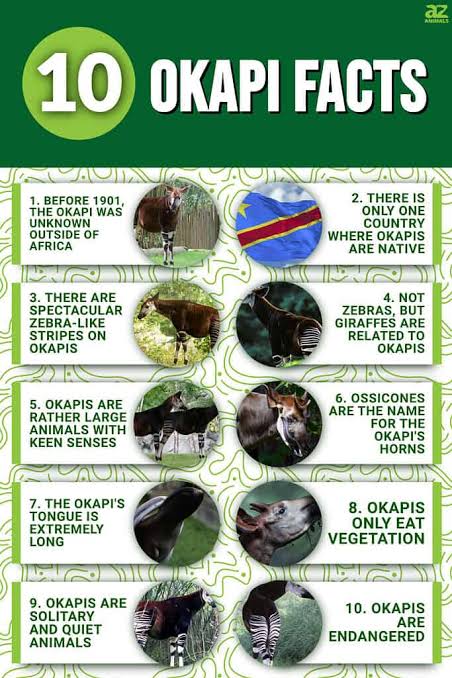
The okapi is one of the most improbable-looking large mammals on Earth. It is a horse-sized animal with the hindquarters of a zebra, the neck of a horse, the tongue of a giraffe. And a dark chocolate-brown body that fades to white horizontal stripes on the upper legs.
It looks, frankly, like an evolutionary committee that couldn’t agree on a design. When the first European accounts of the okapi reached scientists in London at the end of the nineteenth century, scientists dismissed the description as fiction. When physical evidence finally arrived a skull and two striped skins purchased by British explorer P.L. Sclater from Ugandan soldiers in 1900 the scientific community was astonished. Scientists formally described the okapi in 1901.
This made it one of the last large mammal species to receive a scientific name from Western science. It remains one of the most remarkable discoveries of the twentieth century’s first decade.
The okapi is not, despite its appearance, related to zebras. It is the only living relative of the giraffe. The two species share a common ancestor that lived approximately 11 million years ago. This makes them the only two members of the family Giraffidae alive today.
The relationship is visible in anatomical details. Both okapis and giraffes have ossicones the bony projections on the head. They share the same unique walking gait in which both legs on the same side move together. They also have similar prehensile tongues for selective browsing. The okapi’s tongue 45 centimetres long and dark blue-black in colour strips leaves from branches in the Ituri and other Congo rainforests.
The giraffe’s tongue strips leaves from tall acacia trees on the African savanna. The habitat and visual appearance of the two cousins are completely different, yet the tongue function is the same.
Okapi Biology and Behavior
Rainforest Life and Solitary Habits
Diet and the Forest Habitat
Okapis are strictly forest-dwelling browsers confined to the dense tropical rainforest of the Democratic Republic of Congo. The largest concentration lives in the Ituri Forest of northeastern DRC. They are selective browsers that feed on leaves, fruit, fungi, and grasses in the forest understory. Iuse their long prehensile tongue to grasp and strip vegetation with precision. They also consume mineral-rich clay from riverbanks and forest clearings.
This mineral licking behavior creates characteristic clearings in the forest floor where multiple okapis have visited repeatedly. Tracking these licks is one of the methods researchers use to monitor okapi population activity in areas too dense for direct observation.
Okapis are solitary animals with large home ranges of 13 to 47 square kilometres. They maintain these ranges through scent marking with interdigital glands on the feet. These leave scent deposits on the forest floor as the animal walks.
They also mark with secretions from tar glands behind the knees. Territories of males and females overlap extensively, allowing encounters for mating. Outside of the mating context, adults avoid each other and maintain distance within their ranges. The extreme shyness and density of their forest habitat makes direct behavioral observation difficult for researchers. Most behavioral data on okapis in the wild comes from camera trap studies, radio-collar tracking, and observation at forest reserve study sites.
Communication and the Infrasound Question
Okapis communicate with a range of vocalizations including soft cough-like calls, whistles, and chuffing sounds. Their most remarkable potential communication medium is infrasound. Research on okapi vocalizations has documented sound production below the range of human hearing. This is similar to the infrasonic communication documented in elephants.
The hypothesis that okapis use infrasound to communicate over distances in dense forest is consistent with the acoustic properties of their habitat. The dense canopy of the Congo rainforest filters high-frequency sounds rapidly. It transmits low frequency infrasound over considerable distances. This makes infrasonic communication a practical solution to maintaining contact between solitary individuals whose paths rarely cross in a visually opaque forest environment.
The okapi’s remarkable hearing comes from independently rotating ears. Each ear can turn through approximately 180 degrees. This allows the animal to monitor for predators across a wide arc while feeding with its head down in forest understory vegetation.
Leopards are the primary okapi predators. They are the only large carnivores capable of hunting effectively in the dense Congo rainforest understorey. The okapi’s escape strategy relies primarily on rapid disappearance into dense forest vegetation rather than sustained speed across open ground. The animal’s build is optimized for agile movement through tangled vegetation.
The striped legs look conspicuous against the chocolate body in photographs taken in open light. In the dappled light of the rainforest floor, they actually provide effective camouflage. Breaking up the animal’s outline against vertical tree stems and filtered sunlight.
Okapi Conservation
Endangered Status and Where to See Them
Threats and Conservation Programs
The IUCN classifies the okapi as Endangered. The population is estimated at fewer than 10,000 to 35,000 individuals in the wild. A wide estimate range reflecting the difficulty of surveying animals in dense rainforest.
The primary threats are deforestation and habitat conversion for agriculture and mining. Bushmeat hunting and armed conflict have made large parts of the okapi’s range inaccessible to conservation monitoring for extended periods. The Okapi Wildlife Reserve a UNESCO World Heritage Site covering 13,726 square kilometres of Ituri Forest provides the primary protected area for the species.
The reserve has experienced significant incursions from armed groups, illegal miners. And commercial poachers that have severely compromised protection efforts in the past two decades.
The Okapi Conservation Project, based in Epulu within the reserve, has maintained a long-term research and conservation program despite significant security challenges. The project manages a captive breeding population of okapis at the Epulu facility. It serves both conservation and education purposes. The project maintains relationships with local indigenous Mbuti communities whose traditional knowledge of okapi ecology is invaluable to research.
It also supports ranger deployment and community benefit programs across the reserve. Over 50 zoos worldwide maintain okapis in captive breeding programs under the Okapi Species Survival Plan. This ensures a genetically diverse insurance population outside of the wild while wild population conservation programs continue.
Seeing Okapis: Where and How
Seeing an okapi in the wild is one of the most ambitious wildlife encounters available to any safari traveler. It is not achievable through standard East Africa safari logistics. The DRC remains a challenging travel destination due to security concerns. Access to the Ituri Forest requires significant advance planning and specialist operator contacts in DRC.
Travelers must also accept the logistical complexity that comes with travel in one of Central Africa’s most remote regions. For travelers with the experience, flexibility, and specific motivation to pursue this objective, specialist operators can arrange Ituri Forest expeditions. These offer genuine if far from guaranteed okapi encounter possibilities.
For most travelers, the okapi is more practically seen at high-quality zoos that maintain captive populations under the Species Survival Plan. Several European and American zoos maintain small groups in forest enclosures designed to replicate the vegetation structure of Ituri Forest.
The Antwerp Zoo in Belgium has the longest history of captive okapi breeding outside Africa. These zoo populations contribute directly to genetic diversity management and research that supports wild population conservation. Visiting them represents a form of conservation support through admission revenue.
The Epulu breeding facility in the DRC itself occasionally hosts researchers and specialist visitors with appropriate contacts. It provides the closest thing to a wild okapi encounter within a managed context accessible to non-specialist travelers willing to navigate DRC logistics.
Plan Your Safari
An okapi encounter in the wild requires DRC expedition planning that is well beyond standard East Africa safari logistics. For travelers interested in Central Africa’s extraordinary biodiversity. Which extends beyond the okapi to include the bonobo, the lowland gorilla, the forest elephant. And dozens of endemic bird species. African Wild Trekkers can discuss the specialist operator contacts and logistical requirements for planning a Congo Basin expedition.
African Wild Trekkers focuses primarily on East and Southern Africa’s established safari circuit. We can also provide guidance and connections for travelers motivated to explore Central African destinations. Africa’s most mysterious large mammals. Okapi, bonobo, bongo. Still live in remote forest habitats far from the mainstream safari world.
Contact African Wild Trekkers at africanwildtrekkers.com/contact with your Africa travel goals and we will discuss the full range of options from standard East Africa circuits to more ambitious Central Africa expeditions within 24 hours.