Why the Serengeti Is the Greatest Wildlife Show on Earth
Many places on earth claim superlatives in wildlife terms — the Amazon for biodiversity, the Galápagos for evolutionary significance, the Arctic for otherworldly drama. But the Serengeti’s claim to being the greatest wildlife show on earth rests on a convergence of factors that no other single location can match simultaneously: the sheer volume of large mammals, the annual wildebeest migration (the largest land migration anywhere on the planet), the density and visibility of big cat predators, the geological and ecological age of the ecosystem, and the scale of the protected landscape. These factors do not merely add up — they interact and amplify each other in ways that make the Serengeti experience categorically different from any other wildlife destination, regardless of budget, duration, or prior wildlife experience.
This is not a marketing claim. Wildlife ecologists, conservation biologists, and experienced wildlife guides who have worked across Africa consistently place the Serengeti in a category of its own. The park is not only exceptional today — it has operated continuously at this level of ecological integrity since before European contact, functioning as it has for hundreds of thousands of years. The animals here are genuinely wild, the ecosystem genuinely intact, and the experience of sitting in a vehicle on the open plains while the natural world operates around you exactly as it always has is one that very few other places on earth can still offer.
The Great Migration: Nothing Else Compares
Scale, Route, and What Makes It Unique
1.5 Million Animals in Continuous Movement
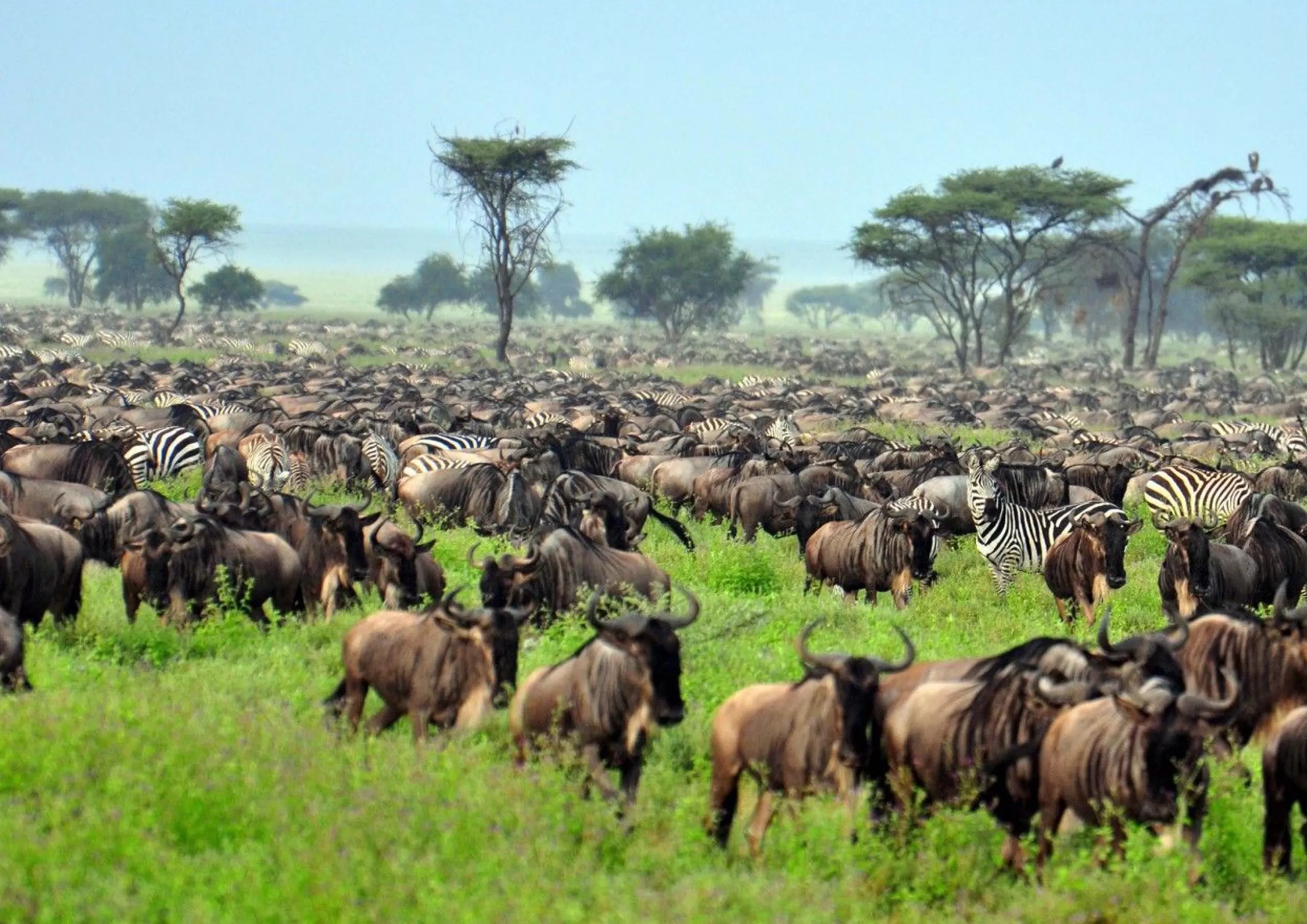
The Serengeti’s annual wildebeest migration involves approximately 1.5 million wildebeest, 300,000 zebra, and 200,000 Thomson’s gazelle moving in a continuous loop through the Serengeti-Mara ecosystem across the Tanzania-Kenya border. This single migration event — the largest overland animal migration on earth — involves more individual large mammals than exist in most other African countries combined. The scale is genuinely difficult to comprehend until you see it: standing waves of animals moving across the open plain, darkening the horizon in every direction, raising dust columns visible from kilometres away, and filling the air with a constant low rumbling of hooves and the calling of thousands of wildebeest simultaneously.
What distinguishes the Serengeti migration from other large animal aggregations is its temporal continuity — this has been happening, in essentially the same form, for hundreds of thousands of years. The animals are responding to ancient rainfall patterns and grass phenology that determined this route long before humans lived in East Africa. The wildebeest are not performing for visitors; they are executing a survival strategy refined across geological time that happens to be observable because the Serengeti ecosystem has remained intact long enough to preserve it. In a world where most large wildlife events have been diminished or eliminated by human activity, the Serengeti migration stands as a testament to what ecological preservation at scale can protect.
River Crossings: The Migration’s Most Dramatic Chapter
The Mara River crossings between July and October, when the migration herds must cross the crocodile-infested water to access fresh grass on the far bank, represent one of the most dramatic wildlife spectacles available anywhere on earth. Herds of thousands of wildebeest build up on the riverbank over hours, working up the collective nerve to cross in the face of large Nile crocodiles visible in the water below. When the crossing begins — triggered by a single animal stepping in, causing a stampede effect that sweeps thousands of animals into and through the river simultaneously — the resulting chaos, noise, and predatory interaction is unlike anything else in the natural world. Crocodiles take individual animals in explosive lunges, the wildebeest climb the far bank in heaving masses, and lions wait downstream to take advantage of injured or separated individuals.
No two crossings are identical in location, timing, or intensity. Some crossings involve tens of thousands of animals and last for hours, others are quick panicked dashes of a few hundred animals across a narrow point. The unpredictability is part of what makes them compelling — you cannot watch a crossing, plan to replicate exactly what you saw, and then recreate the experience. Each crossing is specific to that moment in that season for those particular animals responding to the conditions in front of them, and that irreproducibility is fundamental to why witnessing one feels so significant.
Predator Density: Lions, Leopards, Cheetahs, and Wild Dogs
Why No Other Park in Africa Matches the Serengeti for Cats
3,000 Lions in One Ecosystem
The Serengeti holds an estimated 3,000 lions — one of the highest lion populations in the world and significantly the largest concentration in any single protected area. These lions are distributed across multiple prides throughout the park, with the highest density in the central Seronera Valley and the western corridor. Unlike in many African protected areas where lion populations are small and sightings are occasional, in the Serengeti you expect to see lions on virtually every full-day game drive. Not encounter them — expect them. The difference in language reflects the difference in experience: lion viewing in the Serengeti has a reliability that transforms the predator relationship from one of exciting uncertainty to one of abundant observation.
The behavioural variety that comes with this lion density is as significant as the numbers. With multiple prides operating in a rich prey environment, you witness the full spectrum of lion social behaviour across a safari week: cubs at various stages of development playing and nursing, sub-adult males testing their independence from natal prides, breeding pairs on extended consortships, and large prides cooperating in coordinated hunts. The Serengeti’s lions are extensively studied by researchers, which means the scientific literature provides interpretive context that guides can draw on to explain what you are observing in terms that go far beyond a simple species identification. The combination of abundance and interpretive richness makes Serengeti lion watching a genuinely deep educational experience rather than a simple sighting checklist event.
Cheetahs, Leopards, and Wild Dogs in a Complete Predator Guild
The Serengeti is exceptional not just for lions but for the completeness of its predator guild — the full complement of large African carnivores operating simultaneously in the same ecosystem. Cheetahs are reliably visible on the open plains, particularly the southern Serengeti around Ndutu during the calving season when Thomson’s gazelle fawns provide abundant easy prey. The Seronera Valley holds habituated leopards among the most accessible in Africa. Wild dogs, historically rare in the Serengeti due to competition with lions and hyenas, have made a partial recovery and are occasionally encountered in the northern sector. Spotted hyenas are present in enormous numbers throughout the ecosystem, and their complex social behaviour and frequent interactions with lions and other predators provide constant interpretive interest throughout every game drive.
The Serengeti’s predator density also means that predation events — hunts, kills, and scavenging interactions — occur with a frequency unavailable in any other East African park. On a seven-day Serengeti safari, most guests witness at least one active hunt and frequently several kills across different species. These events are not staged or facilitated — they happen because the prey-to-predator ratio in the Serengeti is high enough that predation occurs constantly across the park. Guides skilled in reading animal behaviour can position guests to observe events already in progress or imminent based on the behaviour of the predators rather than simply arriving at a scene already concluded.
Ecosystem Scale and Ecological Integrity
Why the Serengeti’s Size Matters
14,763 Square Kilometres of Protected Savannah
The Serengeti National Park covers 14,763 square kilometres — roughly the size of Connecticut or Northern Ireland — but the broader Serengeti-Mara ecosystem including the Ngorongoro Conservation Area, the Masai Mara in Kenya, and surrounding game reserves and conservancies covers several times this area. This scale matters ecologically because large mammals require large landscapes, and the integrity of the wildebeest migration depends on the entire circuit remaining connected and functional. Tanzania’s commitment to maintaining this ecosystem — resisting agricultural encroachment, road construction through migration corridors, and development within buffer zones — has preserved an ecological reality that most comparable grassland systems across Africa have lost.
The scale also matters experientially. Driving for two hours in any direction from the centre of the Serengeti without reaching park boundaries means that the feeling of being in genuine wilderness — surrounded by space in all directions, no visible infrastructure, no audible human activity — is achievable and sustained throughout your time in the park. This is rare in modern Africa. Most other famous wildlife areas have been compressed by surrounding agriculture, human settlement, or infrastructure development to the point where wild space is a managed island rather than a continuous landscape. The Serengeti remains close enough to its original form that the experience of space and wildness it provides is genuinely authentic rather than curated.
Geological and Evolutionary Significance
The Serengeti’s wildlife did not appear recently. The grassland ecosystem and its associated fauna have been evolving in this region for millions of years, and the park’s proximity to Olduvai Gorge — where researchers discovered some of the most significant early human ancestor fossils — means that this landscape witnessed human evolution itself. The soils, the grass species, the acacia trees, the migrating herbivores, and the predators that hunt them are components of a system that shaped the evolutionary trajectory of the animals observing them. Visiting the Serengeti with this geological and evolutionary context in mind transforms the experience from a wildlife viewing holiday into a form of engagement with deep time that is genuinely unique to this place.
Tanzania has sustained conservation efforts in the Serengeti across more than sixty years of national park protection, and the scientific research conducted here — by institutions including the Frankfurt Zoological Society, the Serengeti Lion Project, and the Tanzania Wildlife Research Institute — has produced some of the foundational knowledge of how savannah ecosystems function. Guides who have engaged with this research tradition bring a depth of ecological understanding to safari interpretation that elevates the quality of the experience in ways that are difficult to quantify but impossible to miss.
When to Go and What to Expect
Seasonal Wildlife Patterns in the Serengeti
Dry Season vs Green Season: Different but Both Excellent
The Serengeti’s two broad seasons provide different but equally valid wildlife experiences. The dry season from June through October is the classic Serengeti safari period — thinning vegetation concentrates animals at water sources, improving sighting predictability, and the clear air and dust-free roads of the early dry season provide excellent photographic conditions. This period coincides with the northern migration and Mara River crossings, and it is peak season for accommodation pricing and availability. Booking for July and August requires planning twelve months or more in advance for the most sought-after camps.
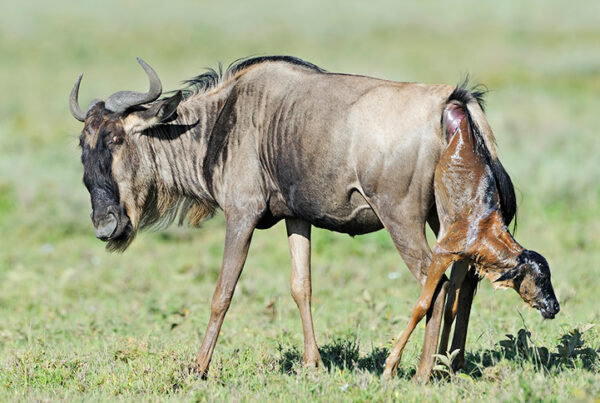
The green season from November through May — particularly the December-March southern Serengeti calving period — offers its own remarkable experiences. The calving of roughly 400,000 wildebeest calves over six weeks around Ndutu is one of the most dramatic wildlife events of the Serengeti year, drawing predators in extraordinary concentrations and producing a density of predation events that rivals and sometimes surpasses the dry-season experience. The landscape is green and lush, dramatically different from the tawny dry-season plains, and the light quality for photography during the green season is often superior to the hazy dry season. Accommodation prices in the green season are substantially lower, and camp exclusivity is significantly higher as visitor numbers drop.
Plan Your Safari
Experiencing the Serengeti at its best requires matching your travel dates to your specific wildlife priorities — migration crossings, calving season, predator density, photographic conditions — and selecting accommodation and game drive routes that give access to the most productive areas for those priorities. A minimum stay of four nights in the Serengeti gives sufficient time to develop a meaningful sense of the ecosystem and encounter a range of wildlife experiences across different areas and conditions.
African Wild Trekkers designs Serengeti safari itineraries for every season and every travel style, from intimate tented camps on the migration route to family-friendly lodges in the central valley, with private vehicles and expert guides matched to your specific interests and experience level. All reservations are confirmed in writing before any deposit is requested.
Contact African Wild Trekkers at africanwildtrekkers.com/contact with your preferred Serengeti travel dates and we will design your itinerary and confirm camp availability within 24 hours.