Impala Facts: Africa’s Most Common Antelope & Why That’s Meaningful
The Most Important Animal on the African Savanna
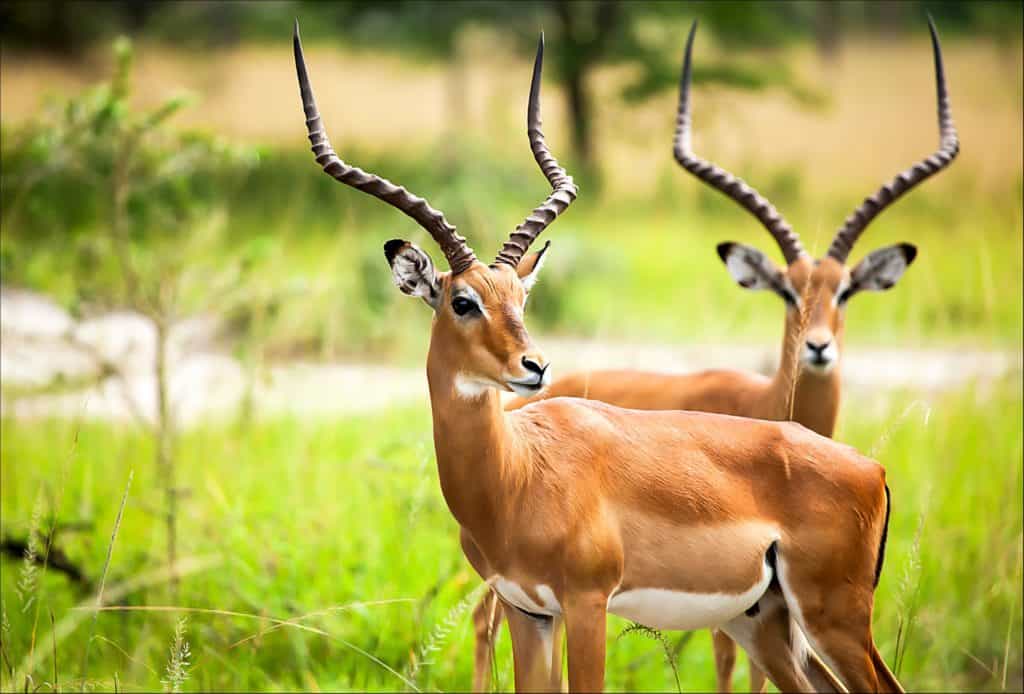
The impala is Africa’s most abundant medium-sized antelope. It is found across virtually every savanna and woodland ecosystem in East and Southern Africa.
Travelers almost certainly dismiss it more often than any other animal on any safari game drive. First-time visitors train their attention toward lions, leopards, elephants, and rhinos.
The impalas that appear in every direction — hundreds of them — quickly become invisible through sheer familiarity. This invisibility is a mistake. The impala is arguably the single most ecologically important animal in the African savanna food web.
It is the primary prey species for lions, leopards, cheetahs, wild dogs, hyenas, crocodiles, pythons, and martial eagles. Its behavior — vigilance, alarm calls, and sudden explosive flight — is the most consistent early warning system on any game drive for predators nearby.
Understanding the impala’s ecological role and behavioral vocabulary transforms the experience of watching them.
An impala herd standing stiffly alert with ears forward tells you something is approaching. An impala that stots—the extraordinary four-legged vertical bounding leap—communicates to the predator that it has detected the pursuit.
It also signals that it is physically fit enough to escape. The snorting alarm call that propagates through an impala herd when a predator appears will stop a safari guide’s vehicle faster than almost any other stimulus.
It reliably indicates that a big cat is within striking distance.
Impala Biology and Social Structure
Herds, Rutting Season, and Bachelor Groups
Female Herds and Territorial Males
Impala social structure is built around female nursery herds of 10 to 200 individuals. A system of territorial males competes for exclusive access to these herds during the breeding season.
Outside of the rut—which in most East African populations peaks in May and June—male impalas form separate bachelor groups. These occupy areas peripheral to the main female herd territories.
As the rut begins, territorial males establish and defend territories vigorously. They spend so much energy chasing rivals, herding females, and mating that they can lose up to 20 percent of their body weight.
The vocalizations of rutting impala males. Loud, resonant bellowing sequences. They are one of the most distinctive sounds of the African bush in rut season.
Female impalas select their territories and home ranges independently of any male’s influence. Herds move freely between male territories in ways that give females considerable agency in mate selection.
Research on impala reproduction has shown that females can delay implantation of fertilized embryos by several weeks.
This reproductive adaptation allows parturition timing to align with optimal grass growth conditions for the fawn’s first weeks of life. This physiological flexibility helps impalas maintain reproductive success across years of variable rainfall.
It contributes to the population resilience that allows impala numbers to recover rapidly after drought years that reduce other ungulate populations more severely.
The Stotting Display and Predator Detection
Stotting—the four-legged vertical bounding that impalas perform when a predator is nearby—is one of the most studied anti-predator behaviors in evolutionary biology. The display is energetically costly, conspicuous to predators, and seemingly counterproductive from the perspective of an animal trying to escape. The evolutionary explanation centers on honest signaling. An impala that stots demonstrates to the predator that it has detected the approach and is physiologically fit enough to perform the demanding leap. Predators observing stotting individuals tend to abandon pursuit and target non-stotting animals preferentially. This is consistent with the interpretation that stotting communicates a credible signal of escape capacity not worth testing. The honesty of the signal is guaranteed by the physical difficulty of the leap when genuinely impaired. An injured or exhausted impala cannot stot convincingly, and predators select non-stotting individuals from mixed groups.
The impala’s alarm snort—a sharp, explosive exhalation that carries well across open ground—is one of the most useful auditory cues available to experienced safari guides. Impalas see, smell, and hear approaching threats at ranges that often exceed what human observers can detect from a vehicle. The propagation of alarm through a herd is nearly instantaneous. Individuals catch the alarm posture or call of a neighbor and adopt it almost simultaneously. This produces an information cascade that alerts every animal in the herd within seconds. The direction that an alerted impala herd faces is a reliable indicator of the threat’s location. An experienced guide can use the synchronized head orientation of a frozen impala group to locate a lion or leopard in grass that would otherwise conceal it.
Impala Predator Relationships
The impala’s position at the center of the African savanna food web is reflected in the extraordinary number of predator species that depend on it. Leopards in South Africa’s Sabi Sand and Zambia’s South Luangwa take impalas as their most frequent prey. Impala account for over 70 percent of kills in some study populations. Cheetahs in the Masai Mara and Serengeti target Thomson’s gazelles as preferred prey but take impalas frequently in bushier habitats. Wild dogs in Zimbabwe and Zambia hunt impalas as their primary prey across most of their range. Lions take impalas opportunistically throughout their range. The impala’s nocturnal vulnerability to lion predation is one reason impalas give birth across all seasons rather than in a tightly synchronized birth pulse. Spreading the birth period reduces the impact of any single predator surge on the total population.
The impala’s abundance — researchers estimate approximately two million individuals across sub-Saharan Africa — is not an accident. It is the product of extremely effective anti-predator biology and dietary flexibility. Impalas switch between grazing and browsing depending on seasonal availability. Their social system provides multiple predator detection inputs from dozens of alert individuals simultaneously. The species has also proved remarkably adaptable to habitat modification. Impalas are among the most resilient antelopes to moderate habitat disturbance. They are among the first species to recolonize degraded areas as vegetation recovers. Their presence and abundance in a savanna ecosystem serve as a useful ecological indicator of the overall productivity of the prey base.
Where to See Impalas
Impalas appear on virtually every game drive in East and Southern Africa and require no special planning to encounter. The Masai Mara, Serengeti, Kruger, South Luangwa, Hwange, Chobe, and Queen Elizabeth all have impala populations reliably visible throughout the day. What rewards attention is the behavioral context. A herd frozen in alert posture, an adult male bellowing in rut, a newborn fawn hidden in deep grass. The impala rewards the observer who treats it as an ecosystem indicator rather than a generic backdrop. Experienced safari travelers learn to scan impala herds for behavioral cues as a primary predator-location strategy.
May and June in East Africa deliver the impala rut at its most intense. The bellowing of territorial males carries through the Masai Mara woodland. Rival males chase each other across the grassland.
The general disruption of normal impala social order makes rut observation consistently engaging. The post-rut calving period a few months later produces fawn sightings and maternal behavior.
Watching a female impala reunite with a well-hidden fawn she has left in cover while grazing is a scene that most travelers find more affecting than they expect.
It typically comes from an animal they had previously dismissed as “just impalas.”
Plan Your Safari
Impala behavior is a constant presence on any African savanna safari and needs no special planning — it needs attention. The behavioral cues that impalas provide become most accessible to travelers with a guide who actively interprets what the animals are doing.
That means more than simply driving toward the next predator report on the radio.
African Wild Trekkers selects guides who treat the entire wildlife community. Not just the Big Five subjects worth understanding.
They build game drives that interpret impala and other prey species’ behavior as part of understanding the predator-prey dynamics that define each ecosystem.
Contact African Wild Trekkers at africanwildtrekkers.com/contact with your travel dates, and we will design a safari itinerary that delivers the full depth of Africa’s wildlife. From apex predators to the animals that sustain them—within 24 hours.