African Vulture Guide: All 11 Species & Why Vultures Matter
Africa’s Most Underrated Birds
Vultures are among the most ecologically important animals in Africa and among the most aesthetically underappreciated. Their role in the ecosystem is as important as that of any top predator. They locate and consume carcasses before disease-causing bacteria can establish themselves.
They return nutrients to the soil and provide a visible signal that guides scavengers and predators across the landscape. The collapse of vulture populations across Africa is one of the most serious, least publicized. And most consequential wildlife conservation crises on the continent.
Africa is home to 11 vulture species. Eight of them endemic to sub-Saharan Africa, three shared with the Palearctic region. The IUCN now classifies six of these African species as Critically Endangered or Endangered. This represents the highest proportion of threatened species in any large, identifiable group of African birds.
For safari travelers, vultures are one of the most accessible indicators of carcass presence. A circling kettle of vultures visible from kilometres across the Masai Mara plains is one of the most reliable signals that a kill has been made in that direction. Watching vultures at a large carcass is one of the most behaviorally complex and hierarchically revealing wildlife events available on any game drive.
The interactions between species at a shared carcass, the dominance hierarchies between individual birds. And the feeding specializations that allow multiple species to process different parts of the carcass simultaneously all constitute a miniature ecological theater. Experienced safari travelers find it as rewarding as any individual predator encounter.
Africa’s 11 Vulture Species
The Big Four and the Supporting Cast
The Four Dominant Scavengers
The four most commonly encountered vultures at African carcasses are the white-backed vulture, the lappet-faced vulture, the Ruppell’s griffon vulture, and the hooded vulture. Each has a distinct carcass role shaped by bill morphology, body size, and feeding specialization. The white-backed vulture is the most abundant and the most frequently seen.
It arrives at carcasses in the largest numbers and feeds primarily on soft tissue from the body cavity once larger species have opened the skin. The lappet-faced vulture is the largest African vulture. With a two-and-a-half-metre wingspan and a bill powerful enough to tear through thick elephant hide. It feeds on the toughest parts of carcasses: tendons, bone cartilage, and thick skin that smaller species cannot process. Most other vulture species give way to lappet-faceds when the two approach a carcass simultaneously.
Ruppell’s griffon vultures are high-altitude specialists that soar at exceptional heights. Up to 11,000 metres, the highest documented bird flight on record. This record resulted from a fatal collision with an aircraft over the Ivory Coast in 1973.
They survey enormous geographic areas for carcasses and feed on soft tissue alongside white-backed vultures. The two species often arrive at the same carcass simultaneously in flocks of dozens or hundreds in productive East African ecosystem years. The hooded vulture is the smallest of the four and feeds on scraps at the edges of carcasses.
It also feeds on small food items unavailable to larger species. Termites, dung beetles. And scattered small pieces of flesh that the feeding crowd of larger birds ignores. Its small size makes it vulnerable to displacement but also allows it to exploit food items that no other vulture species bothers with.
The Other Seven Species
The seven remaining African vulture species occupy more specialized niches or restricted geographic ranges. The white-headed vulture is a medium sized, strikingly colored species with a white crown and multicolored bill. It feeds on medium-sized carcasses and is one of Africa’s rarest vultures. The IUCN estimates fewer than 3,000 individuals remain, and the species is Critically Endangered.
The Egyptian vulture one of the three species shared with the Palearctic is a small, white-and-black vulture famous for its tool using behavior. It uses stones to crack open ostrich eggs that its relatively weak bill cannot otherwise access.
The bearded vulture, or lammergeier, is one of the most spectacular raptors in Africa. It feeds almost exclusively on bone. Carrying large bones aloft and dropping them onto rocks to crack them, then swallowing bone fragments and digesting them with an extremely acidic stomach.
The palm-nut vulture is an anomaly among the group. It feeds primarily on the fruit of oil palms and raffia palms rather than on carrion. This makes it more frugivore than scavenger despite its vulture classification. The Cape vulture is one of South Africa’s most charismatic raptors.
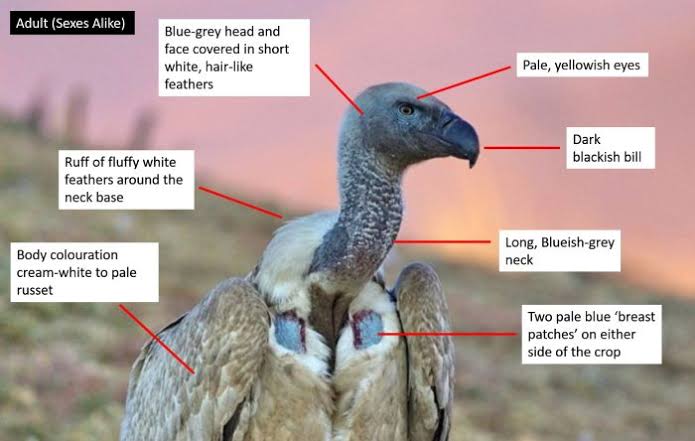
It nests in large cliff colonies and soars over the mountains and grasslands of southern Africa. While reduced from historical levels, it still produces spectacular colony sightings at places like the Vultures’ Restaurant hide near Magoebaskloof in Limpopo. The white-backed vulture nests in trees rather than on cliffs — unusual among vultures. It forms large colony nests in the canopy of acacia and other tall trees in savanna ecosystems from Kenya and Tanzania through Zimbabwe to South Africa’s lowveld.
The Vulture Conservation Crisis
Threats and Why It Matters
The Scale of the Decline
Six of Africa’s 11 vulture species have declined by 80 to 99 percent in the past 30 years. This collapse has no parallel in any other group of large birds anywhere in the world. The primary causes are poisoning, lead poisoning from lead bullet fragments in carcasses, and collision with powerlines. Incidental poisoning occurs when vultures feed on elephant and lion carcasses that poachers have laced with poison.
Poachers do this to remove the vultures’ circling behavior that alerts rangers to illegal kills. Targeted poisoning supplies the traditional medicine market that uses vulture body parts in “muti” preparations across West and Southern Africa. The scale of the poisoning events is extraordinary. A single poisoned elephant carcass in Zimbabwe in 2013 killed 537 vultures of multiple species. One of the largest single wildlife poisoning events ever recorded in Africa.
The ecological consequences of vulture decline are already measurable. In areas where vulture populations have collapsed. Particularly in West Africa. Where multiple species are now functionally extinct across large portions of their historical range. Carcass persistence rates have increased dramatically. Disease transmission from rotting carcasses is elevated.
Less efficient species including feral dogs that serve as disease vectors now partially fill the roles that vultures performed. The public health implications of vulture decline are significant. In South Asia, the collapse of three vulture species following accidental diclofenac poisoning in the 1990s removed 95 percent of the vulture population within a decade.
Rabies deaths from feral dog proliferation increased measurably in subsequent years. This provided empirical evidence for the connection between vulture abundance and public health outcomes that many ecologists had predicted theoretically.
Best Vulture Viewing in Africa
The best vulture viewing in Africa comes from two contexts: carcass visits and colony visits to cliff-nesting species. Carcass visits bring multiple species together in the feeding hierarchy that makes multi-species vulture observation most ecologically informative.
The Masai Mara and Serengeti deliver carcass-based vulture viewing of extraordinary quality during the Great Migration and throughout the year. Resident lion and cheetah kills attract dozens to hundreds of vultures from across the ecosystem. The immediate post-kill activity as vultures assemble from the air, establish feeding order through display and confrontation. And process a large carcass with remarkable speed is one of the most biologically informative wildlife events available on any African game drive.
South Africa’s Lappet-faced Vulture colony at Bateleur camp in northern Kruger, the Cape vulture colony at Vultures’ Restaurant in Limpopo Province. And the Hooded Vulture roost sites in parts of East Africa’s urban fringe all provide colony-based viewing opportunities. These are rarer and more memorable than standard carcass encounters. Several vulture restaurants operate in South Africa, Zimbabwe, and Namibia. These are feeding stations where carcasses are provided regularly to maintain vulture populations in areas where natural food supply is insufficient. They provide reliable vulture viewing that benefits both visitors and the conservation of the declining species that depend on supplemental feeding to maintain viable population densities in fragmented habitats.
Plan Your Safari
Vulture viewing is a natural component of any carcass sighting in East or Southern Africa. The species diversity visible at a large wildebeest or buffalo carcass in the Masai Mara or Serengeti rivals the bird diversity available at any dedicated birding destination on the continent. Including time at carcasses waiting for the full scavenger community to assemble in any Big Five safari adds a layer of ecological understanding unavailable from predator-only observation.
African Wild Trekkers designs safari itineraries that treat the scavenger community. Vultures, jackals, hyenas. As integral parts of the wildlife experience rather than afterthoughts to predator sightings. We build time at carcasses and carcass-adjacent observation into game drives in the ecosystems where scavenger diversity is highest.
Contact African Wild Trekkers at africanwildtrekkers.com/contact with your travel dates and we will design a safari itinerary that includes the best vulture viewing alongside Africa’s full predator and prey spectacle within 24 hours.