Mountain Gorilla Population 2026: How Many Are Left and What Saved Them
The Mountain Gorilla’s Remarkable Conservation Story
The mountain gorilla’s trajectory from the edge of extinction to a slowly recovering population represents one of the most significant conservation success stories of the twentieth and twenty-first centuries. It is a case study in what becomes possible when scientific rigor, international funding, and political will are present. And genuine community engagement converge around a single species with sufficient time and resources.
In 1981, renowned primatologist Dian Fossey estimated the entire mountain gorilla population at fewer than 250 individuals. They were confined to a fragmented volcanic forest habitat that landowners simultaneously cleared for agriculture while poachers decimated it for animals to sell to zoos and for tourists demanding skulls as trophies.
Any conventional ecological assessment would have deemed the species functionally doomed within two to three decades.
It was a large-bodied, slow-reproducing primate with a tiny total population and a shrinking habitat. And a catastrophically overlapping range with one of the most densely populated and economically pressured regions of sub-Saharan Africa.
A combination of factors achieved the gorilla’s survival and subsequent recovery. Factors that conservationists continue to study for lessons applicable to other critically endangered species. Dian Fossey’s research and advocacy work at the Karisoke Research Center in Rwanda’s Virunga mountains, continued after her murder in 1985 by the ongoing research programs that her organization maintains, created an unbroken scientific record of individual gorilla identification, group composition, and behavioral data.
This forms the foundation of all subsequent conservation and management decisions. The establishment of tourism revenue as the primary economic justification for gorilla habitat conservation. Starting with Rwanda’s Parc des Volcans gorilla trekking program in the 1970s and expanding through Uganda’s Bwindi Impenetrable National Park permit program in the 1990s. Fundamentally changed the economic logic of habitat protection.
It made living gorillas in their forest more financially valuable than any alternative land use the same area could support. The community benefit programs that channel a meaningful portion of gorilla trekking revenue to health and education. And infrastructure projects in villages adjacent to gorilla parks created a human constituency for conservation. Their self-interest aligns with wildlife protection rather than against it.
Current Population and Distribution
The 2021 Census and What It Revealed
The most recent comprehensive mountain gorilla census was completed in 2021 by a consortium of wildlife authorities from Rwanda, Uganda, and the Democratic Republic of Congo. They collaborated with international conservation organizations, including the Gorilla Doctors and the Wildlife Conservation Society. And the Max Planck Institute for Evolutionary Anthropology.
The census counted 1,063 mountain gorillas across the two separate populations. The Virunga Massif population spans the borders of Rwanda and Uganda. And the DRC. And the Bwindi-Sarambwe population in southwestern Uganda and a small adjacent area of the DRC. This figure represents a remarkable increase from the 880 individuals counted in the 2018 census and the 604 individuals recorded in the 2003 baseline.
It was sufficient to prompt the IUCN to reclassify the mountain gorilla’s conservation status from Critically Endangered to Endangered in September 2018. The first downlisting for the species in the IUCN’s history. Conservation organizations and governments across the region described this as one of the most meaningful achievements of African wildlife conservation in a generation.
The increase from approximately 250 individuals in 1981 to over 1,000 in 2021 represents a quadrupling of the total population in forty years. This rate of population recovery is genuinely extraordinary for a large, slow-reproducing primate.
Females give birth to a single infant approximately every four years. And infant mortality in the first year of life averages around 20 percent in wild populations. The current population growth rate sits at approximately 3 percent per year.
Absent new threats, the global mountain gorilla population will exceed 1,500 by approximately 2035. This trajectory is genuinely positive. But conservation geneticists and population biologists consistently caution against complacency: 1,063 individuals remains a critically small number from a population viability and genetic diversity perspective.
The Virunga and Bwindi populations have been genetically separated for a sufficiently long period that cross-population gene flow has essentially ceased. Any significant new threat disease outbreak, habitat loss from political instability in the DRC, or a novel pathogen could reverse decades of recovery within a single reproductive generation.
Where Mountain Gorillas Live in 2026
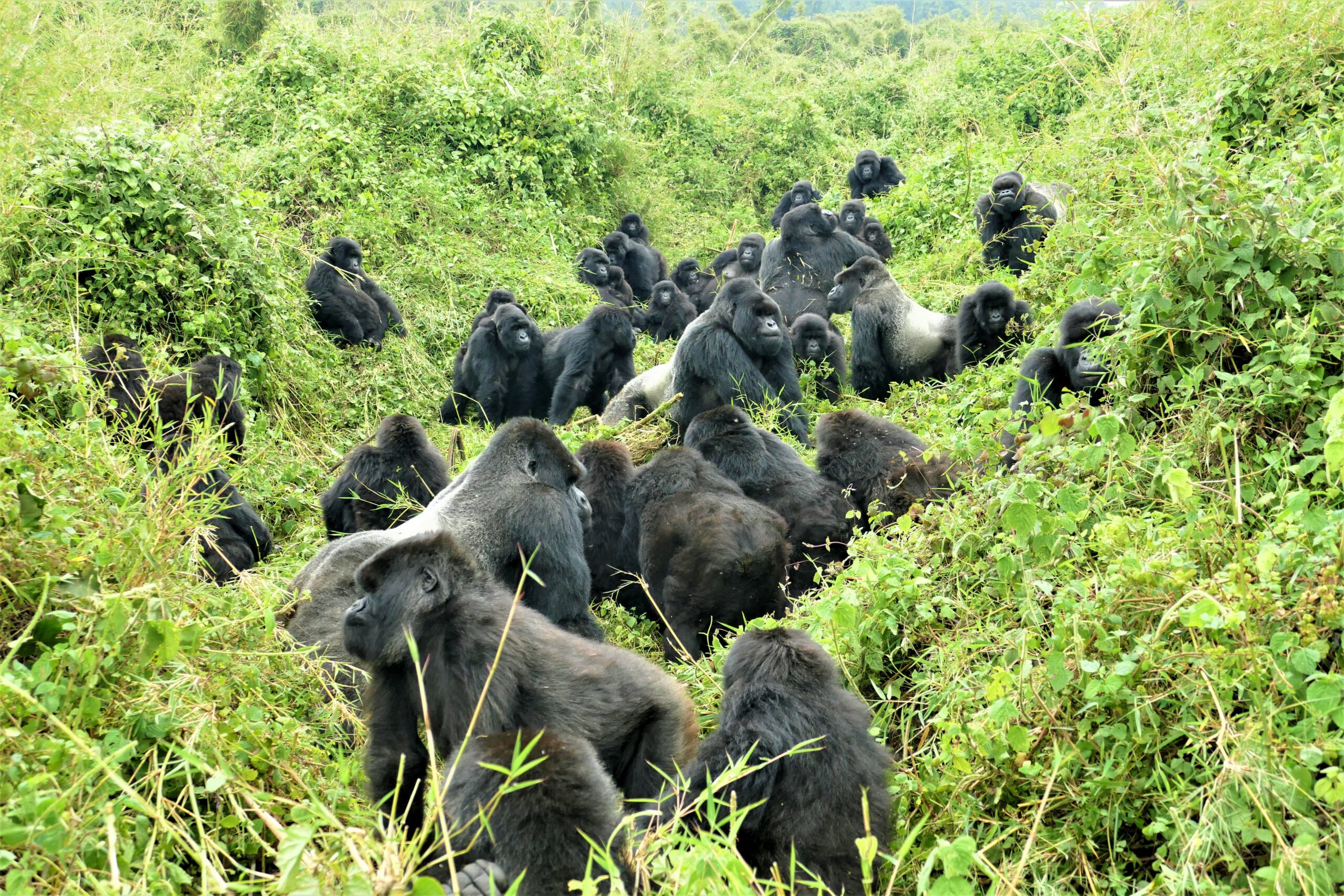
Mountain gorillas exist in the wild only in two geographically separate populations across the Albertine Rift region of Central East Africa. One of the world’s most biologically diverse and simultaneously most economically pressured landscapes. The Virunga Massif population of approximately 604 individuals (2021 census) occupies the chain of volcanic mountains that straddles the borders of Rwanda, Uganda, and the DRC.
The largest portion is in Rwanda’s Volcanoes National Park and the DRC’s Virunga National Park, with a smaller number in Uganda’s Mgahinga Gorilla National Park.
The Bwindi-Sarambwe population of approximately 459 individuals occupies the ancient Bwindi Impenetrable National Park in southwestern Uganda. One of Africa’s most botanically diverse forest remnants. And a small adjacent section of the Sarambwe Nature Reserve in the DRC.
These two populations sit approximately 25 kilometers apart, separated by agricultural land, with no current wildlife corridor connecting them. Each population operates effectively independently. The genetic diversity of both populations presents a significant long-term concern for conservation managers.
The habituation status of gorilla groups for tourism and research access in 2026 covers approximately sixteen gorilla families across Volcanoes National Park in Rwanda, eleven families in Bwindi across its four sectors (Buhoma, Ruhija, Nkuringo. And Rushaga).
And a small number in Mgahinga and Virunga. This totals approximately 35 to 40 habituated family groups with a combined membership of 350 to 450 individuals.
Habituation is a multi-year process involving daily non-intrusive contact between research teams and specific gorilla groups. It gradually reduces the animals’ flight response to human presence.
This careful, time-intensive process creates the conditions for the one-hour face-to-face encounters between tourists and gorilla families that generate the permit revenue funding the entire conservation program.
Each habituated family receives a maximum of eight tourists per day under strict protocols. These limit visit duration to one hour and maintain a minimum distance of seven meters between gorillas and visitors. And prohibit any direct contact or feeding behavior.
These protocols are designed to minimize disease transmission risk and behavioral disturbance while maintaining the revenue generation that justifies the conservation investment.
The Threats That Remain
What Could Still Reverse the Recovery
Human respiratory disease is the single most documented ongoing threat to mountain gorilla populations. This arises from the genetic similarity between gorillas and humans. Sharing approximately 98.7 percent of DNA.
That makes gorillas susceptible to most of the same respiratory pathogens that affect people. These include influenza, measles, respiratory syncytial virus, and COVID-19. Which produced documented infections in habituated gorilla groups in Uganda in 2021.
The Gorilla Doctors program provides veterinary medical care to all habituated mountain gorilla individuals across the range. It monitors gorilla health continuously and intervenes medically when respiratory infections or other treatable conditions appear.
But the fundamental challenge of preventing disease transmission from the thousands of tourists who visit gorilla groups annually remains the most intractable tension in gorilla conservation. Tourist screening protocols include temperature checks and mandatory face masks within seven meters of gorillas.
And quarantine of anyone presenting with respiratory symptoms provides meaningful but imperfect barriers. Asymptomatic transmission of respiratory viruses occurs in human populations, and temperature screening cannot detect it.
Political instability in the DRC’s eastern provinces represents the most unpredictable and potentially catastrophic ongoing threat to the species’ recovery. A significant portion of the Virunga gorilla population resides in Virunga National Park.
Armed conflict between government forces and various non-state armed groups has periodically closed sections of Virunga National Park to tourists and researchers. It has compromised ranger patrol capacity and created conditions where poaching increases significantly.
Several of Virunga’s habituated gorillas have died or sustained injuries in conflict-related incidents over the past decade.
The park’s conservation staff have faced extraordinary personal risk to maintain continuity of gorilla protection during periods of active hostility. Sixteen Virunga rangers died in a 2018 ambush while on patrol. Representing the human cost of gorilla conservation in the DRC’s conflict environment. Any sustainable long-term solution for the DRC gorilla population requires a political and security resolution to the eastern DRC conflict. This conflict has resisted all attempts at durable peace for over twenty-five years.
Plan Your Safari
African Wild Trekkers organizes gorilla trekking experiences in both Rwanda’s Volcanoes National Park and Uganda’s Bwindi Impenetrable National Park. This includes securing the advance permit bookings that are essential given the strict limit of eight tourists per gorilla family per day. We advise every guest on the current permit availability situation and the relative merits of the Rwanda versus Uganda experience. And the specific families and park sectors that offer the best trekking experiences at the time of their visit. Based on our ongoing guide network intelligence from both countries.
Every gorilla trekking itinerary we design includes the specific health preparation requirements. Vaccination status, the seven-day symptom-free requirement before trekking.
And the specific permit health declaration that guests must complete. It also includes practical preparation for the physical demands of the trek itself. This can involve two to six hours of forest walking at altitude depending on where the gorilla family has moved on the morning of your specific visit.
We prepare every guest fully for the physical, logistical, and emotional dimensions of this experience so that the encounter itself can receive the complete focus and presence it deserves.
Contact African Wild Trekkers at africanwildtrekkers.com/contact with your preferred gorilla trekking destination and travel dates and we will confirm permit availability and design a complete gorilla safari itinerary within 24 hours.