White-Tailed Mongoose Facts: Africa’s Largest Mongoose and Its Night Forays
The white-tailed mongoose is one of East Africa’s most commonly encountered mammals on night drives and one of the least discussed in safari wildlife literature. Africa’s largest mongoose species — up to 5 kilograms — carries a bushy white tail that makes it immediately identifiable in a spotlight beam. Nocturnal, solitary, and not associated with any dramatic behavioural spectacle, it passes through most night drives in seconds without the extended observation it deserves.
What Is the White-Tailed Mongoose?
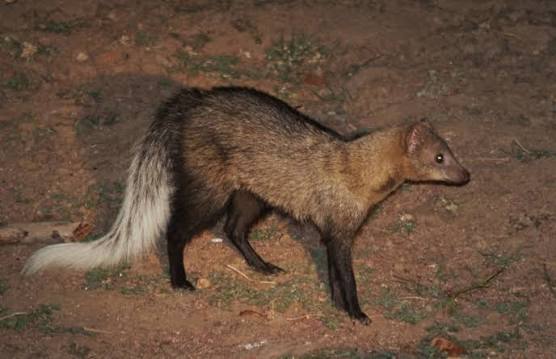
The white-tailed mongoose, Ichneumia albicauda, is the sole member of its genus and Africa’s largest mongoose. Adults weigh between 2.5 and 5.2 kilograms. Body length reaches 47 to 71 centimetres with a tail of 35 to 47 centimetres. The coat is coarse and grey-black darker on the limbs and face, lighter on the body. The tail is pure white, bushy, and held semi-erect during movement. That white plume shows at 100 metres in a spotlight even when the rest of the animal is in shadow.
The legs are disproportionately long for a mongoose the body stands high off the ground compared to other species. A pointed muzzle and small ears are standard mongoose features. The anal glands produce a powerful secretion for scent marking and defence. A threatened individual raises its tail, faces the threat, and erupts the anal gland secretion toward the aggressor.
Nocturnal and Solitary
The white-tailed mongoose is strictly nocturnal. After dark it emerges from daytime dens hollow trees, rock crevices, or abandoned burrows and forages alone through its home range. Nightly foraging routes cover 3 to 8 kilometres in a systematic pass through the territory. Home ranges overlap minimally between same-sex neighbours. The scent-marking system maintains spacing without requiring direct encounters.
Unlike the banded mongoose and dwarf mongoose the most conspicuously social of East Africa’s mongooses this species is not gregarious. Pairs form only during the brief mating period. Females rear litters of 2 to 3 pups entirely alone. A large home range, low prey density foraging strategy, and nocturnal activity pattern all reduce the benefit of group foraging that drives sociality in smaller diurnal mongoose species.
Diet: Invertebrates and Small Vertebrates
The white-tailed mongoose eats invertebrates primarily beetles, millipedes, termites, crickets, and earthworms supplemented by frogs, lizards, rodents, and bird eggs found on the ground. Foraging involves slow walking with the nose to the ground surface and litter. At the smell of a buried invertebrate or rodent, the animal pauses and digs. Large body size allows handling of prey large beetles, heavily armoured millipedes that smaller mongooses cannot safely manage.
Snake venom immunity, shared with most mongoose family members, allows this species to take venomous snakes during foraging. The approach uses rapid feinting attacks to tire the snake, then a kill bite to the back of the skull when the snake momentarily stills.
Range in East Africa
The white-tailed mongoose occupies sub-Saharan Africa wherever woodland, savanna, or forest edge exists. In East Africa it spreads widely across Uganda, Kenya, and Tanzania. Dense forest interiors and very arid zones fall outside its range. Night drives in virtually any East Africa national park or conservancy with a night drive programme produce sightings.
Plan Your Safari
Night drives in the Maasai Mara conservancies, Tanzania’s Ngorongoro, Ruaha, and Selous, and Uganda’s Queen Elizabeth and Murchison Falls regularly produce white-tailed mongoose encounters. The animal moves slowly on its foraging route and tolerates quiet vehicle approach. Parking 10 metres away and watching through binoculars while it forages produces observation quality that a drive-past approach misses entirely. The white tail waving through the grass as it searches the leaf litter is as unmistakable as any large mammal sign in Africa at night.
African Wild Trekkers includes night drive programmes in safari itineraries where available. Contact us to plan an East Africa safari that covers the full spectrum of the nocturnal ecosystem.