Uganda Forest Buffalo: The Congo Basin Buffalo in Uganda’s Forests
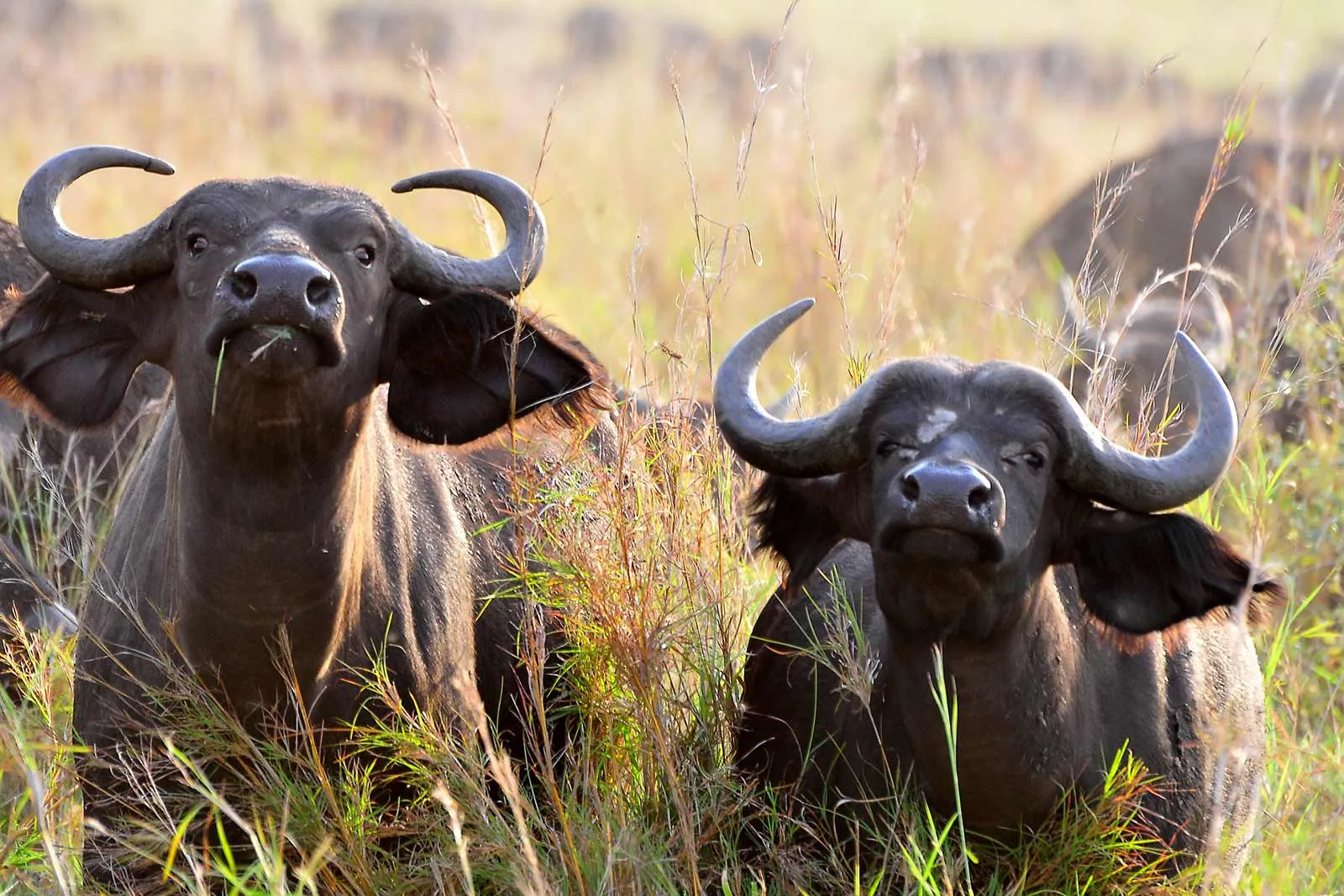
Uganda forest buffalo inhabit the dense rainforest and forest edge zones across western Uganda, representing a distinct ecological type from the large-horned Cape buffalo of Uganda’s open savannas. The forest buffalo is smaller, redder, and less gregarious than the savanna buffalo. Uganda forest buffalo groups typically number 4 to 20 animals compared to savanna buffalo herds of 100 to 500. These forest-adapted animals navigate dense undergrowth, papyrus swamps, and riverine thickets that savanna buffalo rarely enter. Queen Elizabeth National Park, Kibale National Park, and Budongo Forest all hold Uganda forest buffalo populations at the forest-savanna transition zone. Encountering these animals on a forest walk or forest edge game drive delivers a completely different quality of buffalo observation from the large Murchison Falls savanna herds.
Uganda forest buffalo belong to the western/central African forest buffalo subspecies group. Their range extends from the Congo Basin forests eastward into Uganda’s Albertine Rift forest zone. The redder coat of Uganda forest buffalo compared to the dark grey of savanna buffalo reflects the different selective pressures of a forest rather than open grassland environment. Forest buffalo at Kibale and Queen Elizabeth show significantly less human fear than savanna buffalo at Murchison. This is counterintuitive but reflects the absence of historical mass hunting in the denser forest areas compared to the open savanna zones.
Uganda Forest Buffalo Behaviour and Ecology: Uganda Forest Buffalo Social Structure
Uganda forest buffalo live in small mixed groups of 4 to 20 animals led by a dominant cow. The small group size reflects the need to move through dense forest vegetation where large herds would create too much noise and disturbance. Solitary old males are the most commonly encountered Uganda forest buffalo individuals on forest walking trails. These solitary males, expelled from the breeding group at maturity, inhabit specific forest edge and riverine thicket territories. They are among the most dangerous animals in Uganda’s forests for walkers who approach too closely without awareness. Uganda forest buffalo solitary males have caused serious incidents with both tourists and rangers at forest sites across Africa.
Uganda forest buffalo feeding behaviour focuses on forest floor vegetation, saplings, and the fresh grass of forest clearings. The animals follow predictable paths between feeding clearings, water sources, and dense forest resting areas on daily circuits. Knowing these paths allows forest walking guides to position ahead of moving buffalo for safer observation. Uganda forest buffalo at the forest-farmland edge near Kibale National Park regularly raid crop fields at night. Community-based electric fencing programmes protect some farms and allow Uganda forest buffalo to maintain their natural range without escalating human-wildlife conflict.
Uganda Forest Buffalo at Key Sites
Queen Elizabeth National Park’s Maramagambo Forest holds Uganda forest buffalo in the dense forest interior and the forest-savanna edge. Game drives through the forest road at Maramagambo regularly encounter small Uganda forest buffalo groups crossing from forest to grassland. The forest edge habitat in the Ishasha sector of Queen Elizabeth also holds Uganda forest buffalo alongside the famous tree-climbing lions. The interaction between Uganda forest buffalo and the Ishasha tree-climbing lions is one of the park’s most watched ecological relationships. Lions that habitually climb fig trees to rest above the Uganda kob grassland also descend to hunt Uganda forest buffalo at the forest margin.
Kibale National Park road verges and forest edges regularly produce Uganda forest buffalo encounters on transfer drives to and from the Kanyanchu visitor centre. The Kibale forest holds a resident Uganda forest buffalo population that moves between the park interior and the farmland buffer zone. Driving through the Kibale area at dawn or dusk maximises Uganda forest buffalo encounter probability as these crepuscular animals are most active in the low-light transition periods. Kibale National Park walking trails with rangers occasionally produce Uganda forest buffalo encounters in the forest interior. These forest encounters deliver the most intimate and atmospheric Uganda forest buffalo observation experiences available.
Uganda Forest Buffalo vs Savanna Buffalo
Comparing Uganda Forest Buffalo and Cape Buffalo
The Cape buffalo of Murchison Falls and Lake Mburo National Parks represents a different subspecies from the Uganda forest buffalo of Kibale and Queen Elizabeth forest zones. Cape buffalo bulls in Uganda reach 800 kilograms and carry the massive boss-horns that make them one of Africa’s most imposing animals. Uganda forest buffalo bulls are significantly smaller at 300 to 400 kilograms, with less massive horns that lack the full boss development of the Cape subspecies. Both types occur within Uganda’s borders, giving the country a rare dual-buffalo situation that few other African countries replicate.
The behavioural differences between Uganda forest buffalo and savanna Cape buffalo reflect their different ecological settings. Savanna Cape buffalo at Murchison move in large herds that create safety through numbers against lion predation. Uganda forest buffalo in dense forest rely on concealment and forest knowledge rather than herd size. A confronted Uganda forest buffalo chooses concealment more readily than a savanna buffalo, which is more likely to stand and face the threat. This behavioural difference matters for walking safari safety management. Rangers leading walks in Uganda forest buffalo habitat use different approach and retreat strategies than rangers on open savanna walking safaris.
Photography of Uganda Forest Buffalo
Uganda forest buffalo photography differs from open savanna buffalo photography in light quality and approach distance. Forest edge encounters provide dappled light that creates challenging exposure conditions but atmospheric and distinctive images. A forest-framed portrait of a Uganda forest buffalo cow with calf in the forest edge light captures a completely different character than a savanna herd photograph. The red coat of Uganda forest buffalo photographs most accurately in open shade rather than direct forest light. Early morning game drives along forest edge roads at Queen Elizabeth produce the warmest light on Uganda forest buffalo coats before full sun creates harsh contrast.
Camera lenses of 200mm to 400mm cover the typical encounter distances for Uganda forest buffalo on game drives and forest walks. Longer lenses are rarely necessary because Uganda forest buffalo at habituated sites allow close approach. Wide-angle shots that include the forest habitat context alongside the buffalo animal tell the ecological story of the forest buffalo more completely than tight animal portraits alone. Building a Uganda forest buffalo photo set that includes forest setting, individual animal behaviour, and the forest-savanna transition habitat creates a rich documentary record of this distinctive and underappreciated Uganda wildlife species.
Plan Your Safari
Plan Uganda forest buffalo encounters as part of game drives along the forest edge roads at Queen Elizabeth’s Maramagambo sector and on the Kibale access road. Include early morning and late afternoon driving sessions at these sites for the best crepuscular encounter windows. Walking safari bookings at Lake Mburo or Murchison provide Cape buffalo encounters as a complementary savanna buffalo experience alongside the forest subspecies.
African Wild Trekkers includes Uganda forest buffalo encounters in western safari itineraries at Queen Elizabeth and Kibale. We design game drive routes that specifically cover the forest edge sections where Uganda forest buffalo encounters are most reliable alongside the standard savanna wildlife programme.
Contact African Wild Trekkers to plan your Uganda forest buffalo safari. We respond within 24 hours and design itineraries that cover Uganda’s diverse buffalo habitats from Kibale forest to the Murchison Falls open savanna.