African Elephant Facts 2026: Behavior, Intelligence & Best Viewing Spots
The World’s Largest Land Animal
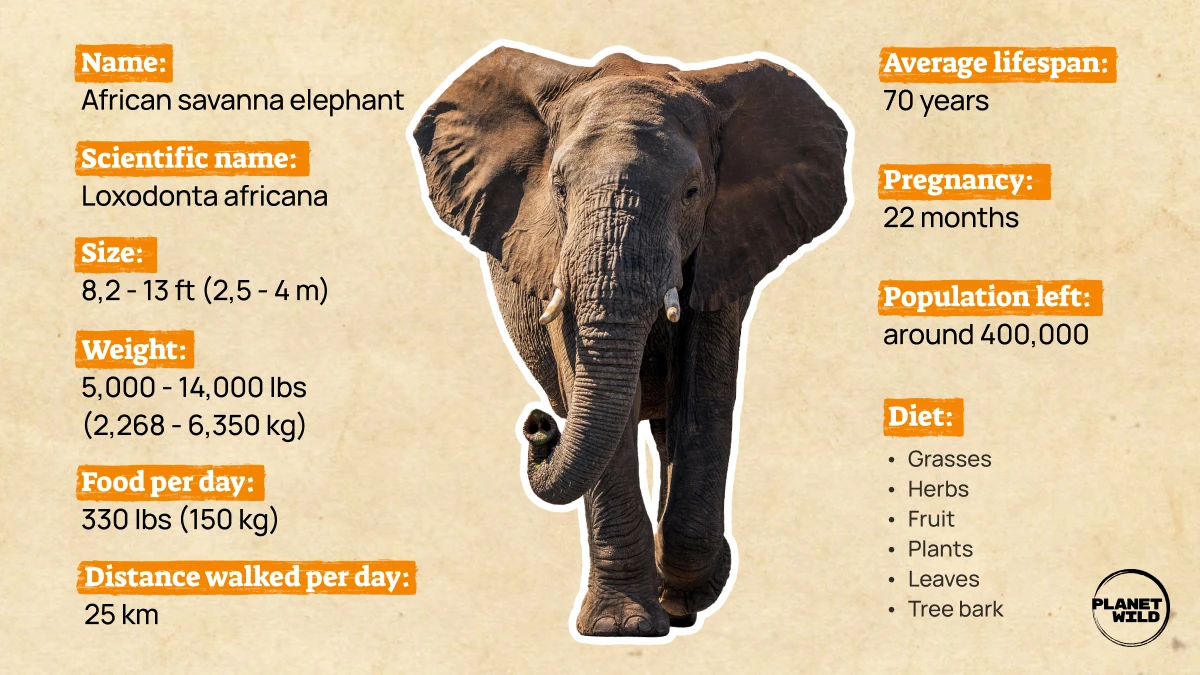
The African elephant is the largest land animal on Earth. Encountering one in the wild. At a waterhole, crossing a river, or moving silently through the forest. Is one of the most powerful experiences that any safari can deliver. African elephants come in two distinct species. The African bush elephant is found across savanna and woodland habitats in East and Southern Africa. The African forest elephant lives in the dense rainforests of Central and West Africa. The bush elephant is the larger of the two and the species most safari travelers encounter. Males can stand over three meters at the shoulder and weigh more than six tons. This body mass requires enormous quantities of food and water to sustain. It drives the daily movements that make elephant watching so consistently rewarding.
Elephants are among the most studied and documented animals in the world. Yet their behavior continues to reveal new layers of complexity that challenge even experienced researchers. Their cognitive abilities, emotional lives, and social structures are more sophisticated than most animals science has studied. Every year new research adds to the picture. Understanding what elephants actually are. Not just as magnificent animals to photograph. But as highly intelligent, emotionally complex social beings. Transforms the experience of watching them. It shifts the encounter from a visual spectacle into something genuinely moving.
African Elephant Social Structure
The Matriarchal Family Unit
African elephant society is built around the matriarchal family unit. This is a group of related females and their young led by the oldest and most experienced female. The matriarch’s role is not ceremonial. She carries decades of learned knowledge about seasonal water sources, migration routes, food locations, and predator threats. The family’s survival depends directly on the quality of her decision-making. Research in Amboseli National Park has shown that families led by older matriarchs have significantly higher survival rates during drought years. Older females have experienced previous droughts and remember water sources that younger animals have never visited. This lived, transmitted knowledge is one of the most remarkable aspects of elephant social biology.
Family units typically consist of six to twelve individuals: the matriarch, her daughters and sisters, and their young calves. Related family units form larger clan groups that share home ranges and interact regularly. They maintain these clan relationships even when the families are kilometers apart. Long-distance infrasonic communication makes this possible. Male elephants leave the family unit at sexual maturity, typically between age ten and thirteen. They either range alone or form loose bachelor groups. The transition from family life to solitary or bachelor existence is gradual and sometimes reluctant. Young bulls often follow their birth family for months after their formal departure before gradually extending the distance between themselves and the group.
Musth and Bull Behavior
Bull elephants experience musth—a periodic state of heightened testosterone and sexual activity—once they reach full adulthood, typically in their mid-twenties. During musth, which can last days or months, bulls become significantly more aggressive. They secrete a dark, oily substance from the temporal glands on the sides of their heads. They also produce a continuous stream of strongly scented urine. Musth bulls actively seek females in estrus and fight other bulls with genuine ferocity. Fights between large musth bulls can result in serious injury or death. Safari guides learn to identify musth males at a distance and typically advise giving them a wider berth than non-musth animals.
Older, larger bulls in musth have priority access to females over smaller or younger males. This dynamic drives the social and genetic structure of elephant populations. Large bulls with well-developed tusks are the dominant breeders in any population. Tusks are functional for digging, fighting, and feeding. They also indicate genetic quality. The selective removal of large-tusked bulls through ivory poaching has had documented effects on elephant genetics across multiple African populations. Average tusk sizes have declined in heavily poached areas over decades. The recovery of large-tusked bulls is one measure of population recovery in parks where ivory protection has improved.
Elephant Intelligence and Emotional Life
Problem Solving and Tool Use
African elephants pass the mirror self-recognition test, one of the benchmarks researchers use to assess self-awareness in animals. They do this alongside humans, great apes, dolphins, and a handful of other species. They demonstrate advanced problem-solving skills. They use tools such as sticks to scratch themselves in locations their trunk cannot reach. They also modify objects in their environment to achieve specific goals. In captivity, elephants have spontaneously used objects as stepping stools to reach high-hanging food items. They have cooperated to solve tasks that neither animal can complete alone. In the wild, the complexity of the social navigation and long-distance route planning that wild elephants perform daily reflects cognitive capacity that researchers continue to find new methods to measure and describe.
Elephant memory is not a myth. Long-term recognition studies have demonstrated that elephants remember individual humans, other elephants, and spatial information across decades. Matriarchs lead their families back to water sources not visited in years without apparent hesitation. Elephants encountering other elephants they knew as calves. After separations of fifteen or twenty years. Demonstrate recognition through complex greeting ceremonies. These involve touching, vocalizing, and temporal gland secretion. The phrase “elephants never forget” is, in terms of spatial memory and individual recognition, a reasonable summary of the peer-reviewed evidence.
Grief, Play, and Communication
Elephants display behaviors that researchers describe as grief responses around the bodies of dead family members. They return repeatedly to carcasses and skeletal remains, touching bones with their trunks. They carry the remains short distances and spend extended periods in apparent stillness near them. This behavior occurs specifically around the remains of known individuals. Family members and close associates. Rather than around unfamiliar elephant carcasses. This suggests that recognition of and emotional connection to the deceased drives what observers interpret as mourning. Whether elephants experience subjective grief in the way humans do is philosophically unprovable. But the behavioral evidence that they respond to death differently from most other species is well established.
Elephant communication occurs across a far broader spectrum than human observers can detect without specialized equipment. Infrasonic vocalizations—below the range of human hearing—carry over distances of several kilometers through both air and ground vibration. This allows families to coordinate movements and communicate threat information across distances that visual or audible signals could never cover. The rumbles, trumpets, screams, and growls that human observers can hear are only part of a far richer communication system. Recordings of elephant vocalizations played back in the field can produce recognizable behavioral responses from elephants several kilometres away.
Best Places to See African Elephants
Amboseli, Chobe, and Hwange
Amboseli National Park in Kenya is widely regarded as the best place in Africa to see large elephant herds in the open, with Kilimanjaro as a backdrop. The park’s elephants are among the most studied in the world. Over 1,600 individuals across more than sixty family groups are individually known to researchers at the Amboseli Elephant Research Project. The familiarity of these elephants with vehicles produces relaxed, natural behavior at very close range. The combination of swamp habitat, open grassland, and the mountain backdrop makes Amboseli photography unlike any other elephant destination. Morning light with elephants crossing the swamp edge and Kilimanjaro filling the frame is one of the most iconic wildlife images in Africa.
Chobe National Park in Botswana hosts the largest elephant concentration in Africa, an estimated 120,000 to 130,000 individuals. During the dry season the Chobe River front draws herds of hundreds of elephants to drink and bathe simultaneously. Boat safaris on the Chobe River at this time produce extraordinary close encounters with swimming elephants and bathing calves. And bulls in musth challenging each other on the riverbank. Hwange National Park in Zimbabwe has over 40,000 elephants maintained by a network of artificial waterholes. Dry-season concentration around these waterholes produces some of the highest-density elephant sightings on the continent. Tarangire National Park in Tanzania is also exceptional for elephant viewing during the dry season when large herds converge on the Tarangire River.
Elephant Conservation Status
African bush elephants are endangered on the IUCN Red List. Their numbers have declined from an estimated 1.3 million individuals in the 1970s to approximately 415,000 today. The primary driver of this decline has been ivory poaching. Which peaked in the 1980s and killed over half the continental population. The 1989 CITES ivory trade ban brought significant reductions in killing rates. A second poaching crisis in the 2000s and 2010s killed over 100,000 elephants between 2010 and 2015. Improved law enforcement, international ivory market restrictions, and demand reduction campaigns in Asian consumer markets began to reduce poaching rates again. The current trajectory in several well-managed populations—Botswana, Kenya, Tanzania’s northern circuit, and parts of South Africa—is positive. But the continental picture remains one of fragmented populations under continuing pressure.
Habitat loss is an accelerating threat alongside poaching. As human populations grow and agricultural land expands, elephant movement corridors between protected areas progressively disappear. This isolates populations and reduces genetic exchange between them. Human-elephant conflict is one of the most complex conservation challenges in Africa. It occurs when elephants raid crops, damage water infrastructure, or injure people in areas where human settlements and elephant habitat overlap. It is a significant cause of elephant mortality in areas outside formal protected areas.
Plan Your Safari
Seeing African elephants in their natural habitat. In large herds, in family groups, at waterholes, crossing rivers. Requires choosing the right park and the right season. Amboseli, Chobe, Hwange, and Tarangire each deliver different qualities of elephant encounter. The best combination depends on your travel dates, budget, and what else you want to see alongside the elephants.
African Wild Trekkers designs itineraries around the elephant-viewing windows that produce the most extraordinary encounters. These include dry-season Chobe for boat safari herds and Amboseli year-round for Kilimanjaro backdrops. And Hwange in September when the waterholes reach their peak. We combine these with complementary safari activities across each destination.
Contact African Wild Trekkers at africanwildtrekkers.com/contact with your travel dates. We will design an elephant-focused safari itinerary that delivers the best viewing conditions within 24 hours.