African Wild Ass Facts: The Critically Endangered Ancestor of the Domestic Donkey
Every domestic donkey on earth descends from the African wild ass. Domestication occurred approximately 5,000 to 7,000 years ago in northeast Africa — most likely in Ethiopia, Eritrea, or Somalia. The wild ancestor that produced this globally important working animal now faces extinction in the wild. Fewer than 600 African wild asses survive, making it one of the most critically endangered large mammals on earth. In East Africa, Ethiopia holds the only accessible wild population — a remnant of what was once a widespread dry-country species across the Horn of Africa and the Red Sea coastal zone.
What Is an African Wild Ass?
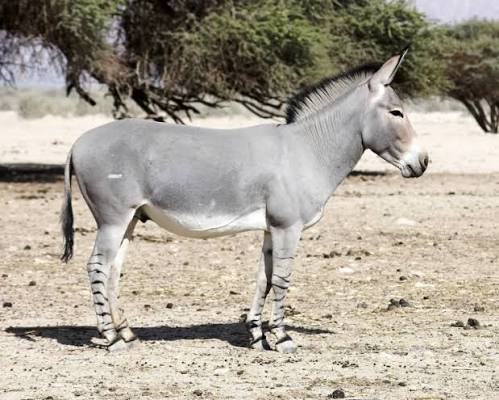
The African wild ass, Equus africanus, is the wild ancestor of the domestic donkey, Equus asinus. Two subspecies survive: the Somali wild ass and the Nubian wild ass, both critically endangered. Adults weigh between 230 and 275 kilograms. Shoulder height reaches 1.25 to 1.45 metres. The coat is smooth, pale grey with white underparts. The Somali subspecies carries distinct black leg stripes — horizontal bands on the lower legs that closely resemble the leg stripes of the Grevy’s zebra. The Nubian subspecies shows a shoulder stripe but no leg stripes. The mane is short and erect. The tail ends in a black tuft. Both subspecies carry the large, mobile ears and loud bray of the domestic donkey — a vocalisation carrying over 3 kilometres in still conditions.
Arid Country Specialist
African wild asses survive in extreme desert and semi-desert conditions where almost no other large mammal can persist. Rocky desert, dry stony plains, and mountain scrub in Ethiopia’s Afar and Tigray regions define the remaining habitat. Water independence is near-complete wild asses can go three to five days without water in cool conditions and survive on vegetation moisture and metabolic water production. When water is available, they drink deeply. Speed up to 50 kilometres per hour allows rapid movement between sparse water sources across large distances.
Hooves are narrow and hard, adapted for the rocky terrain of the Ethiopian highlands and coastal desert. The narrow hoof contacts rocky ground on the outer rim a configuration that provides traction on loose rock and dry, cracked terrain that wider, softer hooves cannot grip. This rocky-terrain specialisation is the most visible anatomical distinction between the wild ass and its domesticated descendant.
Social Structure
African wild asses are not strongly social. Dominant stallions hold territories in productive habitat and tolerate mares and sub-adults within the territory. Bachelor males and non-territorial stallions range widely outside territorial areas. Stable group formation beyond mother-offspring pairs is uncommon. This loose social structure differs from the tight family units of Grevy’s zebras and plains zebras — possibly reflecting the extreme food and water scarcity of the desert habitat where individual foraging strategies outperform group movement.
Conservation Status and East Africa Range
The African wild ass qualifies as Critically Endangered. Hybridisation with domestic donkeys is the most severe ongoing threat domestic donkeys penetrate wild ass range across the Ethiopian lowlands, and hybrid offspring are genetically detectable in most sampled wild ass populations. Pure-bred individuals become increasingly rare as hybridisation progresses. Hunting for traditional medicine and direct competition with livestock for scarce water sources add pressure. Ethiopia’s Afar Region and the Danakil Depression hold the most significant surviving populations.
Plan Your Safari
Ethiopia’s Afar Region and the Danakil Depression provide the best opportunity to observe African wild asses in the wild. The Yangudi Rassa National Park in Ethiopia’s northeast was established specifically to protect the Somali wild ass population. Visits require specialist desert expedition logistics — the terrain is remote, extremely hot, and accessible only with experienced local guides and appropriate vehicles. The combination of the wild ass sighting with the Danakil Depression’s otherworldly volcanic landscape makes this one of Africa’s most unusual and demanding wildlife destinations.
African Wild Trekkers designs Ethiopia safari itineraries combining the Danakil Depression and Afar Region with the Bale Mountains, Simien Mountains, and Omo Valley. Contact us to plan an Ethiopia safari that reaches the country’s most extraordinary and remote wildlife habitats.