Hippo Facts Africa: The Third Largest Land Animal and Africa’s Deadliest Mammal
The hippopotamus kills more people in Africa than any other large mammal. This statistic consistently surprises visitors who picture a slow, barrel-shaped animal wallowing harmlessly in river mud. The hippo’s danger comes from predictable behaviour misread as passivity. Hippos on land between water and open ground are moving between their daytime refuge and their nighttime grazing territory. Anything interrupting that transit path — a person, a boat, a vehicle — encounters an animal weighing up to 3,000 kilograms with canine teeth reaching 50 centimetres and an instinctive response to perceived obstacles that involves charging at full sprint.
What Is a Hippopotamus?
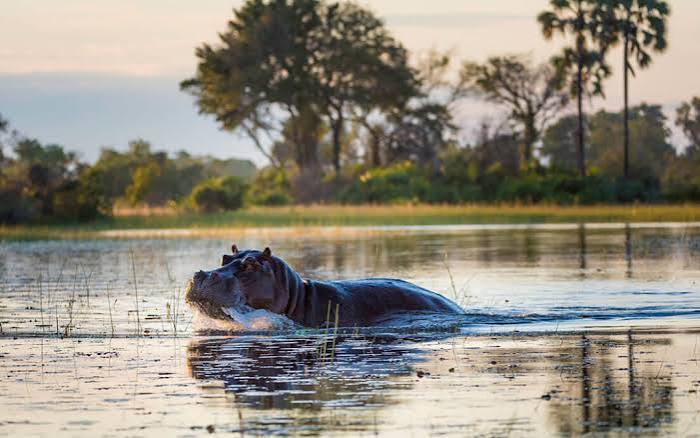
The common hippopotamus, Hippopotamus amphibius, is the third largest land animal after the elephant and white rhinoceros. Adult males weigh between 1,500 and 3,200 kilograms. Females weigh 1,400 to 2,000 kilograms. Shoulder height reaches 1.4 to 1.7 metres. Body length reaches 3.3 to 5.2 metres. The skin is nearly hairless — sparse hairs appear around the muzzle, ears, and tail tip, but the bulk of the body is bare grey-brown skin. The legs are short and stocky. The head is enormous relative to body length — wide, blunt-muzzled, and carrying the large canine teeth that open in the characteristic yawning threat display. Eyes, ears, and nostrils sit at the very top of the head, allowing the animal to breathe, see, and hear while almost completely submerged.
The Blood Sweat: Skin Protection
Hippos secrete a reddish fluid from their skin that initially appears to be blood or sweat. Neither description is accurate. The secretion is a unique skin moisturiser produced by specialised skin glands that functions simultaneously as a sunscreen, antimicrobial agent, and possible insect repellent. The reddish pigment — hipposudoric acid — absorbs ultraviolet radiation, protecting the bare skin from sun damage during the hippo’s daytime exposure at the water’s edge. The antimicrobial properties help prevent skin infections from the cuts and scrapes that fighting males sustain regularly. No equivalent secretion exists in any other mammal.
Semi-aquatic Lifestyle
Hippos spend up to 16 hours per day in water. The aquatic lifestyle provides thermoregulation in the African heat bare skin without subcutaneous fat loses heat rapidly in water but overheats equally rapidly in direct sun. Water immersion maintains body temperature within a viable range. Hippos do not swim in the conventional sense they walk along the river or lake bed, bouncing off the bottom with each stride to move through deeper water. The buoyancy of their body fat means they rest in water with minimal muscular effort.
After dark, hippos emerge from the water to graze. A single adult hippo consumes 35 to 40 kilograms of grass per night. Grazing routes extend up to 10 kilometres from the water source along established paths worn into the riverbank and surrounding grassland. The return journey before dawn follows the same paths hippo paths are among the most durable wildlife infrastructure in any East Africa riverine environment.
Range in East Africa
Hippos occupy rivers, lakes, and permanent wetlands across Kenya, Tanzania, and Uganda. The Mara River, Kazinga Channel, Nile at Murchison Falls, Lake Victoria margins, Lake Naivasha, Ruaha River, and Selous-Nyerere’s river systems all hold significant populations. Uganda’s Kazinga Channel connects Lake Edward and Lake George and supports one of East Africa’s highest hippo densities — approximately 5,000 individuals along 36 kilometres of channel.
Plan Your Safari
Uganda’s Queen Elizabeth National Park Kazinga Channel boat safari delivers the finest hippo encounter in East Africa. The 2-hour boat journey along the channel passes aggregations of hundreds of hippos at close range the scale of the hippo population visible from water level is genuinely impressive. Kenya’s Maasai Mara river pools concentrate hippos during the dry season, and dawn drives along the Mara River produce dramatic dawn aggregation observations. Tanzania’s Selous-Nyerere boat safaris on the Rufiji River pass hippo pools of 50 to 100 animals at very close range.
African Wild Trekkers designs Uganda, Kenya, and Tanzania safari itineraries with boat safari experiences on the best hippo waterways in East Africa. Contact us to plan a safari revealing the full diversity of East Africa’s water-dependent megafauna.