Great Migration Maasai Mara 2026: What to Expect and When to Go
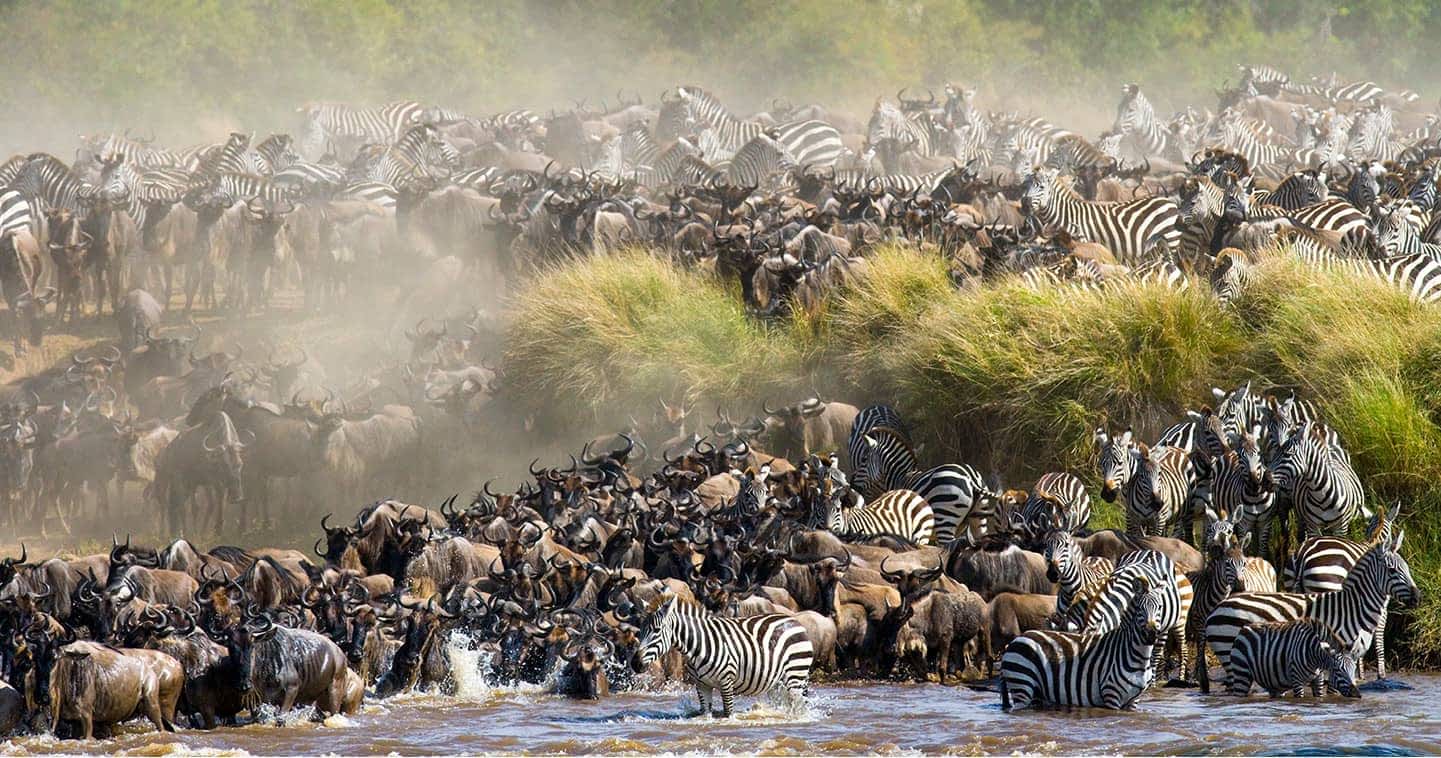
The Great Migration Maasai Mara 2026 brings approximately 1.5 million wildebeest, 200,000 zebras, and thousands of gazelles from Tanzania’s Serengeti into Kenya’s Maasai Mara between July and October, creating the largest land animal migration on earth and the most famous wildlife spectacle available to safari travelers. This annual movement follows the seasonal rainfall that generates fresh grass across the Serengeti-Mara ecosystem, and the herds’ clockwise circular route between Tanzania and Kenya has repeated for millennia with the predictability that makes it bookable but the moment-by-moment unpredictability that makes it genuinely thrilling. African Wild Trekkers positions clients in the Maasai Mara during the optimal crossing window based on current seasonal conditions and places them in camps with the best river access for the specific weeks they visit.
Understanding the Migration Circuit
The Annual Calendar of the Wildebeest
Wildebeest calve in the southern Serengeti and Ngorongoro Conservation Area between January and March, and the approximately 400,000 calves born during this period grow rapidly on the fresh short-grass plains that provide ideal lactation grazing for their mothers. The herds begin moving north through the Serengeti’s central plains in April and May as southern rains taper and grass quality declines, and the northward progression reaches the Grumeti River in western Tanzania around June where the first significant river crossing events occur before the herds continue east toward the Mara. The Tanzania-Kenya border crossing happens between late June and mid-July, and the Mara River crossing events that define the Kenyan migration experience occur primarily between July and early October as herds move back and forth across the river in response to grass quality signals on both banks. The return south through Tanzania begins in October and November as Kenya’s short rains trigger fresh grass growth in the Serengeti, completing the annual circuit.
Why the Mara River Crossings Are Spectacular
The Mara River crossing events concentrate the migration’s drama into an intense physical spectacle because the river acts as a barrier requiring wildebeest to overcome genuine fear in order to reach grazing on the far bank. Herds gather on one bank for hours — sometimes days — while individual animals test the water’s edge and retreat before the collective courage threshold is reached and thousands of animals plunge simultaneously into the crocodile-filled water. The crossing itself lasts between 15 and 90 minutes depending on herd size and river conditions, and the combination of surging bodies, churning water, crocodile strikes, and the desperate scramble up the far bank on steep muddy slopes creates visual and auditory chaos that overwhelms observers regardless of how many documentary sequences they have watched in preparation. Survival from a crossing is not guaranteed — animals drown in the current, die in crocodile attacks, or are trampled on the exit bank — and the physical reality of this event in front of you produces a profound recognition of natural processes operating without human influence or mitigation.
Where to Position Yourself for Crossings
Key Crossing Points in the Maasai Mara
The Mara River has several established crossing points that the wildebeest use repeatedly through the season, and positioning near these specific locations significantly improves your probability of witnessing a crossing during a given game drive. The crossing at Mara Serena near the reserve’s southern sector attracts herds during July and August when the wildebeest first enter the Mara from Tanzania. The Purungat Bridge crossing in the central Mara sees activity throughout the season because the crossing topography here — a relatively accessible bank on both sides — makes it one of the most frequently used Mara River crossing points. The northern crossings near Mara North Conservancy activate primarily in August and September when the herds push deeper into the reserve’s northern sections. Your camp guide receives daily information from ranger networks about which crossing points are showing congregation activity, and this intelligence allows game drives to reach the right location rather than arriving at an empty bank.
Private Conservancy vs National Reserve for Crossing Views
Camps located in Olare Motorogi, Mara North, Naboisho, and other private conservancies surrounding the national reserve offer crossing viewing with significantly fewer competing vehicles than the main reserve crossing banks, where dozens of vehicles from multiple camps converge simultaneously during active crossing events. Conservancy operators self-regulate vehicle numbers at crossing banks and enforce quieter behavior protocols that maintain an atmosphere appropriate to witnessing a profound natural event rather than a stadium spectacle. The trade-off is that conservancy crossings may be less reliable than main reserve crossings because the herds’ movements through these areas are more dispersed, but the quality of the experience when a crossing occurs in a conservancy context consistently exceeds the crowded main reserve equivalent. African Wild Trekkers recommends conservancy-based camps for clients who prioritize experience quality over statistical crossing probability, and main reserve camps for clients who want to maximize the probability of seeing a large crossing event regardless of vehicle numbers.
Practical Preparation for Migration Season
Booking Lead Time for 2026
Maasai Mara properties during peak migration season from late July through September sell out 10 to 14 months in advance at the most sought-after camps, and travelers who decide in March to join the August 2026 migration will find their first-choice properties fully booked at every accommodation tier. The December 2025 through February 2026 window represents the optimal booking period for July to October 2026 safari dates at top-tier Mara properties, and African Wild Trekkers confirms availability immediately upon client enquiry and holds space while budgets and itineraries are finalized. Budget travelers have greater flexibility because lower-priced camps outside the most popular conservancies retain availability longer into the booking cycle, but the highest-demand months still require six to eight months advance booking even at mid-range properties. Late bookings are sometimes possible when cancellations create availability, but the risk of finding nothing suitable in a suitable location is significant enough to make advance booking the consistently reliable approach.
What to Pack for Migration Season Game Drives
Migration season game drives in July and August can start in genuinely cold temperatures at 6 AM when the Mara sits at altitude above 1,500 meters and overnight cloud cover traps cold air over the grassland. A heavyweight fleece or light down jacket worn over your game drive clothing provides warmth for the first two hours before the sun burns through the cloud and the temperature rises to pleasant midday levels. Dust from the wildebeest movement creates persistent haze during crossing events, and a UV-blocking scarf or bandana over your face reduces inhalation discomfort during the dustiest hours. Camera setup for crossing events requires a telephoto lens of at least 300mm for compelling individual animal shots from the crossing bank distance, and a higher-speed memory card than standard reduces the writing lag between action frames during continuous shooting bursts. Sunscreen, sunglasses, and a hat remain essential even in the dry-season cooler temperatures because UV intensity at the Mara’s altitude is stronger than most travelers from northern latitudes experience at home.
Plan Your Safari
Book Your 2026 Great Migration Safari
African Wild Trekkers secures Great Migration camp bookings and positions clients at the right Mara River crossing points for their specific travel dates in 2026. Contact us at africanwildtrekkers.com/contact before the best slots sell out.
What Your Package Covers
Your Great Migration package includes conservancy or reserve access, Maasai guide, all game drives with daily crossing point intelligence, full-board accommodation, and transfers from Nairobi or Wilson Airport for your chosen Mara camp.
Request Your Migration Safari Quote
Tell us your 2026 travel dates and camp tier preference and we will confirm availability and send a complete package quote within 24 hours. Reach us at africanwildtrekkers.com/contact.