Kenya Travel Guide 2026: Everything You Need Before You Go
Kenya combines extraordinary wildlife, dramatic landscapes, vibrant cities, and coastal beaches in one destination. The country welcomes millions of international visitors each year. Its tourism infrastructure handles first-time travelers well when they prepare correctly. This guide covers entry requirements, health preparation, currency, and the practical details that determine whether your trip runs smoothly. African Wild Trekkers manages all pre-travel logistics—from visa assistance to health briefings—so you arrive in Nairobi informed and ready.
Entry Requirements for Kenya 2026
Kenya Visa and ETA Process
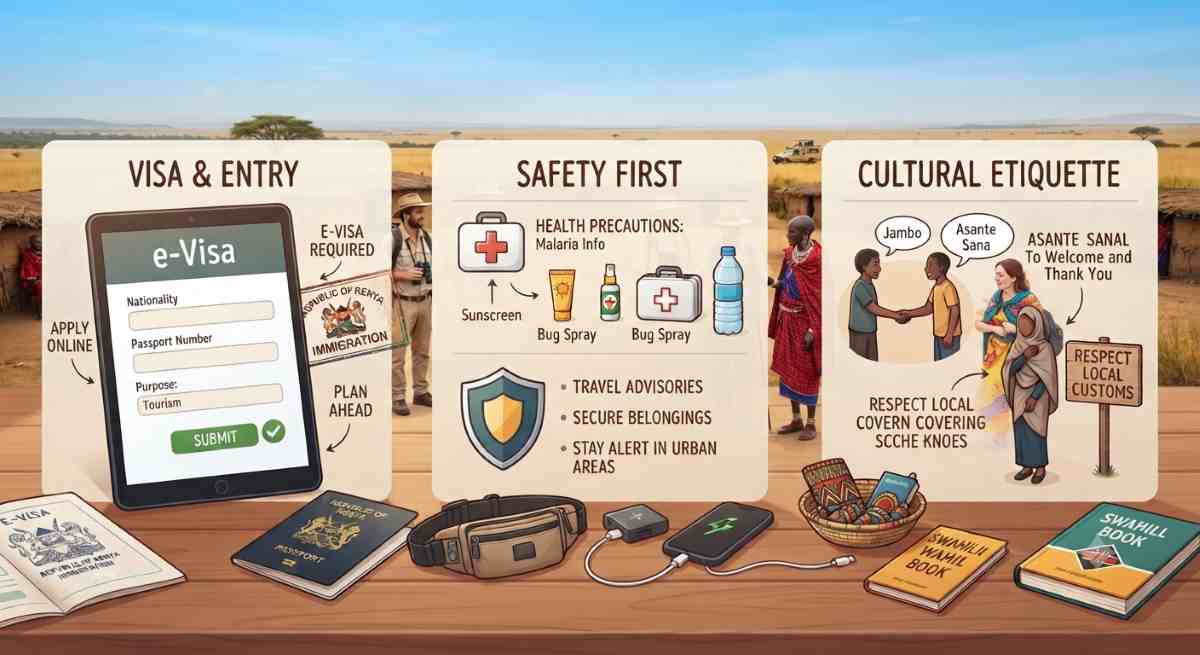
Kenya replaced visa-on-arrival with the electronic travel authorization in January 2024. Every international visitor now needs an approved ETA before boarding their flight to Nairobi. Apply at the Kenya Immigration Service portal by submitting your passport details, travel itinerary, accommodation address, and a passport photo. The ETA costs $32.50 USD, permits a stay of up to 90 days, and arrives by email within two to five business days.
Submit your application at least two weeks before departure to allow for processing time. Citizens of Tanzania, Uganda, Rwanda, and Burundi enter Kenya without an ETA under the East African Community free movement agreement. Most travelers from Europe, North America, Australia, and Asia need the ETA without exception. African Wild Trekkers sends every client a pre-travel checklist at booking that includes the correct ETA portal link.
Health Requirements for Kenya Entry
Kenya requires a yellow fever vaccination certificate from travelers arriving from endemic countries, which includes most of sub-Saharan Africa and parts of South America. Travelers arriving directly from Europe, North America, or Australia do not need the certificate at the immigration desk. Carry it regardless—any intermediate stop in an endemic country triggers the requirement. Other recommended vaccines for Kenya include typhoid, hepatitis A, hepatitis B, and a tetanus booster.
Malaria prophylaxis is essential for all visitors to Kenya’s wildlife areas below 1,500 meters elevation. Nairobi carries minimal risk at 1,700 meters, but game parks, including the Maasai Mara, Tsavo, and Samburu, require full prophylaxis. Consult a travel medicine clinic at least four weeks before departure to start medication on schedule. Pack 40 percent DEET repellent and choose lodges with screened windows and bed nets for full protection.
Money and Costs in Kenya 2026
Currency and Payments
The Kenyan shilling (KES) is the local currency, trading at approximately 128–135 KES per US dollar in 2026. USD is widely accepted at tourist facilities, national park gates, lodges, and camps across the country. Many safari operators quote and accept payment in dollars, euros, or British pounds. Credit cards—Visa and Mastercard—work reliably at Nairobi hotels, upscale restaurants, and larger tourist establishments.
Withdraw KES at Nairobi’s airport ATMs or at Equity Bank and KCB ATMs across Westlands—both give solid exchange rates. Safari and lodge costs range from $150 per person per night for budget camps to $1,500 for luxury tented camps during migration season. The Maasai Mara National Reserve entrance fee stands at $200 per person per day for non-residents. African Wild Trekkers builds all park fees into your package price so no unexpected costs appear on arrival.
Tipping Culture in Kenya
Tipping guides, drivers, and lodge staff forms an important part of the income structure for the people who deliver your Kenya safari experience. Private safari guides receive $15–$20 USD per person per day, given in an envelope at the end of the trip. Lodge camp staff receive tips through a communal tip box at $10–$15 USD per person per night. Restaurant service charges of 10 percent appear automatically at many Nairobi establishments catering to tourists.
Tipping in Kenya is not aggressive — no guide or staff member will request a tip or show disappointment if you give nothing. Carry clean USD $1 and $5 bills for small individual tips throughout the trip. African Wild Trekkers provides every client with a printed tipping guide before departure covering current rates for every person on your service team.
Getting Around Kenya 2026
Domestic Flights and Safari Transfers
Kenya’s domestic aviation network connects Nairobi’s Wilson Airport to every major safari destination in under 90 minutes. Safarilink, AirKenya, and Fly Sax operate daily scheduled services to the Maasai Mara, Samburu, Amboseli, and Lewa. A one-way flight from Nairobi to the Maasai Mara costs $150–$250 USD and replaces a five-hour road journey. Pack all luggage into a soft bag under 15 kilograms—light aircraft have strict weight limits and reject hard suitcases.
Road transfers work well for shorter routes. Nairobi to Amboseli takes four hours on a fully paved road through scenic Rift Valley country. The route to Naivasha, Lake Nakuru, or the Aberdares runs two to three hours on a sealed highway. African Wild Trekkers coordinates all transfers between your destinations so you never need to navigate Kenyan roads independently.
Nairobi Orientation for Arriving Travelers
Jomo Kenyatta International Airport sits 18 kilometers southeast of the city center. The journey into Nairobi takes 30 minutes in off-peak traffic and up to 90 minutes during morning and evening rush hours. Arrange an airport transfer through your hotel or safari operator before arrival. Unauthorized drivers approach new arrivals aggressively in the arrivals hall—avoid them and use your pre-arranged transfer.
Westlands, Karen, and Gigiri are Nairobi’s safest and most comfortable neighborhoods for overnight stays before or after safari. Hotel options run from $50 budget guesthouses to $400 four-star properties in these areas. Spend at least one night in Nairobi rather than rushing through—the Giraffe Centre, David Sheldrick Wildlife Trust, and Karen Blixen Museum each fill a worthwhile half-day before your flight to the bush.
Plan Your Safari
Kenya travel logistics—ETA applications, health documentation, domestic flight bookings, and accommodation across multiple destinations—need advance coordination to avoid sold-out and delay problems during peak season. African Wild Trekkers manages your full pre-travel checklist from ETA guidance to safari permit booking so every component of your Kenya itinerary is confirmed before you fly.
Your Kenya package includes private 4×4 transport or domestic flights between destinations, national park fees, an experienced safari guide, full-board lodge accommodation, and all transfers, including airport pickup and drop-off.
Contact African Wild Trekkers at africanwildtrekkers.com/contact with your travel dates and group size, and we will send a full Kenya itinerary with confirmed availability within 24 hours.