Lamu Sunset Cruise: Sailing the Lamu Archipelago at Dusk
Lamu is the oldest continuously inhabited town on the East African coast. It has operated as a trading port since at least the ninth century. The island and its surrounding archipelago have been declared a UNESCO World Heritage Site for their living Swahili culture and their extraordinarily intact historical townscape.
Lamu town has no paved roads and no motorised vehicles. Donkeys carry goods and residents use boats for all movement between islands and along the waterfront. The traditional dhow remains the primary working vessel of the archipelago.
A sunset cruise in Lamu does not require any aesthetic or historical imagination to experience as authentic. The vessels, the waterfront, and the seamanship on display are genuinely old, genuinely used, and genuinely part of a living maritime culture that the modern world has bypassed almost entirely.
Lamu Old Town Waterfront at Sunset
The Lamu Old Town seafront is the most atmospheric waterfront on the East African coast. The nineteenth century Swahili buildings face the channel between Lamu Island and Manda Island across a narrow strip of tidal water. The buildings’ carved wooden door frames, their coral stone walls, and the narrow alleyways behind the waterfront street carry a density of architectural history that no other East African coastal town approaches.
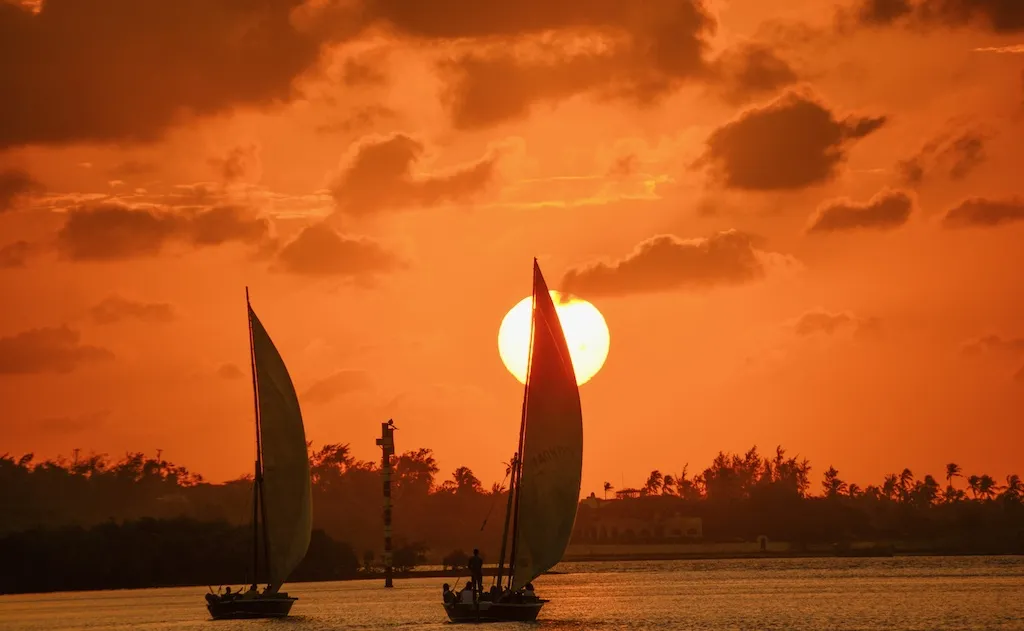
From the deck of a dhow moving slowly along this waterfront in the last hour of light, the full composition of the scene becomes visible at its best. The warm light picks out the carved door frames and the whitewashed coral walls. The harbour’s working dhows are moored or moving in the foreground. The call to prayer from the town’s mosques echoes across the channel as the sun approaches the horizon behind the mangroves of the western shore.
Mangrove Channel Exploration
The Lamu Archipelago’s mangrove channels provide a second dimension to the sunset cruise experience. The channels between Lamu, Manda, and Pate islands cut through extensive mangrove forests that carry important ecological and historical significance. The channels were the primary navigation routes for dhow traders entering and leaving the archipelago throughout the town’s trading history.
A sunset cruise that moves from the open harbour into the mangrove channels provides a transition from the open-water architectural spectacle to an enclosed, sheltered waterway of different character. The channels are calm regardless of wind conditions. The mangrove canopy closes above the boat in the narrower sections.
Fish eagles perch on exposed mangrove roots. Green herons stalk the shallow margins. The light in the channels at sunset filters through the mangrove canopy in green-gold shafts that create an enclosed, cathedral-like quality in contrast to the open-water harbour view.
Lamu’s Working Dhow Culture
The dhow building tradition at Lamu remains active. The boatyard at the town’s northern end produces new dhows using techniques passed through apprentice systems from master builders to the next generation. The specific Lamu dhow design, called the jahazi, is the largest traditional vessel type still built in the archipelago.
It carries cargo between Lamu, Mombasa, and the Tanzanian coast on the seasonal monsoon winds. The smaller mashua dhow is the primary fishing and passenger vessel within the archipelago.
Watching a mashua or jahazi under sail in the Lamu Channel at sunset, against the backdrop of the old town’s waterfront, is one of the most visually complete expressions of living Indian Ocean maritime culture available anywhere on the Swahili coast today. The experience requires no cultural staging or historical imagination because the activity in front of the observer is genuine, daily, and entirely functional.
Plan Your Safari
Lamu is accessible by scheduled daily flight from Nairobi and Mombasa. The flight from Nairobi takes approximately 90 minutes. Lamu requires a minimum of two nights to experience adequately.
Three nights allows the sunset cruise, a walking tour of the old town, a mangrove channel boat trip, and a beach day on Shela beach. Lamu pairs naturally as a Kenya coastal extension following the Maasai Mara or Laikipia circuits. The flight routing from Nairobi makes Lamu accessible without requiring a separate coastal travel programme.
African Wild Trekkers includes Lamu Island extensions in Kenya safari itineraries for guests seeking the most authentic expression of East Africa’s Swahili coastal culture. Contact us to plan a Kenya safari that combines the Mara wildlife circuit with the living history of East Africa’s oldest coast.