Red Tailed Monkeys Kibale: Meet Cercopithecus Ascanius
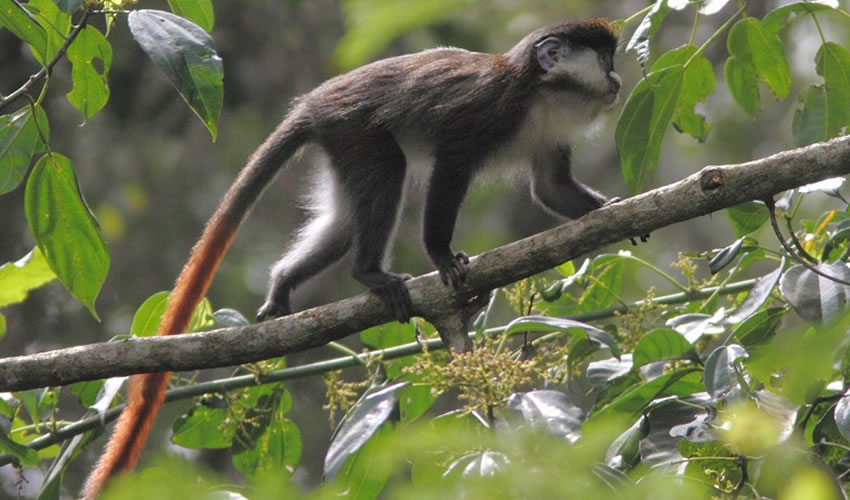
Red tailed monkeys Kibale represent one of the most acrobatic and visually distinctive primates in East Africa’s forests. Cercopithecus ascanius reaches 3 to 4 kilograms in adulthood. Adults display a vivid white nose spot set against dark facial fur and the trademark bright red tail that gives the species its name. Social groups average 20 to 35 individuals and maintain well-defined home ranges within Kibale Forest. Their energetic canopy movement and constant vocalizations make them among the most noticeable primates in the forest.
Red Tailed Monkeys Kibale: Why This Forest Has So Many
Kibale Forest hosts Africa’s highest primate density of any forest. Thirteen primate species share the 766 square kilometre protected area, from chimpanzees in the upper canopy to L’Hoest’s monkeys on the forest floor. Red-tailed monkeys thrive in Kibale’s mid-canopy zone, feeding on fruits, insects and young leaves. The forest’s protection since 1932 and designation as a national park in 1993 has allowed primate populations to recover and grow to extraordinary densities compared to degraded forests elsewhere in East Africa.
Red Tailed Monkeys Kibale: Behaviour in Detail
Watch for acrobatic leaping between branches — red-tailed monkeys cover distances of 5 to 8 metres in a single bound. Foraging groups spread through the canopy and use sharp chirp alarm calls when they detect predators. Juveniles wrestle and chase in play sessions visible from forest trails. Groups often form polyspecific associations with grey-cheeked mangabeys and black-and-white colobus — mixed-species groups of 50 or more move through the forest together, with different species foraging at different canopy levels simultaneously.
Red Tailed Monkeys Kibale: Where to See Them
The main Kanyanchu chimp trekking trail produces frequent encounters. Rangers following chimp groups often pass through red-tailed monkey territories, and the two species interact regularly. The most cost-effective location for guaranteed sightings is Bigodi Wetland Sanctuary, where community rangers lead 2-hour walks for $10 per person. Red-tailed monkeys appear on almost every Bigodi walk. Grey-cheeked mangabeys, olive colobus and L’Hoest’s monkeys complete the Bigodi primate checklist on a single walk.
Red Tailed Monkeys Kibale: Other Primates You’ll See Alongside Them
Grey-cheeked mangabeys produce the loudest vocalizations in Kibale Forest — their whoopgobble calls carry 400 metres through the trees. Large groups of 30 to 50 mangabeys forage noisily and move fast through the mid-canopy. L’Hoest’s monkeys appear on the ground and forest edge, shy and terrestrial in habit. Olive colobus remain the hardest Kibale primate to spot — they freeze motionless in vine tangles when disturbed. Chimpanzees travel through the upper canopy and can appear overhead at any point on the main trails.
Red Tailed Monkeys Kibale: Best Time and Photography Tips
Activity peaks between 6am and 9am when groups move and feed before the forest heats up. Set your camera to a minimum shutter speed of 1/500th of a second — faster movement requires 1/1000th of a second. Raise ISO to 3200 or higher inside the dark forest canopy. Use continuous autofocus and burst mode to capture movement sequences. A 200mm to 400mm telephoto allows you to fill the frame from 10 to 20 metres below a moving group. Mornings after overnight rain often trigger intense foraging activity as fruit falls from wet branches.
Red Tailed Monkeys Kibale: Conservation Context
Red-tailed monkeys face significant pressure from habitat loss outside protected areas across Central and East Africa. Farmers and landowners in Uganda’s agricultural zone outside the park still encounter monkeys raiding crops, creating human-wildlife conflict. Inside Kibale’s protected boundary, the population thrives without pressure. The forest-agriculture boundary around the park’s periphery requires active management to reduce conflict and support communities living alongside the park. Community programs around Kibale convert former conflict into co-existence by employing local residents as guides at Bigodi and other community sites.
Plan Your Uganda Safari
How to Start Your Booking
Contact Us With Your Travel Dates
Reach out to African Wild Trekkers with your preferred travel window and group size. We check gorilla permit availability first, then build the full itinerary around your confirmed permit date. Contact us as early as possible for peak season dates.
Tell Us Your Budget and Style
We build Uganda safaris at every budget level — from $150 to $2,000+ per person per day. Share your accommodation preferences, activity interests and any special requirements. We tailor every element to match exactly what you want.
What Every Package Includes
Permits, Fees and Activities
Your quoted price covers all activity permits, park entry fees and ranger guide charges throughout Uganda. There are no hidden costs at park gates or trailheads. What we quote is exactly what you pay.
Transport, Accommodation and Meals
Private 4×4 safari vehicle with driver-guide, all lodge accommodation, full-board meals, Entebbe airport transfers and 24/7 in-country support are included in every African Wild Trekkers package from arrival to departure.
Why Travel With African Wild Trekkers
Local Expertise That Makes a Difference
We are a Uganda-based team with direct knowledge of every national park, lodge and guide in our network. We trek these forests and drive these plains ourselves. Our recommendations come from personal experience, not online research.
Request Your Custom Safari Quote
Visit africanwildtrekkers.com/contact to send us your enquiry. We respond within 24 hours every day of the week and deliver your personalised itinerary within three working days.