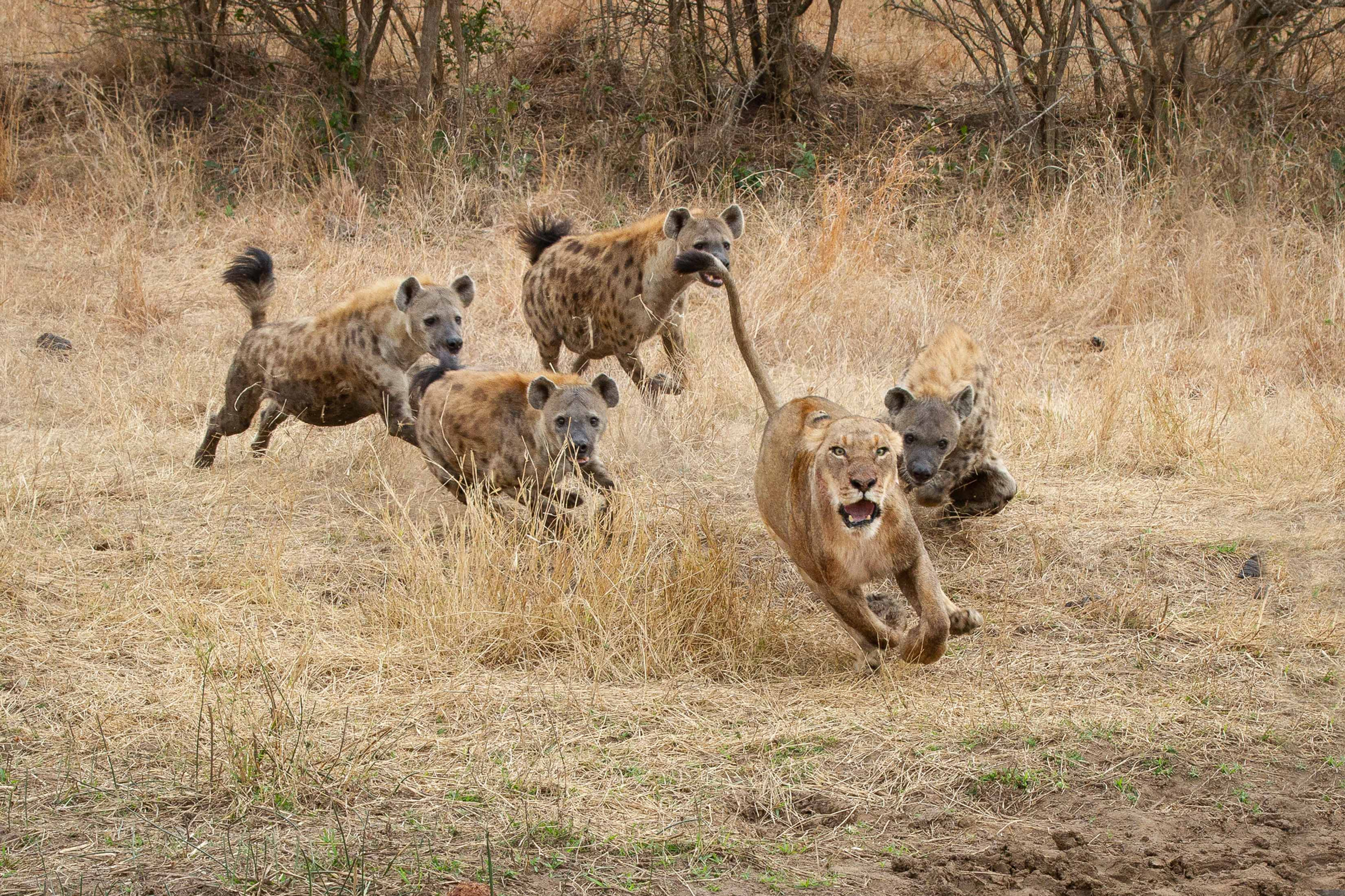
Spotted Hyena Hunting Africa: How Africa’s Most Efficient Predator Kills
The spotted hyena’s reputation as a scavenger is the most persistent misconception in East African wildlife. In the Ngorongoro Crater — where hyena-lion dynamics have been studied longer than almost anywhere else — hyenas kill approximately 70 percent of the food they eat. Lions in the same ecosystem kill about 50 percent and scavenge the rest — often from hyenas. The popular image has it almost exactly backward. Understanding spotted hyena hunting means dismantling one of wildlife tourism’s most entrenched myths.
The Hunting Mechanics: Endurance Over Speed
Spotted hyenas do not ambush. They chase. The strategy is endurance — a sustained pursuit at moderate speed that exhausts prey over 1 to 5 kilometres. Large, disproportionate forequarters and a powerful cardiovascular system maintain 50 to 60 kilometres per hour for 2 to 3 kilometres — far longer than any primary prey species can sustain. The prey animal reaches its aerobic limit first. The hyena does not.
Hyenas typically direct the chase at a specific individual — one that separated slightly from the herd, one that moved a fraction slower in the first 200 metres, one that showed a subtle gait asymmetry suggesting injury. Hyenas are extraordinarily sensitive to prey individuality. Experiments using recordings of prey distress calls show that hyenas discriminate between calls and adjust their response based on inferred prey condition and group composition.
Cooperative Hunting: How Group Size Affects Success
A single hyena hunting wildebeest succeeds on roughly 15 to 20 percent of attempts. Two hunting together succeed at 30 percent. A group of three or more achieves 35 to 40 percent. Beyond five, the improvement diminishes — coordination costs begin to outweigh access benefits. Zebra require larger groups than wildebeest — the zebra’s defensive kick is dangerous to a single hyena approaching for the throat grip. Groups of 5 to 10 hunt adult zebra regularly in the Ngorongoro.
Communication during cooperative hunts is visual and vocal. The giggle call — the characteristic laughing sound — summons clan members from a distance during hunts and at kills. The whoop call, a rising, far-carrying sound, brings distant clan members to kill sites and coordinates individuals spread across a wide hunting territory.
The Kill: Evisceration Rather Than Suffocation
Hyenas kill by evisceration — pulling out intestines and internal organs through the abdominal wall while prey is still mobile. This kill mechanism is slower and more traumatic than a cat’s throat grip, but far safer for the hyena. The hyena’s head stays away from the prey’s dangerous hooves and horns throughout. The prey animal incapacitates itself through blood loss and organ damage rather than asphyxiation.
Eating speed following a kill is extraordinary. Five hyenas reduce a wildebeest to nothing — bones included — in 15 minutes. Bone-crushing ability in the back teeth, combined with a highly acidic digestive system, means almost nothing of a carcass wastes. Hyena scat is white from the calcium carbonate of digested bone — a reliable field sign of hyena activity in any area.
Plan Your Safari
The Ngorongoro Crater is the finest hyena hunting observation location in the world. The crater’s contained area, high hyena density, and open terrain make night hunts visible and followable from a vehicle. Dawn drives — starting at first light when the previous night’s hunts are finishing — frequently find hyenas still at a fresh kill. The Maasai Mara’s Mara River area during the wildebeest migration produces large clan hunts of crossing animals. Seeing the hyena as a predator first and a scavenger second transforms every encounter permanently.
African Wild Trekkers designs Ngorongoro and Maasai Mara itineraries for visitors interested in predator behaviour and East Africa’s full carnivore ecology. Contact us to plan a safari that reveals the real hyena.