Rwanda Kinyarwanda Phrases: Essential Words for Your Rwanda Safari
Learning a handful of Kinyarwanda phrases before your Rwanda visit is one of the most rewarding preparations you can make. Rwandans respond with immediate warmth when a visitor makes the effort to speak even basic words in the national language. The responses you receive from market sellers, community members, and guides when you try Kinyarwanda are genuinely different from those you get when you speak only English. Language is the single most accessible way to signal respect for the culture you are visiting.
Kinyarwanda is a tonal language with a complex grammar. Fluency requires years of study. But the functional purpose of visitor phrases is not fluency. It is connection. A greeting, a thank you, and a few market words delivered with confidence and a smile achieve that purpose without requiring grammatical precision. Start with the essentials and build from there.
Essential Greetings
Muraho is the standard hello and the first word to learn. It works in all settings and at all times of day. Rwandans will respond with muraho and often with a broader greeting exchange. You can nod and smile to indicate the exchange is complete if you have not yet learned the responses.
Amakuru means how are you. It is the natural follow-on greeting after muraho. The expected response is ni meza, meaning I am fine or things are good. Saying muraho, amakuru? and receiving ni meza in response creates a complete greeting exchange that Rwandans find genuinely pleasing from a visitor.
Mwaramutse means good morning and nimugoroba means good evening. Using the time-specific greeting rather than the general muraho demonstrates a slightly deeper engagement with Kinyarwanda that Rwandans notice and appreciate. These two phrases are worth adding once the basic muraho greeting is comfortable.
Murabeho is goodbye. Tugasubire is see you again or until we meet again. Using murabeho at the end of any interaction, no matter how brief, creates a respectful close that generic English goodbyes do not deliver in the same way.
Courtesy and Essential Phrases
Murakoze means thank you. It is one of the most important and most frequently useful Kinyarwanda words for any visitor. Use it after every transaction, every direction given, and every service received. Murakoze cyane means thank you very much. The cyane intensifier is worth adding immediately as it elevates the courtesy level of the expression.
Yego means yes and oya means no. These two words are essential for any market or direction interaction. Knowing them removes the need to nod ambiguously when a simple yes or no answer is needed. They are also useful for confirming understanding during guided activities.
Mfite amakosa means I am sorry or I made a mistake. This phrase is useful when you make an error in an interaction. Rwandans appreciate the acknowledgment of error and the cultural expectation of courtesy in social exchanges means that the phrase carries positive social weight in any context where it is appropriate.
Market and Practical Phrases
Angahe means how much does it cost. This is the single most useful phrase for any market visit. Saying angahe while pointing at an item produces an immediate price response. It also signals to the seller that you have some Kinyarwanda ability, which often creates a more genuine and less elevated initial price than the assumption of a non-Kinyarwanda-speaking visitor sometimes produces.
Biragoye cyane means it is very expensive. This phrase is useful in negotiation at market stalls. Delivered with a smile rather than aggression, it signals that you want to negotiate rather than accept the opening price. The seller’s response will either confirm the price or offer a reduction. Rwandan market negotiation is generally good-natured and the expression of a price opinion is culturally appropriate at market stalls.
Ndashaka means I want or I would like. Ndashaka iyi means I want this one. These two phrases allow basic ordering and selection at food stalls and market sellers without requiring extended explanation in English. They are also useful in simple restaurant settings in smaller towns where English menus and English-speaking staff may not be available.
Numbers
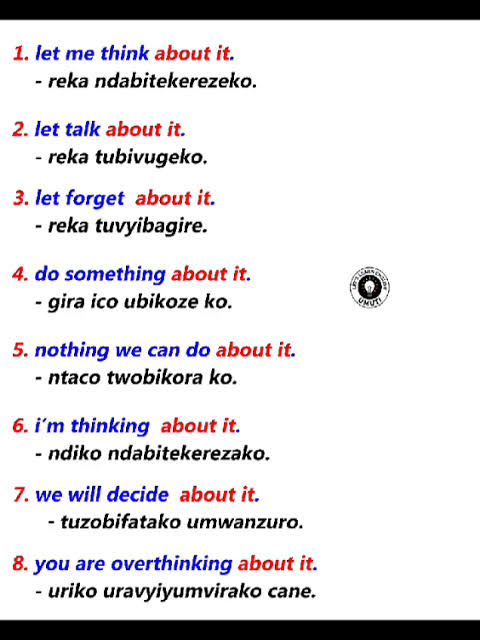
Knowing numbers one through ten in Kinyarwanda is useful for market transactions and for understanding prices. Rimwe is one, kabiri is two, gatatu is three, kane is four, gatanu is five, gatandatu is six, karindwi is seven, umunani is eight, icyenda is nine, and cumi is ten. Beyond ten, Kinyarwanda numbers use combination patterns. Knowing one through ten allows basic quantity and price communication in market settings.
Using Your Kinyarwanda on Safari
Use your Kinyarwanda phrases at every opportunity throughout the Rwanda safari. Greet market sellers in Kinyarwanda before switching to English for the transaction. Thank guides and porters in Kinyarwanda. Greet community members on village walks. The cumulative effect of these interactions over a week in Rwanda creates a qualitatively different relationship with the country than using English in every exchange.
African Wild Trekkers provides Rwanda safari clients with a Kinyarwanda phrase guide as part of pre-trip preparation. Contact us to plan a Rwanda safari that prepares you to engage authentically with the country and its remarkable people.