Rwanda Weaver Birds: Finding Africa’s Master Nest Builders
Weavers are among the most conspicuous and most architecturally impressive birds in Rwanda. The family Ploceidae is extraordinarily diverse in Africa. Rwanda hosts more than 30 weaver species across its range of habitats. The woven grass nests that give these birds their name are a defining feature of the Rwanda landscape at wetlands, forest edges, and garden areas throughout the country.
Male weavers in breeding plumage are among the most striking birds in Rwanda’s avifauna. The brilliant yellow and black combination of many species, the vivid red of others, and the specific species-level variation in bill shape, head colour, and nest structure make weavers an endlessly interesting family for birders at any level of expertise. Non-specialist birders often find weavers among the most satisfying Rwanda birds to identify and observe because their conspicuousness and the variety of their nest structures make them visually accessible in ways that cryptic forest birds are not.
Weavers at Akagera
Akagera National Park holds the most diverse weaver community in Rwanda. The savanna, wetlands, and lake margins create multiple habitat types that different weaver species partition by nesting and feeding preference. The lake shores are particularly productive because several weaver species colonise the reeds and papyrus in large, noisy, conspicuous breeding colonies.
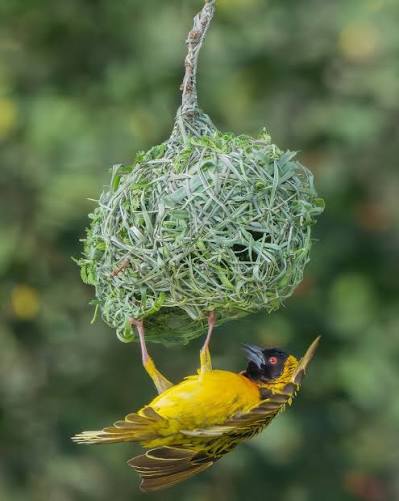
The spectacled weaver is one of Akagera’s most elegantly marked species. The yellow and black pattern with a distinctive black eye stripe makes it one of the most easily identified weavers in the park. It builds a distinctive long-tailed woven nest suspended from reed or branch tips over water. The nest construction behaviour, observed during the breeding season, demonstrates the extraordinary architectural skills that give the family its name.
The white-headed buffalo weaver is a conspicuous Akagera savanna species. Its striking black and white plumage and its habit of perching on exposed thornbush branches make it easy to find in the dry woodland sections. It nests in loose colonies and the combined calling of a small colony is audible from a considerable distance. Its distribution in the dry savanna sections of Akagera contrasts with the papyrus-breeding weavers of the lake margins.
Nyungwe and Garden Weavers
Several weaver species inhabit the forest edges and clearings of Nyungwe Forest. The black-necked weaver and the black-billed weaver occur in the forest interior. They are less conspicuous than the open-country species but reward patient observation along forest edge habitats. The forest weavers have subdued plumage compared to the brilliant yellow savanna species. Their identification requires attention to bill colour and the specific pattern of head and body markings.
Rwanda’s gardens, hotel grounds, and agricultural areas support their own weaver community. The village weaver is one of the most abundant and most widely distributed species in human-modified Rwanda landscapes. Its conspicuous yellow and black breeding plumage and its tendency to nest in large, noisy colonies in trees adjacent to human habitation make it one of the first Rwanda birds that visitors encounter. Large village weaver colonies in the trees outside Kigali lodges and along roadsides are immediately apparent to any attentive observer.
The Holub’s golden weaver occurs in wetland margins and gardens with dense shrubbery. Its all-yellow plumage distinguishes it from the patterned species. It is a quieter, less colonial nester than the village weaver and requires more careful observation to find in the mixed shrubbery habitats it prefers. It is regularly encountered in well-planted hotel gardens and around Rwanda’s lake shore wetlands.
Observing Weaver Nest Building
Watching a male weaver build or display at his nest is one of Rwanda’s most engaging bird behaviour observations. The male constructs the nest entirely from grass and plant material, weaving each strand through the structure with its bill. The nest grows from a simple loop to a complex enclosed sphere with a downward-pointing entrance tunnel over several days of construction activity.
Female weavers inspect the male’s nest critically before accepting or rejecting it. The female’s inspection behaviour, in which she probes and tests the structural integrity of the nest, can be observed at active breeding colonies from a respectful distance. Nests rejected by females are often torn down by the male and rebuilt with fresh material, demonstrating a quality control process that is fascinating to observe in the field.
Plan Your Rwanda Weaver Birding
Weavers are encountered across Rwanda’s entire safari circuit without specific planning effort. Their conspicuousness and abundance make them among the easiest Rwanda birds to observe. However, the most rewarding weaver observations, at active breeding colonies during nest construction season, require visiting during the breeding period and identifying specific colony locations with a knowledgeable guide.
African Wild Trekkers designs Rwanda birding safaris that cover the country’s full avifauna including the weaver diversity of Akagera, the forest weavers of Nyungwe, and the garden species of Kigali and the national park lodge areas. Contact us to plan a comprehensive Rwanda birding safari.