Tanzania on a Budget: Can You Do the Northern Circuit for Under 3000 USD?
The Budget Tanzania Safari Question
The question comes up constantly: can you do a Tanzania northern circuit safari for under USD 3,000 per person? The honest answer is yes — but it depends on what you mean by “do the northern circuit” and what you are willing to accept in terms of accommodation standard, vehicle type, and overall experience quality. The northern circuit — covering Tarangire, Lake Manyara, the Serengeti, and Ngorongoro Crater — is achievable within USD 3,000 per person including park fees, accommodation, and game drives. But it requires specific choices that affect comfort and experience quality in ways you should understand before booking.
This guide gives an honest breakdown of what a sub-USD 3,000 Tanzania northern circuit safari actually includes, what the trade-offs are relative to more expensive options, where the money goes (park fees account for a larger percentage than most first-timers expect), and what specific product categories exist in the Tanzania market at this price point. It is not a guide to getting the cheapest possible Tanzania safari — it is a guide to understanding what the budget tier genuinely delivers and whether it represents good value for what you will experience in the field.
Where the Money Goes: Tanzania Park Fees Explained
Why Park Fees Are the Non-Negotiable Foundation
Calculating Park Fees for a 7-Day Northern Circuit
TANAPA (Tanzania National Parks Authority) sets Tanzania’s national park fees at the same rate regardless of whether you are on a budget tour or a luxury private safari. A standard 7-day northern circuit itinerary covering Tarangire (2 nights), Serengeti (3 nights), and Ngorongoro (1 night) accumulates park fees per person of approximately USD 480 to 550 at 2026 rates, depending on exact days at each park and the specific Ngorongoro fees for crater descent. This fee is per person, non-negotiable, and represents a significant proportion of the total USD 3,000 budget before accommodation, food, transport, or guide costs are counted. Understanding that USD 500 of your USD 3,000 budget goes unavoidably to park fees narrows the remaining budget to USD 2,500 for everything else across 7 days.
Vehicle fees add approximately USD 60 per day per vehicle on top of per-person fees. In a budget group safari divided across 6 to 7 passengers, this adds roughly USD 60 to USD 70 per person for a 7-day trip. Ngorongoro Conservation Area entrance, crater descent fee, and any community or conservancy fees for optional side activities can add another USD 50 to 100 per person. The realistic park fee total for a 7-day northern circuit comes to approximately USD 550 to 600 per person at 2026 rates — already 18 to 20 percent of a USD 3,000 total budget.
Budget Accommodation Options
What You Sleep in on a Sub-USD 3,000 Safari
Budget Camping Safaris: The Most Affordable Option
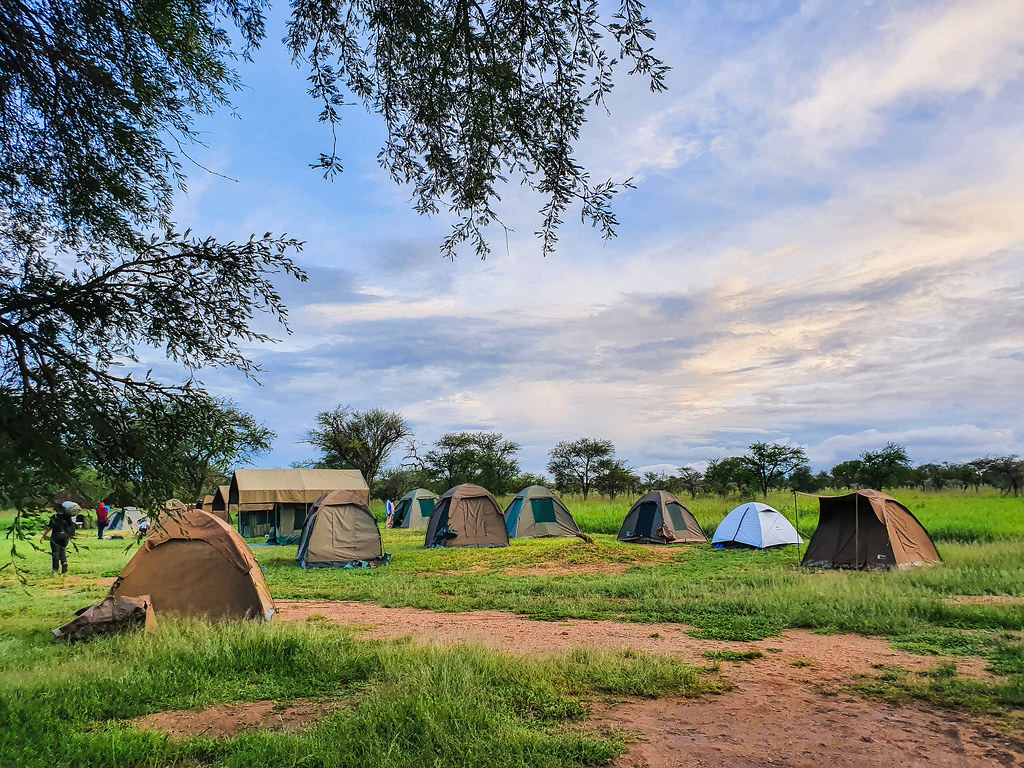
Budget camping safaris — using public campsites within national parks rather than private tented camps or lodges — are the primary way travellers achieve sub-USD 3,000 northern circuit itineraries. Public campsites in Tanzania’s national parks provide basic facilities: a toilet block, sometimes a shower (cold or solar-heated), and a cleared camping area where you pitch a tent and eat meals your camp cook prepares. The accommodation cost at public campsites is typically USD 30 to 50 per person per night — dramatically lower than the USD 150 to 400 per person per night at standard lodges and tented camps. This cost difference is what makes the sub-USD 3,000 safari math work.
Budget camping safari operators in Arusha typically provide a safari vehicle (usually a shared Land Cruiser with 6 to 7 passengers from different travel parties), a driver-guide, a camp cook who prepares meals at the campsites, all cooking equipment, and tent hire if you do not bring your own sleeping equipment. The experience is genuinely different from a lodge safari — you sleep on the ground in a tent within the park, hear the same lions you saw on the game drive moving around camp overnight, and eat simple but adequate camp food rather than three-course lodge dinners. For travellers who value this kind of immersive camping experience and are comfortable with basic facilities, budget camping is not merely a compromise — it is a different and arguably more authentic way to experience the African bush.
Mid-Budget Lodges and Budget Tented Camps
Several lodges and permanent tented camps in the northern circuit offer accommodation at USD 100 to 200 per person per night in the budget to low mid-range category. These provide private rooms or tents, basic en-suite facilities, and included meals at a standard significantly above public campsites. At 7 nights at USD 150 per person per night (total USD 1,050) plus park fees of USD 600 and transport and guide costs of approximately USD 400 to 500 per person for a shared vehicle, the total approaches USD 2,100 to 2,200 per person — keeping a 7-day itinerary within the USD 3,000 budget with some margin for visa fees, tips, and incidentals.
The trade-off relative to mid-range lodging at USD 250 to 400 per person per night is in room quality, location, food quality, and service level. Budget lodges rarely sit at the most wildlife-productive areas of each park and typically offer fewer or shorter game drive windows than camps that invest in better terrain access. Food quality at the budget end is functional rather than enjoyable. For travellers who are primarily interested in game drives and can be comfortable with simple accommodation, these trade-offs are entirely acceptable.
Vehicle and Guide: The Most Important Variable
What Shared vs Private Vehicle Means for Your Safari
Shared Vehicle Safaris on the Northern Circuit
The most common vehicle arrangement on budget northern circuit safaris is a shared Land Cruiser with 4 to 6 other passengers from different countries and travel parties who have each booked individually with the same operator or through a third-party booking platform. This shared vehicle model works well when the group dynamic is positive — most safari travellers are enthusiastic, respectful, and genuinely fun to share a vehicle with — and it is the primary cost-reduction mechanism that makes budget safari pricing possible. When it works, a shared vehicle adds a social dimension that solo and couples travellers sometimes genuinely appreciate. When it does not work — a group member who talks constantly at sightings, a photography-focused traveller in conflict with members who want to move on — the shared vehicle dynamic can meaningfully diminish the experience.
Private vehicle arrangements in Tanzania are significantly more expensive per person than shared vehicles. The incremental cost of having a vehicle exclusively for your party rather than sharing is approximately USD 100 to 200 per person per day depending on group size. This alone can push the total itinerary cost well above the USD 3,000 threshold for individual travellers or couples. Groups of four to six who can fill a vehicle themselves reduce the per-person private vehicle premium to manageable levels and represent the sweet spot for budget-conscious travellers who want private vehicle benefits without the premium of a two-person booking.
What You Realistically Get for Under USD 3,000
The Honest Summary
A 7-Day Northern Circuit Is Achievable at This Budget
A 7-day Tanzania northern circuit safari covering Tarangire, the Serengeti, and Ngorongoro is achievable for under USD 3,000 per person using budget camping accommodation, a shared vehicle with 5 to 6 other passengers, and a driver-guide who may or may not have specialist naturalist training depending on the operator. The wildlife viewing quality in terms of what you actually see — animals, landscapes, game drive hours — is genuinely excellent at this budget level. The park fees you pay are the same as at the luxury tier, and the animals don’t know or care what you paid for the vehicle. Where the budget shows is in comfort, food, accommodation quality, vehicle exclusivity, and the interpretive depth of the guiding rather than in wildlife encounter quality per se.
The specific things to expect at the budget level include public campsite toilets rather than en-suite facilities, simple camp food rather than lodge dining, a sharing vehicle potentially with strangers, a guide who is competent but may not have the specialist knowledge of a high-end private guide, and accommodation that sometimes sits a significant drive from the most productive game areas rather than within them. These are real trade-offs, but they are not disqualifying for travellers whose primary goal is time in Africa’s greatest wildlife areas at a price that respects real-world budget constraints. Tanzania’s wildlife does not require an expensive frame to be extraordinary.
Plan Your Safari
Budget Tanzania safari planning requires comparing multiple Arusha-based operator quotes for the same itinerary structure, confirming exactly what vehicle type, campsite standard, and meal arrangement the quoted price includes, and reading recent reviews specifically from travellers at the budget accommodation level you are considering. The budget market in Tanzania has a wide quality range, and researching the specific operators offering sub-USD 3,000 itineraries is the most important investment you can make before booking.
African Wild Trekkers offers northern circuit itineraries from mid-range upwards, with our entry-level packages starting at accommodation standards above the budget camping tier while remaining competitive on overall value within the USD 3,000 to 4,000 per person range for a 7-day itinerary. We do not operate budget camping tours but can advise on reputable budget operators for travellers whose priorities require that price point.
Contact African Wild Trekkers at africanwildtrekkers.com/contact with your Tanzania travel dates and budget range. We will provide a transparent itemised quote and honest advice on what each price tier actually delivers within 24 hours.