Africa in 2026: Why Now Is the Right Moment
Why visit Africa in 2026 specifically, rather than at some indefinite future point after the children are grown, after the mortgage is paid, after retirement arrives? The honest answer is that Africa’s greatest experiences — the ones that fundamentally alter how you understand both the natural world and your own place in it — are time-sensitive in ways that other travel destinations are not. The mountain gorilla population has recovered to over 1,000 individuals and is growing, but the forests that protect them are under pressure from agricultural expansion on all sides. The wildebeest migration continues its ancient circuit across the Serengeti-Mara ecosystem, but climate variability is already shifting its timing in ways that make the historical seasonal calendar less reliable than it was. The human cultures that have evolved alongside Africa’s wildlife for tens of thousands of years are changing rapidly as urbanisation, digital connectivity, and global economic integration transform communities that were living in deep relationship with wildlife landscapes within living memory. Africa in 2026 is still magnificent. Africa in 2036 will still be worth visiting. But the specific combination of wildlife abundance, cultural depth, and wilderness accessibility that exists today will not remain exactly as it is.
Beyond the urgency argument, Africa in 2026 offers a travel experience that no other continent on earth can replicate: the simultaneous engagement of physical senses, intellectual curiosity, emotional depth, and genuine surprise that comes from being in places where human beings are not the most powerful organisms present. The reasons to visit Africa are as diverse as the continent itself, spanning ecological wonder, cultural richness, adventure, personal transformation, and the simple satisfaction of standing somewhere so extraordinary that the fact of your own presence there feels improbable and therefore precious. Here are twenty reasons that together constitute a comprehensive case for making Africa your next travel destination — not someday, but in 2026.
The Wildlife, the Landscapes, and the Human Experience
Wildlife Experiences Found Nowhere Else on Earth
Reasons 1 Through 7: Wildlife and Wilderness
The first and most obvious reason to visit Africa is that it contains the most spectacular concentration of large mammal diversity on earth — not a species here or there, but entire ecosystems where elephants, lions, leopards, rhinos, buffalo, hippos, giraffes, zebras, and hundreds of other species live in ecological relationships that have evolved over millions of years and are visible in real time from a vehicle or on foot. Witnessing a lion hunt at dawn in the Serengeti or a hippo pool at the Mara River where forty animals jostle for position in murky water creates sensory memories that no documentary can substitute for and no description can adequately convey to someone who has not experienced it. The second reason is the mountain gorillas of Uganda and Rwanda — a population of approximately 1,000 critically endangered great apes that are close enough to human beings genetically to share eye contact with an intimacy that reorganises how you think about human uniqueness and our relationship to the rest of the natural world. An hour in the presence of a wild gorilla family is described by virtually every visitor as the most profound wildlife encounter of their lives, regardless of what else they have seen.
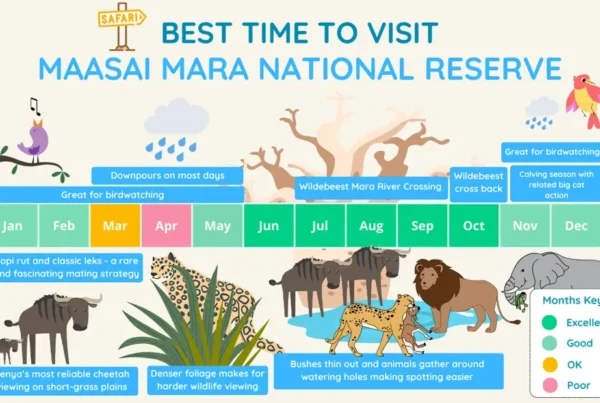
The third reason is Africa’s birds — over 2,000 species on the continent, including the shoebill stork in Uganda’s papyrus swamps, the lilac-breasted roller whose colour combination should not be physically possible, the African fish eagle whose call defines the sound of the continent, and the sociable weaver whose colonial nests in southern Africa’s Kalahari trees house hundreds of individual birds in structures that can weigh a ton and last for a century. The fourth is the wildebeest migration, which remains the largest remaining land animal migration on earth despite the threats surrounding it. The fifth is the night sky — the absolutely undeniable, life-changing revelation of genuinely dark African skies that make the universe visible in a way that urban humanity has entirely lost access to. The sixth is the African landscape’s scale — the Rift Valley escarpments, the Serengeti’s open horizon, the Congo Basin’s impenetrable green canopy, the Sahara’s mathematical geometry — the sheer physical size of the continent expressing itself as an experience of space that feels physiologically different from any other environment on earth. The seventh is the walking safari: moving through the African bush on foot with an armed guide, reading tracks and smells and sounds, understanding the landscape at the same speed and vulnerability level as its other inhabitants, and discovering that the experience of genuine wildness available on foot in Africa has no contemporary equivalent anywhere else in the world.
Reasons 8 Through 14: People, Culture, and Depth
The eighth reason to visit Africa in 2026 is the people — a statement that risks cliché but reflects a genuine and consistent experience of visitors who report that encounters with Ugandan farmers, Maasai guides, Rwandan genocide survivors who have rebuilt their lives into extraordinary organisations, Zanzibar dhow fishermen navigating by the same star paths their ancestors used, and Kampala’s next generation of software developers and coffee entrepreneurs constitute the most unexpectedly enriching dimension of Africa travel. Africa contains over 3,000 distinct ethnic groups speaking over 2,000 languages, and the human diversity this implies is reflected in cultural practices, artistic traditions, oral literatures, food cultures, and ways of organising social life that represent the broadest living range of human possibility accessible to any traveller. The ninth reason is that East Africa’s safari infrastructure has matured to the point where luxury and wilderness coexist without contradiction — Singita Grumeti in Tanzania and Mahali Mzuri in the Masai Mara offer accommodation experiences that compete with the world’s finest hotels in every dimension of service, food, and design while positioning guests in the middle of active wildlife areas where lions and elephants are visible from their tents.
The tenth reason is the gorilla and chimpanzee trekking system that Uganda, Rwanda, and Tanzania have developed, which represents the most thoughtfully managed wildlife encounter model anywhere in the world — strictly limited permit numbers, habituated animal groups that are genuinely wild and behaviorally natural rather than trained or captive, and a revenue distribution model that flows meaningful funding to conservation and community development simultaneously. The eleventh reason is Africa’s food, which has been profoundly underrepresented in international culinary culture: Ethiopian injera with fermented teff flatbread and complex spiced stews, Ugandan matoke and groundnut sauce, Zanzibar’s Arabic-influenced seafood curries, Cape Town’s Cape Malay cuisine blending Indonesian spice traditions with Atlantic seafood, and the extraordinary coffee culture of Uganda and Ethiopia that is finally receiving the international recognition it deserves. The twelfth reason is Zanzibar and the East African coast, where medieval Swahili trading port culture, Indian Ocean dhow sailing, and coral reef ecosystems with some of the highest marine biodiversity on earth combine in a post-safari context that rewards travellers who extend their East African visit to include coastal experiences. The thirteenth is Rwanda — the most extraordinary national transformation story of the past 30 years, from the ruins of genocide in 1994 to one of Africa’s most functional, clean, and rapidly developing nations in 2026, a country whose trajectory challenges every assumption about Africa that Western media has perpetuated for decades. The fourteenth is that Africa’s adventure activities — gorilla trekking, white water rafting on the Nile at Jinja, hiking the Rwenzori Mountains, walking with Maasai guides across the open Amboseli plains — offer physical challenge and genuine risk management experience that adventure travellers find in few other destinations at comparable intensity.
Practical and Personal Reasons to Go Now
Reasons 15 Through 20: Why 2026 Is the Year
The fifteenth reason is that East African safari tourism is genuinely more accessible in 2026 than at any previous point in history — better information availability through independent operator research, more flight route options from more origin cities, a greater range of price points from ultra-budget overlanding to ultra-luxury mobile camps, and digital booking systems that make independent research and planning feasible without the specialist travel agent dependency that safari travel required in previous decades. The sixteenth is that Africa’s conservation story in 2026 is more hopeful than it has been for decades in specific important respects: mountain gorillas are recovering, southern white rhinos have been successfully reintroduced to multiple countries, lion populations in well-managed reserves are stable or growing, and African Parks’ management of previously struggling national parks in Rwanda, Malawi, Zambia, and Zimbabwe has produced documented wildlife recovery results that demonstrate that conservation investment genuinely works when it is adequately resourced and professionally managed. Visiting Africa in 2026 means contributing your tourism spend to these recovery stories at a moment when that contribution is actually making a measurable difference.
The seventeenth reason is that Africa offers what may be the highest return on investment of any long-haul travel destination in terms of the ratio of life-changing experiences to travel hours invested — the density of remarkable moments per day of Africa travel consistently exceeds any alternative destination in the accounts of experienced global travellers who have visited every inhabited continent. The eighteenth is that Africa’s digital connectivity has improved sufficiently that remote work from safari lodges is now genuinely feasible for many professionals, enabling longer stays that were previously impossible to justify outside formal vacation periods — the combination of reliable satellite internet in premium lodges and the extraordinary productivity that genuine wildlife immersion inspires has made the working safari a real option for 2026 in ways that would have been impossible five years ago. The nineteenth reason is that Africa changes you in ways that are difficult to articulate before you go but absolutely clear after you return — the cognitive reset of time in genuinely wild spaces, the recalibration of what constitutes wealth and sufficiency that comes from spending time in communities with much less material wealth and much more social and ecological richness than most Western visitors’ daily environments, and the simple expansion of what you understand about the range of ways human beings and other species can inhabit this planet. The twentieth and final reason is the one that every returned Africa traveller who has genuinely engaged with the continent will confirm: you will want to come back. Africa is not a destination that satisfies curiosity — it multiplies it, because every answer to a question about the continent reveals five more questions more interesting than the original, and the person you are when you leave Africa is someone who cannot imagine not returning.
Plan Your Safari
The decision to visit Africa is easy once made — the harder questions are which countries, which parks, which experiences, and in what order to sequence them for the most coherent and rewarding journey possible. First-time Africa travellers often underestimate how much the structure of an itinerary affects the quality of the experience, because Africa’s best moments are often not the marquee attractions but the unexpected encounters and connections that a well-designed itinerary creates space for.
African Wild Trekkers specialises in East African safari design for first-time and returning Africa travellers, combining gorilla trekking in Uganda or Rwanda with wildlife safari in Kenya or Tanzania into itineraries that use the continent’s best experiences without the logistical friction that undermines so many self-planned Africa trips. We know which camps offer genuine wilderness versus managed spectacle, which guides deliver genuine intellectual engagement versus commentary by rote, and which itinerary sequences allow Africa to unfold with the building momentum that makes the experience transformative rather than merely impressive.
Contact African Wild Trekkers at africanwildtrekkers.com/contact with your travel dates and interests and we will design an Africa first visit — or return visit — that delivers every one of these twenty reasons in an itinerary built specifically around what matters most to you.