Rwanda Bird List: The 10 Species Every Serious Birder Must See
The Rwanda bird list tops 700 species despite the country’s small land area, and the concentration of Albertine Rift endemics found nowhere else on earth makes Rwanda one of Africa’s most rewarding birding destinations relative to its size. The Rwanda bird list rewards birders who visit Nyungwe Forest, Akagera National Park, and the Volcanoes bamboo zone because each ecosystem hosts a completely different set of species, and covering all three within a single trip produces a life list additions rate that larger countries struggle to match. African Wild Trekkers partners with specialist bird guides for clients who prioritize ticking endemics, and can combine birding time into any Rwanda itinerary without sacrificing the gorilla trekking and other wildlife priorities that non-birder travel partners typically require.
Top 10 Rwanda Bird Species
1. Shoebill (Balaeniceps rex) — Akagera Wetlands
The shoebill ranks as Africa’s most sought-after bird for serious listers, and its prehistoric bill, slate-grey plumage, and statue-still hunting behavior make it the single most dramatic bird sighting available anywhere in Rwanda. Akagera National Park’s papyrus wetlands around Lake Ihema and the northern lagoons host a small but reliable shoebill population, and boat safaris specifically routed through the papyrus channels produce sightings for the majority of dedicated seekers who spend two or more hours on the water. Shoebills stand up to 1.4 meters tall and hunt lungfish by standing motionless in shallow papyrus water for minutes at a time before striking with explosive speed, and the scale of the bird combined with its behavior makes sightings genuinely shocking even to travelers who knew exactly what to expect. Your boat guide knows the current shoebill territory boundaries and adjusts the circuit to maximize your chances based on recent ranger observations.
2. Grauer’s Broadbill (Pseudocalyptomena graueri) — Nyungwe Forest
Grauer’s Broadbill qualifies as one of Africa’s most difficult endemic birds to see outside of Nyungwe because its restricted range occupies a narrow altitude band in the Albertine Rift montane forest, and Nyungwe provides some of the most reliable access to this species available anywhere. The bird’s vivid blue-green and rufous plumage makes it visually spectacular despite its small size, and the characteristic horizontal posture on mid-story branches helps trained eyes pick it out in dense forest canopy. Specialist bird guides in Nyungwe know the habitual territory of the broadbill population and deploy targeted playback during appropriate dawn windows to bring the birds into viewable positions. African Wild Trekkers recommends allocating at least two Nyungwe mornings specifically to birding if Grauer’s Broadbill is on your target list, because single visits succeed less consistently than two attempts that approach from different trail directions.
3. African Green Broadbill (Pseudocalyptomena graueri) — Nyungwe and Gishwati
The African Green Broadbill inhabits the dense understorey of Nyungwe Forest at elevations between 1,600 and 2,400 meters, and its rich emerald-green coloration and distinctive flat bill separate it from every other Nyungwe bird at reasonable viewing distances. Early morning forest walks between 6 and 8 AM produce the highest activity levels for this species, and the dawn chorus period creates opportunities for locating territories by sound before attempting a visual approach. Gishwati Mukura National Park’s recovering forest also hosts this species in the older established sections where canopy height and understorey density have reached the threshold this bird requires. A specialist guide who knows current territory locations dramatically improves sighting probability over independent searching in the forest understorey.
4. Rwenzori Turaco (Gallirex johnstoni) — Nyungwe and Volcanoes
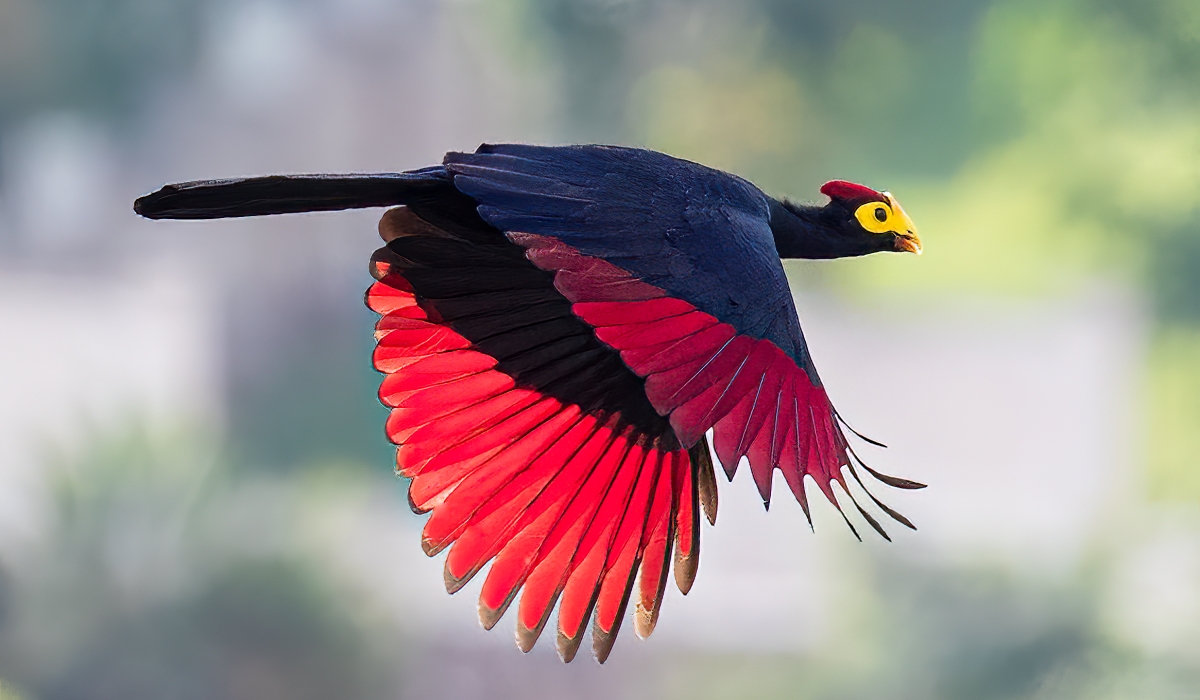
The Rwenzori Turaco combines a crimson wing flash with bright green body plumage and a white-and-red facial pattern that makes it one of Africa’s most visually stunning forest birds, and its large size relative to most forest species makes it more locatable by movement through the canopy. Nyungwe and the Volcanoes bamboo zone both host populations, and morning bird walks from any Nyungwe lodge typically produce sightings within the first 30 minutes in a forest where the turaco is vocal and active throughout the dawn period. The wing flash is most visible when birds fly between feeding trees in mid-canopy, creating brief but brilliantly colored exposure that produces memorable photographs even for non-birding travel companions who happen to be in the right position. This species appears commonly enough in Rwanda’s montane forests that missing it entirely requires genuinely bad timing.
5. Handsome Francolin (Scleroptila nobilis) — Nyungwe Forest Edge
The Handsome Francolin inhabits forest edge grasslands and heath zones in Rwanda at elevations above 2,000 meters, and Nyungwe’s upper trails near the montane grassland ecotone provide reliable habitat for this striking endemic. The bird’s rufous, black, and white patterning earns its descriptive name, and its call — a loud, repetitive whistling series — carries 200 meters through open habitat and helps locate pairs before they flush into cover. Dawn walks along the boundary between Nyungwe’s forest and the tea estate zone that borders the park produce consistent francolin activity as pairs move between grassland feeding areas and forest edge roost sites. This species requires grassland habitat that some Nyungwe guides skip in favor of deeper forest birds, so specifying your interest to the guide before departure ensures the route includes the appropriate habitat zones.
6. Grey-Crowned Crane (Balearica regulorum) — Akagera Grasslands
The Grey-Crowned Crane serves as Uganda’s national bird and appears frequently across Akagera’s grassland and wetland edges in Rwanda, where its ornate golden crown, red throat wattle, and formal upright posture make it one of Africa’s most dignified-looking large birds. Pairs and small groups feed in open grassland alongside zebra and buffalo, and game drive circuits through Akagera’s northern section encounter cranes regularly during morning drives from April through October. Display dances between pairs during breeding season create remarkable behavioral photography opportunities, as the birds stretch, leap, and bow toward each other in synchronized sequences that continue for several minutes at a time. Non-birding safari travelers often rank their grey-crowned crane encounters among their most memorable Akagera moments even without specific interest in the species list.
7. African Fish Eagle (Haliaeetus vocifer) — Lake Kivu and Lake Ihema
The African Fish Eagle holds status as one of Africa’s most iconic birds through its instantly recognizable call — the soaring, two-note shriek that defines the soundtrack of any African lake or river — and Rwanda’s Lake Kivu and Lake Ihema both support healthy populations visible daily from the shoreline. Fish eagles hunt by perching on high branches or rocks above the water, scanning for surface fish, then diving feet-first in a strike that carries them below the surface before resurfacing with prey. Lake Ihema boat safaris pass fish eagle perch trees multiple times during a circuit, and guides know which specific trees hold the most reliable resident pairs for photography. The call alone encountered at dawn across Lake Kivu water represents one of Africa’s most evocative sounds and immediately marks the landscape as wild regardless of whether you see the bird making it.
8. Martial Eagle (Polemaetus bellicosus) — Akagera Open Country
The Martial Eagle ranks as Africa’s largest eagle and a formidable aerial predator capable of killing prey as large as young antelope and monitor lizards, and Akagera National Park’s open savanna provides the hunting territory and prey density this species requires. Sightings are less frequent than smaller raptor species but dramatically impactful — a soaring martial eagle at altitude displays a four-foot wingspan and distinctive white-spotted underparts visible from considerable distance. Game drive circuits through Akagera’s northern savanna produce the most consistent martial eagle encounters because the open terrain allows the bird to hunt efficiently and the grassland edge provides the large tree perches it uses between hunting efforts. This species appears on Akagera game drives as a genuinely exciting addition to a list that already includes shoebill from the boat and the endemic forest birds of Nyungwe.
9. Papyrus Canary (Crithagra koliensis) — Akagera Wetlands
The Papyrus Canary specializes so completely in papyrus swamp habitat that it barely ventures into adjacent vegetation, making Akagera’s extensive papyrus beds around Lake Ihema the most accessible location in Rwanda for this restricted-range species. The bird’s small size and preference for dense papyrus stems make it challenging to observe without a guide who knows the calling sites where males establish territories during the breeding season between September and January. Boat safaris that specifically target papyrus specialists reach this species more reliably than shoreline walking because the boat’s position at water level brings you to the same height as the papyrus stems where the canary moves. Dedicated birders who request a specialist papyrus circuit rather than the standard wildlife-focused boat route significantly improve their chances of clear views.
10. Long-Crested Eagle (Lophaetus occipitalis) — Widespread
The Long-Crested Eagle appears across Rwanda’s agricultural landscape, forest edges, and wetland borders with a frequency that makes it one of the country’s most reliably encountered raptors regardless of which region you visit. The dramatic two- to three-feather crest that gives the species its name is visible at distance from a moving vehicle, and the bird’s habit of perching prominently on roadside poles, fence posts, and isolated trees makes it easy to observe and photograph without leaving the vehicle. This species rewards new birders with an accessible hawk that delivers visual impact through its crest and bold black-and-white underpart patterning, and it appears alongside the rarer endemics as a reliable daily sighting that maintains morale on days when the target species prove elusive. Including the Long-Crested Eagle in a Rwanda bird day produces a satisfying photographic encounter with minimal searching effort that leaves energy for the more challenging endemics.
Plan Your Safari
Plan Your Rwanda Birding Trip
African Wild Trekkers arranges specialist Rwanda birding itineraries with expert bird guides who know current territory locations across Nyungwe, Akagera, and Volcanoes National Park. Contact us at africanwildtrekkers.com/contact to discuss your target list.
What Your Package Covers
Your Rwanda birding package includes specialist guides, park entry fees, targeted birding routes in each ecosystem, transfers between birding sites, and accommodation positioned for early morning birding access.
Request Your Rwanda Birding Quote
Share your target species and available days and we will design a Rwanda birding itinerary optimized for your list. We respond within 24 hours at africanwildtrekkers.com/contact.