Caracal Facts Africa: The Tufted-Ear Ambush Hunter of East Africa’s Dry Zones
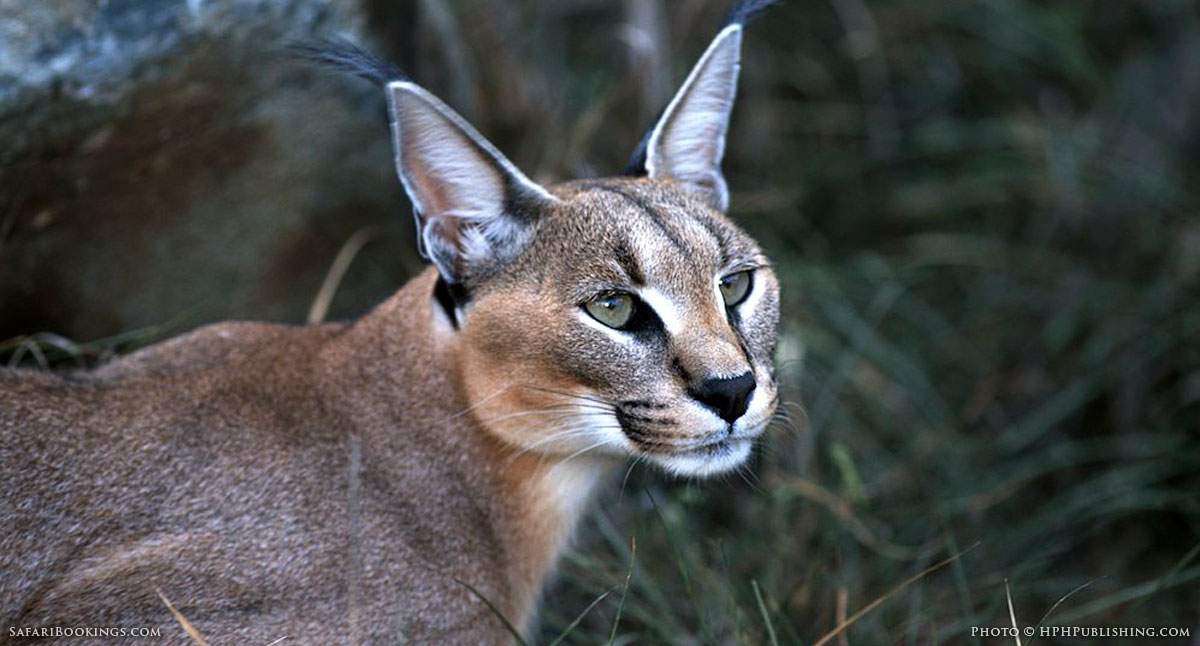
The caracal has ear tufts. Long, black-tipped tufts project up to 5 centimetres above each ear tip. They have generated more speculation than any other feature of any East African cat — camouflage, communication, sound collection, species recognition, individual identification. The honest answer is that no one knows their primary function with certainty. What is certain is that the caracal carrying them ranks among Africa’s most powerful small cats — capable of leaping 3 metres vertically from a standing position to knock a bird from the air. The tufts may be mysterious. The hunting ability is not.
What Is a Caracal?
The caracal, Caracal caracal, is a medium-sized wild cat distributed across Africa, the Middle East, and South Asia. Adult males weigh between 8 and 20 kilograms. Females weigh 7 to 16 kilograms. Body length reaches 62 to 91 centimetres. The coat is uniformly tawny-red to brick-red above and paler below, with no spots or stripes on the flanks. Black marks run along the muzzle and from the eye corners, and the distinctive black ear tufts project above long, pointed ears. Hindlegs are slightly longer than the forelegs — providing the explosive jumping power the caracal relies on for hunting.
The caracal often draws comparison to the serval: both are spotless, mid-sized African cats with long legs and distinctive ears. Field separation is straightforward. The serval has a spotted body and enormous rounded ears with no tufts. The caracal is uniform reddish-brown with pointed ears and long black tufts. One is a wetland specialist. The other is a dry-country generalist.
The Vertical Leap: Catching Birds in Flight
Caracals catch birds in mid-air using a standing vertical leap. The caracal approaches a resting bird flock to within ambush range, conceals itself, then launches upward when the flock takes off in alarm. Forepaws bat birds down — sometimes two or three in rapid succession from a single leap. A leap height of up to 3 metres combined with powerful forepaw striking power makes this technique genuinely effective, not merely opportunistic.
This bird-catching ability extends to roosting birds in low trees and bushes. Long, powerful hindlegs give the caracal access to heights no similarly sized mammalian predator can reach with a standing jump. Francolin, guinea fowl, spurfowl, and bustards are the primary bird prey. Small mammals — hares, dik-dik, small gazelles, rodents — fall to the typical cat ground ambush sequence.
Habitat: Dry Zones and Rocky Terrain
Dry-country generalist describes the caracal accurately. Arid and semi-arid savanna, rocky terrain, dry scrub, and agricultural margins all fall within its range. Dense forest and the highest-rainfall zones do not. Kenya’s Samburu, Tsavo East, and the drier parts of the Maasai Mara ecosystem produce sightings. Rocky terrain preferred by hyraxes — a favoured prey item — consistently delivers caracal encounters.
Nocturnal and Elusive
Caracals are primarily nocturnal and crepuscular. Daytime sightings occur but are uncommon where human activity is significant. Night drives in good habitat produce encounters with moderate regularity. Orange-red eye-shine is vivid and visible at up to 100 metres in a spotlight beam. The typical reaction on spotlight contact is to freeze briefly, assess, and move quickly into cover — giving a short but clear view if the vehicle stops immediately when the eye-shine appears.
Plan Your Safari
Kenya’s Samburu National Reserve and Tsavo East National Park are the most productive East Africa destinations for caracal sightings. Night drives in dry season produce encounters when caracals move to waterholes. Laikipia Plateau conservancy night drive programmes also deliver consistent sightings. Patient, slow driving with excellent spotlight technique produces far more encounters than speed through good habitat.
African Wild Trekkers designs Kenya safaris that include night drive programmes in the best small cat habitats. Contact us to plan an itinerary targeting East Africa’s less visible but equally extraordinary cat species.