Puku Antelope Uganda: The Rare Floodplain Grazer of the Albertine Rift
The puku is a medium-sized antelope restricted in East Africa to the floodplains of Uganda’s Albertine Rift—particularly the wetland margins of Queen Elizabeth National Park. It closely resembles the Uganda kob. Both species co-exist in the same grassland habitats, creating one of the more interesting field identification challenges in East African wildlife watching. Understanding the puku requires both the ability to separate it from the kob and an appreciation of its genuinely restricted range.
What Is a Puku?
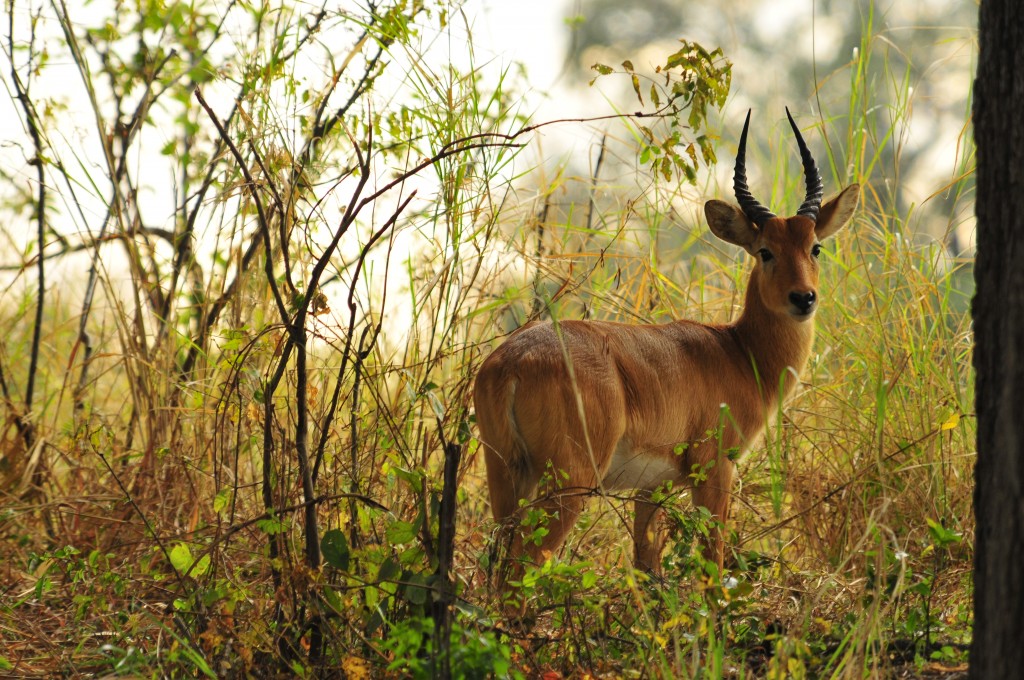
The puku, Kobus vardonii, is closely related to the kob and the waterbuck—all members of the group Reduncini. Adult males weigh between 65 and 91 kilograms. Females weigh 55 to 65 kilograms. Shoulder height reaches about 80 centimeters. Only males carry horns—lyre-shaped with forward-curved tips, reaching 45 to 60 centimeters. The coat is uniform golden-yellow to tawny, with pale underparts. No black leg markings appear—which immediately separates the puku from the Uganda kob, whose forelegs carry a black marking. The overall look is that of a slightly smaller, more uniformly golden kob.
Zambia’s Kafue and Luangwa valleys hold the puku’s core range, where it ranks among the most abundant antelopes. The Uganda population—centered on Queen Elizabeth National Park’s Ishasha Sector and adjacent wetlands—represents a small, isolated northern extension. Tanzania’s far western zones near the DRC border hold a marginal population. East Africa’s puku numbers are genuinely small and localized.
Habitat: Floodplain and Wetland Margins
Puku specializes in floodplain grazing. Short to medium grass near permanent water is their core requirement—the same habitat as the Uganda kob—but puku show less tolerance for dry or degraded grassland. They drink daily and maintain a strong association with riverine and lacustrine habitats. In Queen Elizabeth National Park, the Ishasha River floodplain and the Kyambura Game Reserve wetland margins are the primary sites.
Close habitat association between puku and kob creates dietary and spatial overlap. Where both species occur together—as in the Ishasha sector—fine-scale grassland partitioning occurs. Puku favors the wetter, lower-lying areas immediately adjacent to water. Kob graze further from the water margin on slightly drier short-grass zones. This micro-habitat separation reduces direct competition despite the apparent similarity in resource use.
Social Structure and Territorial Behavior
Puku maintains a territorial social system similar to the kob’s. Males hold small territories, display to females, and compete with rival males. Territories are established on elevated areas—raised banks, mound tops, slightly elevated grassland patches—that increase the male’s visibility to both females and rivals. Female herds of 5 to 20 individuals move through the landscape independently, visiting multiple male territories. Males do not herd females.
Male-male competition involves parallel walking, horn tilting, and occasional physical sparring. Fights between well-matched males produce interlocked horn wrestling bouts—both males push with their heads down, attempting to force the rival sideways or backward. These contests rarely cause injuries and usually resolve within minutes when one male withdraws.
Plan Your Safari
Uganda’s Queen Elizabeth National Park is the only reliable East Africa site for puku. The Ishasha Sector—the southern part of the park famous for tree-climbing lions—is the primary location. Early morning game drives on the Ishasha floodplain produce puku alongside Uganda kob, warthog, and occasionally waterbuck. Separating puku from kob in the field requires attention to leg markings and the subtle golden-versus-tawny coat difference—worth noting before the drive so the distinction is clear when both species appear simultaneously.
African Wild Trekkers includes the Ishasha sector in Uganda safari itineraries. Contact us to plan a Uganda trip covering the country’s full range of grassland antelope species.