Guereza Colobus Uganda: The Stunning Black-and-White Monkey of Ugandan Forests
Few African primates match the guereza colobus for visual impact. Jet black body. White-faced fringe. Long white mantle flowing from the shoulders. A white tail bobbing through the canopy. A large male guereza crashing between trees in full flight is one of Uganda’s great wildlife moments—dramatic, unexpected, and immediately arresting against the deep green of the forest canopy.
What Is the Guereza Colobus?
The guereza, Colobus guereza, is the most widespread black-and-white colobus in East Africa. It is sometimes called the eastern black-and-white colobus or the mantled guereza. The subspecies present in Uganda is Colobus guereza occidentalis. The species ranges from Ethiopia and Eritrea southward through Uganda, Rwanda, Kenya, and northern Tanzania. It occupies forests from sea level to over 3,000 meters.
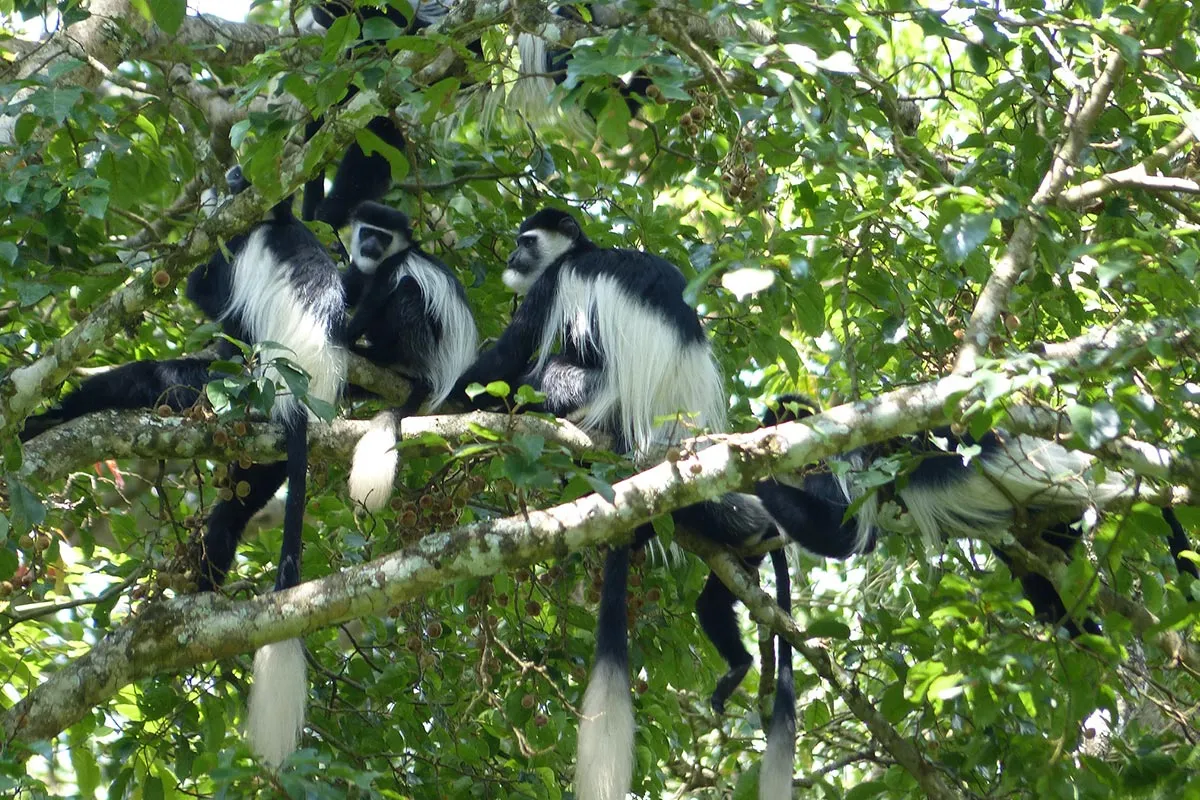
An adult male guereza weighs between 9 and 14 kilograms. Females are smaller at 7 to 9 kilograms. The coat pattern is unmistakable—a completely black body with white facial framing, a long white mantle on the shoulders and flanks, and a white-tipped tail. The mantle is longer in males than females and develops fully only after sexual maturity.
The White Mantle: Function and Display
The guereza’s white mantle is a visual signal that functions in multiple social contexts. During territorial calls, males raise and spread the mantle to maximize its visual impact. From a distance in forest light, the white against the dark body is visible through the canopy when movement would otherwise be invisible. The mantle is also used in grooming — it is a social focus point that other group members attend to during social interactions.
The long tail and tail tip serve as visual signals during canopy leaps. A leaping guereza spreads its arms, and the tail flares behind it—a display that communicates identity, direction, and arousal state to other group members. The tail tip is the last thing visible as the animal disappears into the canopy, providing a continued visual cue after the body is hidden.
Forest Habitat and Range in Uganda
The guereza colobus occupies all of Uganda’s major forest parks. Kibale National Park holds one of the most studied guereza populations in Africa. The Kibale Forest Project has followed individual groups for decades. Budongo Forest, Bwindi, Queen Elizabeth National Park’s Maramagambo Forest, Kyambura Gorge, and the forests around Lake Victoria all support guereza populations.
The guereza also lives in riparian forest strips that extend into savanna. Groups established along the Kazinga Channel and along Murchison Falls National Park’s Nile banks live in forest patches surrounded by open grassland. These edge-habitat groups show slightly different behavior—more terrestrial movement and greater vigilance for ground predators—than fully forest-interior groups.
Group Territory and Defence
Guereza groups of 3 to 15 individuals occupy small, well-defended territories. The resident male — sometimes two males in larger groups — produces a resonant, far-carrying call series at dawn each morning. This call broadcasts territorial occupancy across the forest. Adjacent group males respond in kind. The morning calling chorus in a forest with multiple guereza groups can last 30 to 60 minutes.
Direct territorial encounters are infrequent but intense. Males display aggressively—spreading mantles, leaping, and chasing—in encounters at shared boundaries. Female group members participate in boundary defense through vocalization and coordinated movement toward the boundary. Group cohesion during territorial defense is tighter than during normal foraging.
Diet and Leaf Specialisation
The guereza colobus eats leaves as its primary food, supplemented by fruit, flowers, and bark. Young leaves are strongly preferred. Groups track the emergence of young leaves across their territory and concentrate foraging on trees in full bloom. The fermentative stomach system — shared with all colobus species — allows efficient processing of the tough cellulose that most primates cannot digest.
In Kibale, the guereza shares leaf-eating niche space with the black-and-white colobus, red-tailed monkeys, and other species. Competition is reduced by dietary differentiation—guereza groups use certain tree species heavily that other species use less, and vice versa. The partitioning of the leaf-food resource among the forest’s many primate species is one of the most studied aspects of Kibale’s primate ecology.
Plan Your Safari
Kibale National Park is the ideal starting point for guereza colobus watching in Uganda. The habituated groups there allow close approach on forest walks. Budongo Forest Reserve in Murchison Falls National Park is another excellent option—the forest walks there target guereza colobus alongside the famous chimpanzee communities. Both parks are accessible on a Uganda safari circuit alongside gorillas at Bwindi and big game at Murchison and Queen Elizabeth.
African Wild Trekkers designs Uganda forest safari circuits that cover the country’s major primate locations. Contact us to build an itinerary that combines Uganda’s primates, forests, and savannas into a single cohesive trip.