Flamingo Safari Kenya: The Best Rift Valley Lakes for Pink Spectacle
Flamingo safari Kenya experiences at the Great Rift Valley’s soda lakes produce some of East Africa’s most visually extraordinary wildlife spectacles — millions of lesser and greater flamingos feeding at Lake Bogoria, Lake Elementaita, and Lake Nakuru create a pink horizon across the alkaline shoreline that ranks among the continent’s most celebrated natural phenomena, even when visitors who arrived for elephant and lion are caught entirely off guard by the flamingo encounter’s scale and color. Kenya’s Rift Valley chain of soda lakes forms one of Africa’s most productive avian environments because the alkaline conditions that exclude most fish species concentrate the Spirulina algae that lesser flamingos filter-feed on in enormous densities — a food source so abundant that flamingos aggregate in populations of 500,000 to 2 million individuals at a single lake when conditions peak. Understanding which lake offers the best flamingo concentration at your specific travel date requires current intelligence because the birds move between lakes in response to water level changes, algae growth cycles, and disturbance pressure — and African Wild Trekkers maintains up-to-date Rift Valley flamingo distribution information for clients planning lake visits alongside their main safari destinations.
Kenya’s Best Flamingo Lakes
Lake Bogoria: Kenya’s Most Reliable Flamingo Destination
Lake Bogoria in Kenya’s central Rift Valley currently hosts the consistently largest flamingo concentration in East Africa — the lake’s geothermal activity creates an alkaline chemistry that supports dense Spirulina growth year-round, and the population of lesser flamingos has steadily increased since the early 2000s when large flamingo groups shifted from Lake Nakuru to Bogoria in response to changing water levels and algae conditions. Lake Bogoria National Reserve charges a park fee of $26 USD per person per day — the most affordable of Kenya’s flamingo lake destinations — and the lake’s remoteness from Nairobi (approximately three hours on the A104 and B4 roads through Nakuru and Mogotio) means visitor numbers remain significantly lower than the more accessible Lake Nakuru, producing a quieter and more intimate flamingo viewing experience at a greater wildlife density. The lake’s shoreline geysers and boiling springs add a geological dimension to the flamingo visit that no other East Africa flamingo destination provides — standing between a spouting geyser and a pink flamingo horizon simultaneously creates a sensory combination that the straightforward lake-and-bird experience at Nakuru and Elementaita cannot replicate. The northern end of Lake Bogoria, accessible by vehicle to a beach area near Loboi gate, produces the most accessible flamingo concentrations for non-walking visitors, while the lake’s western shoreline requires a four-wheel-drive track to reach the geothermal zone where flamingo densities are typically highest.
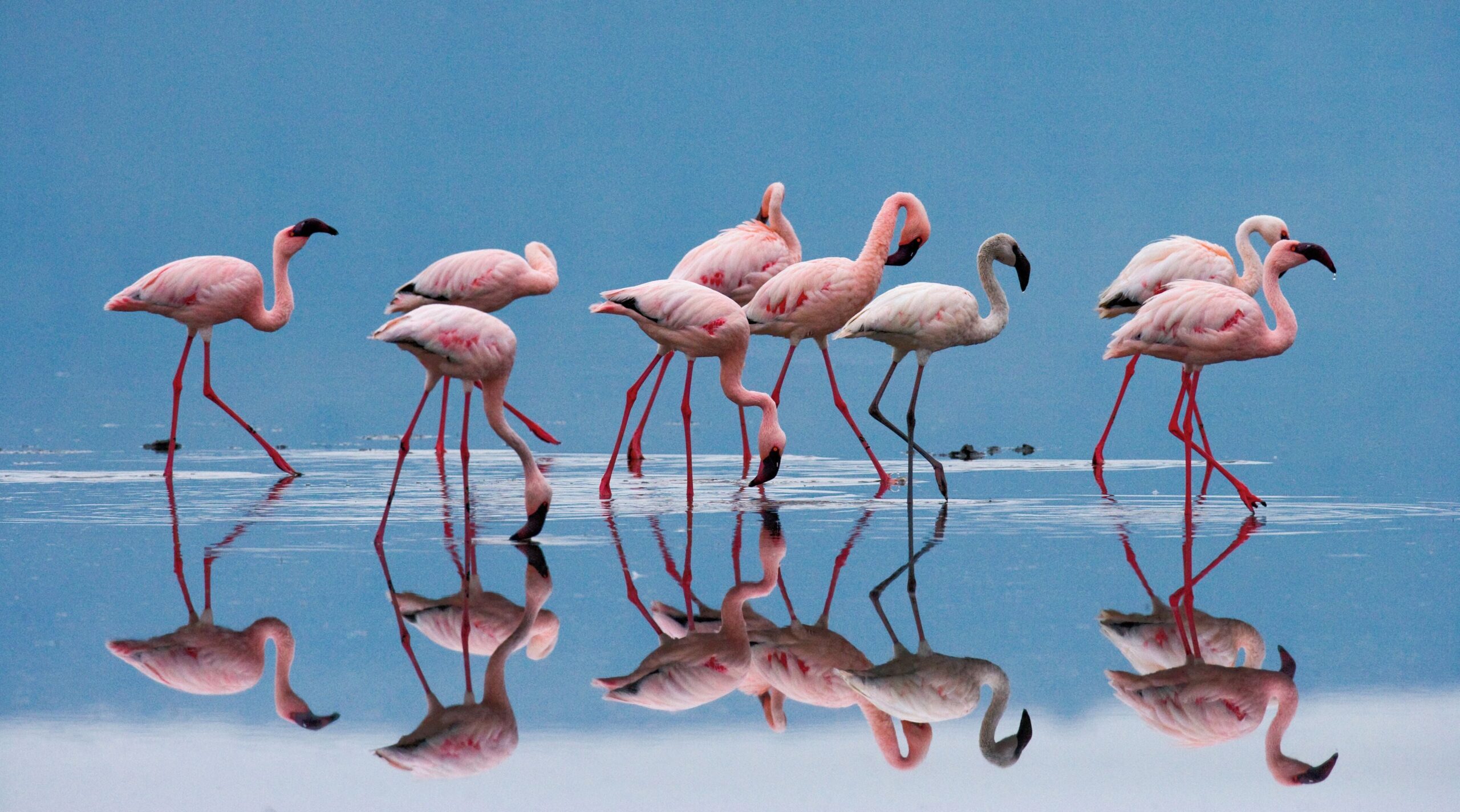
The flamingo spectacle at Lake Bogoria peaks between October and March when water levels and algae concentrations combine to support the largest populations — visitor counts during this period regularly document a million-plus flamingos on the lake simultaneously, the visual equivalent of the entire shoreline disappearing beneath a moving pink carpet that extends from the immediate foreground to the distant mountains of the Rift Valley wall. The lesser flamingo’s coordinated feeding movement — thousands of birds walking in the same direction across the alkaline shallows while pumping their specialized bills to filter algae — creates a hypnotic wave pattern across the flock’s surface that flamingo photographers specifically seek for the abstract composition it produces at telephoto focal lengths. Greater flamingos feed in deeper water than lessers, using their more powerful bills to probe for invertebrates rather than filtering algae, and the height difference between the two species — the greater flamingo stands 120 centimeters versus the lesser’s 80 — allows visual species identification in mixed flocks at moderate viewing distances. African Wild Trekkers builds Lake Bogoria into Samburu-northern Kenya circuits as a half-day extension from the Nakuru-to-Samburu road routing that passes near the lake’s access road without requiring a dedicated out-and-back detour.
Lake Nakuru: The Most Accessible Flamingo Lake
Lake Nakuru National Park offers Kenya’s most accessible flamingo viewing within a full national park context — the $53 USD per person per day park fee includes not only flamingo at the lake but also white and black rhino, lion, leopard, Rothschild giraffe, and a dense woodland bird population that makes Lake Nakuru one of Kenya’s most species-rich wildlife destinations per square kilometer. The lake’s flamingo population fluctuates more dramatically than Bogoria’s because Nakuru’s water level changes with rainfall patterns — in wet years the lake dilutes the alkaline chemistry that supports Spirulina, and the flamingos shift to Bogoria or Elementaita where conditions remain more favorable. In optimal years — typically following dry periods when the lake’s alkalinity concentrates — Lake Nakuru flamingo populations reach 500,000 to 1 million birds and the southern lakeshore viewing area presents a pink and white spectacle of thousands of individual birds visible in a single sweep of the binoculars. The lake’s accessibility from Nakuru town (30 minutes drive) and from Nairobi (two hours on the A104 highway) makes it the most practical flamingo addition to a standard Kenya safari itinerary, and African Wild Trekkers schedules Lake Nakuru as a half-day or full-day add-on to the Nairobi-Samburu or Nairobi-Maasai Mara road connection for clients passing through the Rift Valley.
Lake Nakuru’s viewing infrastructure — a paved road circuit around the lake’s southern half, multiple designated viewing points on elevated shoreline positions, and a picnic area near the lake’s southern end — makes the flamingo viewing accessible to travelers who prefer to observe from the vehicle rather than walking the shoreline. The hippo pool near the main park gate provides a second wildlife focal point separate from the flamingo lake, and the rhino sanctuary’s woodland road system delivers white and black rhino encounters alongside the lake’s bird spectacle in a single park entry. The yellow fever tree woodland that borders the lake’s eastern and northern shores hosts significant leopard activity — the trees’ distinctive yellow-green bark and multiple-fork structure provide classic leopard resting sites, and an afternoon drive through the yellow fever grove after the flamingo viewing frequently produces leopard sightings that complete Lake Nakuru’s wildlife portfolio. African Wild Trekkers guides brief clients on the optimal Nakuru time allocation — two hours at the lake for flamingo photography and four hours for the woodland rhino and leopard circuit — to ensure the park visit covers all three of the wildlife experiences that make Nakuru consistently rewarding regardless of the year’s flamingo population level.
Lake Elementaita: Kenya’s Quietest Flamingo Experience
Lake Elementaita in the central Rift Valley between Naivasha and Nakuru hosts smaller flamingo populations than Bogoria or Nakuru but offers Kenya’s most intimate and least-visited flamingo experience in a landscape of remarkable geological beauty — the Kariandusi prehistoric site, the Soysambu Conservancy’s wildlife, and the Delamere estate’s historic farming heritage all surround a lake accessible by non-motorized boat or shoreline walk rather than by vehicle circuit. Great white pelican, great flamingo, and lesser flamingo all occur at Elementaita, and the pelican-and-flamingo mixed flocks create photographic compositions unavailable at the more flamingo-dominated Bogoria and Nakuru. The Sleeping Warrior hillside above the lake’s northern shore provides a hiking ascent with aerial views of the lake and its bird population that positions Elementaita as an activity-oriented rather than purely vehicle-based wildlife experience. Soysambu Conservancy, through which the Elementaita lakeshore is accessible, hosts significant wildlife beyond the lake’s birds — waterbuck, zebra, giraffe, and occasionally lion and hyena — creating a full-day conservancy safari experience with the flamingo lake as the central rather than the exclusive attraction.
Elementaita suits travelers specifically seeking a quieter Rift Valley alternative to the busier Nakuru experience — visitor numbers at Elementaita are a fraction of Lake Nakuru’s, the entrance is through the Soysambu conservancy rather than a national park gate, and the walking safari format along the lakeshore creates a physical engagement with the flamingo experience that the vehicle-based Nakuru visit cannot deliver. Standing at the Elementaita shoreline as flamingos take flight in a synchronized lift-off — thousands of birds rising simultaneously in a pink and white cloud against the Rift Valley escarpment backdrop — is a flamingo encounter moment that no vehicle window frames with the same immediacy. African Wild Trekkers builds Elementaita into Lake Naivasha and Aberdare circuit itineraries for travelers whose Kenya itinerary already passes through the central Rift Valley and who want to experience the flamingo spectacle without diverting to Nakuru or Bogoria.
Planning Your Flamingo Safari
When Flamingo Numbers Peak in Kenya
Kenya’s flamingo population is not fixed at any single lake but migrates between Bogoria, Nakuru, Elementaita, and the less-visited Baringo and Logipi lakes in northern Kenya in response to water chemistry changes that alter Spirulina availability at each lake simultaneously. Predicting which lake will hold the largest population on any specific date requires current environmental monitoring that the Kenya Ornithological Society, Kenya Wildlife Service, and the Flamingo Specialist Group’s East Africa monitoring program provide through ongoing water level and salinity measurements. As a general seasonal guide, October through March produces the strongest Bogoria concentrations when the dry season’s water concentration effect increases Spirulina density, while the post-long-rains period of July through September often shifts populations toward Nakuru as the lake’s alkalinity recovers from the April–June dilution effect. The flamingo’s population mobility means that a lake generating zero flamingo coverage in August may support a million birds by November and return to low numbers by February as algae cycles run their course — and the reverse is equally true. African Wild Trekkers checks current flamingo population data from Wildlife service contacts within two weeks of each client’s arrival and adjusts the lake visit recommendation to whichever Rift Valley lake currently holds the most active flamingo concentration.
Early morning provides the best flamingo viewing conditions at all Kenya’s Rift Valley lakes — the low sun angle creates warm sidelight across the pink flock, the birds are actively feeding in the shallows rather than resting in dense standing groups, and the morning calm before the Rift Valley’s convective wind patterns establish in late morning keeps the lake surface mirror-flat for reflection photography. Mid-afternoon visits produce backlit conditions with harsh overhead light that eliminates the pink tones that make flamingo photography distinctive — plan lake visits as the first activity of the morning rather than the after-lunch stop that many standard Kenya itineraries schedule based on geographic convenience rather than photographic timing. Binoculars are worth carrying to any Kenya flamingo lake visit — the birds’ bill structure, leg coloring, and plumage gradients between adult and juvenile birds are all clearly distinguishable at moderate magnification in a way that naked-eye observation at flamingo distances cannot resolve.
Plan Your Safari
Flamingo safari Kenya itineraries integrate best when the lake visit coincides with the morning game drive timing rather than being treated as an afternoon afterthought — African Wild Trekkers schedules Rift Valley lake visits as first-morning activities and provides current flamingo population intelligence from on-the-ground contacts within two weeks of your arrival. We build the most productive flamingo lake into your Kenya itinerary based on current conditions rather than defaulting to the closest lake regardless of flamingo density.
Your Kenya flamingo safari package includes Rift Valley accommodation near the target lake, private 4×4 vehicle with experienced bird-specialist guide, lake entry or conservancy fees, full-board meals, and connection to your main safari destination at the Maasai Mara or Samburu. We coordinate the Nakuru, Bogoria, or Elementaita visit within the road connection between Nairobi and your safari park.
Contact African Wild Trekkers at africanwildtrekkers.com/contact with your travel dates and we will confirm current flamingo distribution and send a complete Kenya itinerary within 24 hours.